
Transformational Coaching: What Makes It Transformational and How Coaches Develop the Skills
A client arrives at session six with the same presenting issue as session one. The coach has been doing everything right - good questions, strong coaching presence, solid accountability check-ins. The trust is real. The relationship is working. And the client is still stuck.
This is the moment where transformational coaching becomes either an empty concept or a useful one. What separates transformational coaching from transactional coaching is not a set of advanced techniques. It is a shift in what the coach attends to - from the behavior the client wants to change, to the system that keeps producing it. This article maps the skills that make transformational coaching possible, the ICF Core Competencies it activates, and the internal capacities coaches must develop to hold it.
Key Takeaways
- Transformational coaching works at the level of beliefs and identity, not just behavior - producing change that persists because the person sees themselves differently.
- Four ICF competencies (Trust & Safety, Presence, Evoking Awareness, Facilitating Growth) drive transformational work when activated at PCC marker depth.
- The capacity for transformational coaching develops across credential levels and hundreds of supervised hours - it is not a weekend-workshop technique.
- Tolerance for depth, engaged neutrality, non-verbal presence, and professional self-awareness are the four internal capacities coaches must build.
- Most coaching sessions are not purely transactional or transformational - the skill is recognizing when the moment calls for a depth shift.
What Is Transformational Coaching?
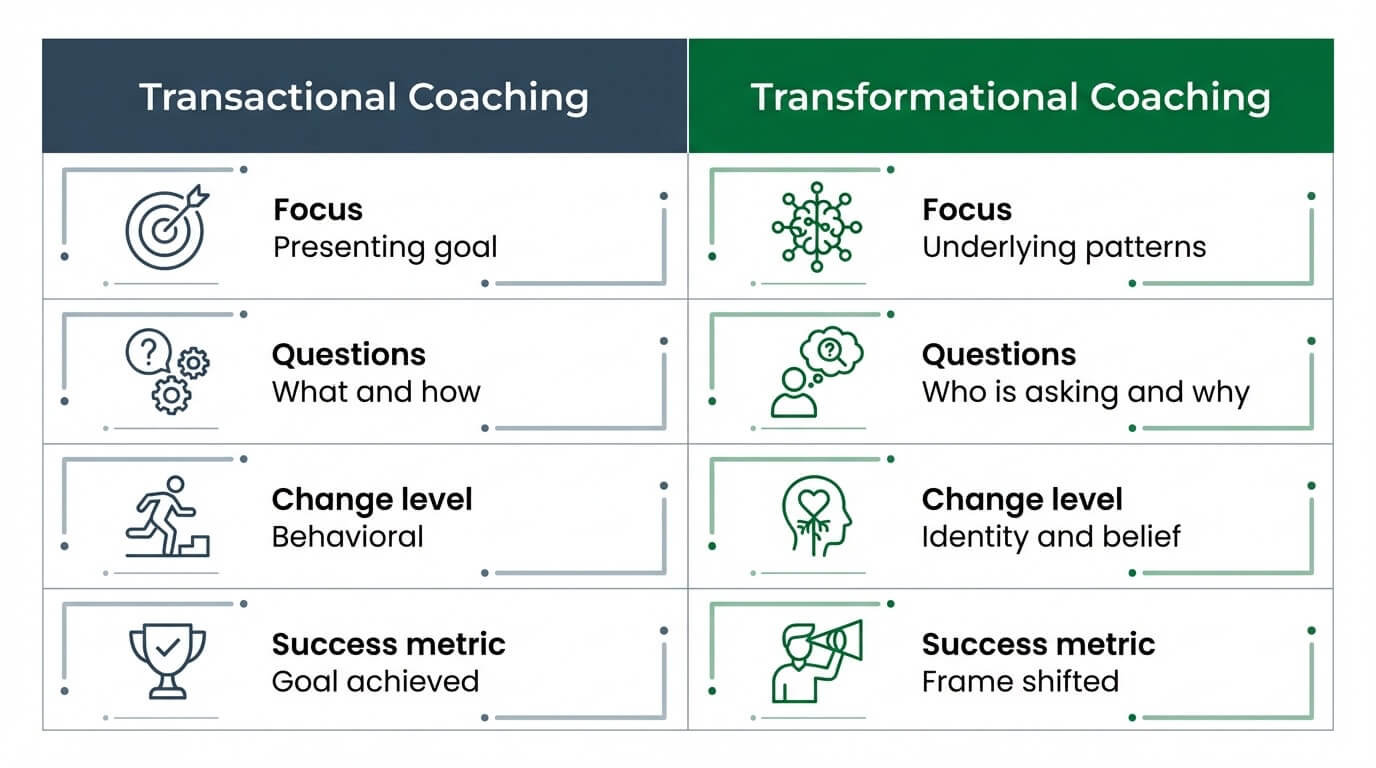
Transformational coaching is a coaching orientation that works at the level of beliefs and identity, not just behavior. Where transactional coaching helps a client do something differently, transformational coaching helps a client see themselves differently - and the behavioral change follows from that shift.
The distinction is not a hierarchy. Both orientations serve clients. A leader who needs to improve delegation skills may get exactly what they need from transactional coaching focused on specific techniques and accountability. But a leader who keeps taking back delegated work despite knowing better is dealing with something underneath the behavior - a belief about what good leaders do, or an identity as the person who holds things together.
The difference shows up in observable ways during coaching sessions.
| Dimension | Transactional Coaching | Transformational Coaching |
|---|---|---|
| Question orientation | “What would help you move forward on this?” | “What would have to be true about you for this to keep happening?” |
| Coach attention | Tracks what the client says | Tracks what the client avoids saying |
| Session ending | Client leaves with an action plan | Client leaves with a shift in how they see the situation |
| Change target | Behavior and performance | Beliefs, assumptions, and self-concept |
Most coaching sessions are not purely one or the other. The skill is recognizing when the moment calls for a depth shift - when the client’s presenting issue is a symptom of something they have not yet examined. A coach who only knows how to work transactionally will keep returning to action plans that the client agrees to and then does not follow through on. A coach who can work transformationally will hear the pattern and name it.
What Changes in Transformational Coaching
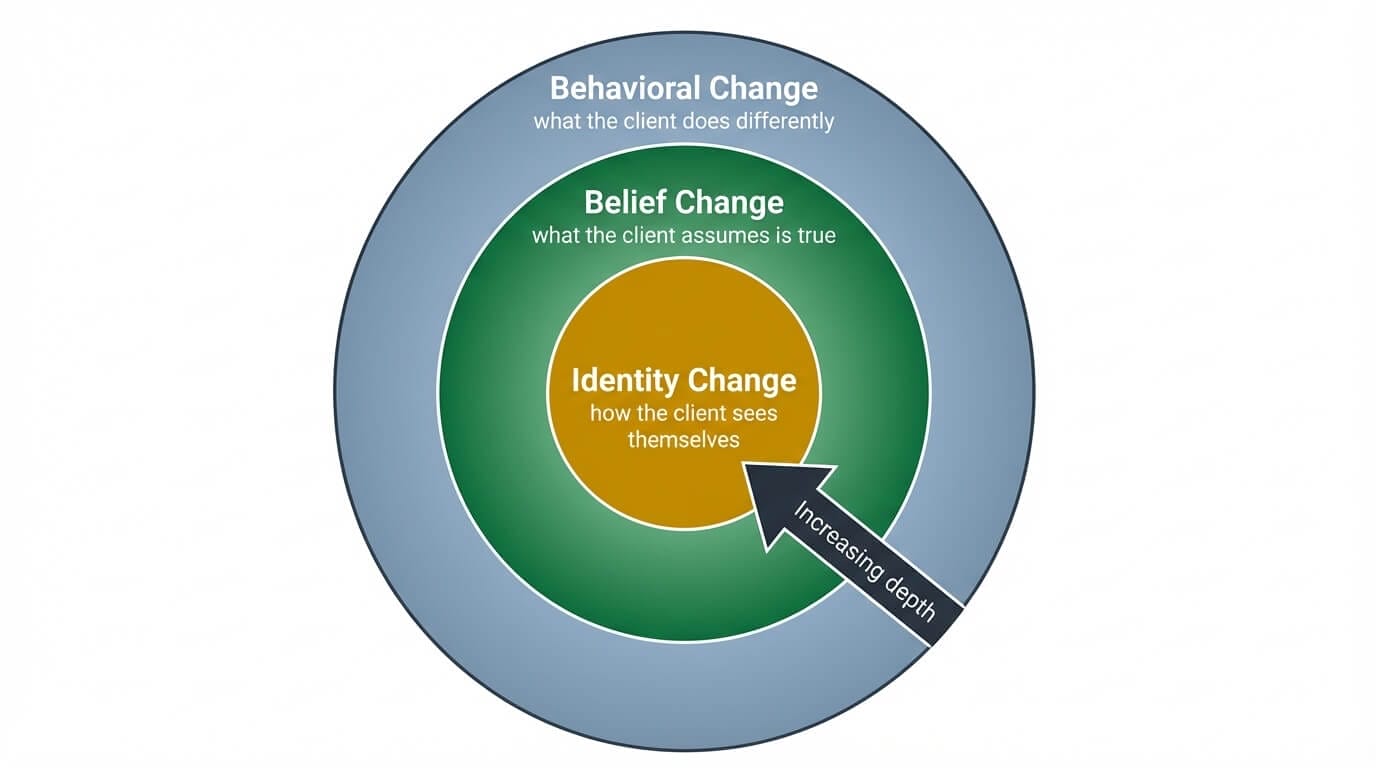
Transformational coaching produces change at three distinct levels. Recognizing which level a client is working at determines whether the coach responds with action planning or with a question that goes deeper.
Behavioral Change (Surface)
The client does something differently. They start delegating, they prepare for meetings, they give direct feedback. This is where most coaching starts and where transactional coaching delivers well. The client identifies a gap, builds a plan, and practices new behaviors.
Belief-Level Change (Middle)
The client holds a different understanding of how things work. Consider a scenario: Lisa, a business owner, came to coaching for time management strategies. She was close to burnout and wanted to know how to fit more into her day. A transactional approach would have produced a productivity system. But the coach noticed that Lisa’s overwork was not a scheduling problem - it was rooted in a belief that if she did not personally oversee every decision, the business would fail. The coaching shifted from managing her calendar to examining that belief. When the belief changed, the overwork changed with it. This is mindset work at the core of transformation.
Identity-Level Change (Depth)
The client reorganizes who they understand themselves to be. David was an emerging leader promoted out of a technical role. His stated goal was confidence in team meetings, but sessions kept circling back to the same hesitation. The coach recognized that David was not dealing with a skill gap. He was caught between two identities - the technical expert who earned his credibility through knowing the answers, and the leader whose job was to ask questions he did not know the answers to. Until that identity tension became visible, no amount of communication technique training was going to stick.
Coaches who are only working at the behavioral level can hear it in their own questions. The questions are directional - they point toward action. Coaches working at belief and identity level ask questions that open rather than point. “What would it mean about you if you stopped being the one with all the answers?” opens a space. “What could you try in your next meeting?” closes one.
ICF Competencies That Drive Transformational Work
Transformational coaching is not a separate methodology that exists outside the professional coaching framework. It activates four specific ICF competencies at a depth that transactional work does not require. Understanding which competencies are most engaged - and at what marker level - gives coaches a concrete development map.
Competency 4: Cultivates Trust and Safety
Trust in transactional coaching means the client believes the coach is competent and has their interests in mind. Trust in transformational coaching means the client is willing to examine beliefs about themselves that they have never questioned. That is a different level of psychological safety. PCC Marker 4.4 specifies that the coach “acknowledges and supports the client’s expression of feelings, perceptions, concerns, beliefs, and suggestions.” In transformational work, this is not a checkbox - it is the foundation without which no depth work happens. The client will not go to the belief level with a coach they do not trust at the identity level. Building trust as prerequisite for transformation is the first developmental task.
Your client will only go as deep as they trust you to hold what they find there. That trust is not built by technique - it is built by how you show up when things get uncomfortable.
Competency 5: Maintains Presence
This is the hardest competency in transformational coaching and the one most coaches underestimate. PCC Marker 5.3 asks coaches to demonstrate “confidence in working with strong client emotions during the coaching process.” In practice, presence quality cannot be performed. If the coach is managing the session - thinking about what question to ask next, worrying about whether the session is productive - they are not present enough for transformational work. The coach’s internal state is data. A coach who is genuinely present can detect shifts in the client’s voice, posture, and energy that signal something important is close to the surface.
Competency 7: Evokes Awareness
PCC Marker 7.4 describes asking questions that help the client “explore beyond current thinking.” In transformational coaching, “beyond current thinking” means beyond the client’s current frame of reference about who they are. The question “What would have to be true about you for this pattern to keep showing up?” is an identity-level question. It does not ask the client to analyze their behavior. It asks them to look at the operating system producing it. Jack Mezirow’s research on transformative learning theory calls these “disorienting dilemmas” - moments where the existing meaning structure can no longer make sense of the experience. Coaches who can evoke this kind of awareness do so not through clever technique but through genuine curiosity about what the client has not yet seen.
Competency 8: Facilitates Client Growth
PCC Marker 8.6 involves helping the client “identify potential results or learning from identified action steps.” In transformational work, this extends to facilitating the client’s recognition that the goal itself may need to change. A client who arrived wanting to be more assertive in board meetings may discover, through belief-level work, that the real issue is their relationship with authority. The “growth” is not learning a skill - it is reorganizing an understanding of self.
What Coaches Need to Develop
The four competencies above describe what transformational coaching requires. This section addresses what coaches must develop in themselves to meet those requirements. These are not techniques. They are internal capacities - and the distinction matters. A coach can learn a technique in a workshop. Developing a capacity requires sustained practice, supervision, and honest self-assessment.
Build These Skills with ICF Training
Tandem's ACC program develops these competencies through structured practice with MCC-level mentors.
Tolerance for Depth
Tolerance for depth means staying with uncertainty instead of rescuing the client. When a client says “I don’t know” after a powerful question, the most common coaching error is to offer another question immediately - to fill the space. A coach who has developed tolerance for depth can hold that “I don’t know” for three additional exchanges, trusting that the client’s processing is happening in the silence. The most common reason deep coaching never happens is not lack of skill but low tolerance for the uncomfortable in-between.
Engaged Neutrality at Depth
What actually happens when a coach tries to hold engaged neutrality in transformational work: the brain offers an opinion. Then a suggestion. Then a solution. Neutrality means noticing all three and choosing none of them. At the belief and identity level, this gets harder. The coach may have a clear sense that the client’s belief is limiting. The pull to steer the client toward “seeing” what the coach already sees is strong. But a coach with investment in what the client discovers about themselves has left the coaching stance. The client must make their own meaning from what they find.
Coaching Presence at the Non-Verbal Level
A client’s voice changes quality when a topic shifts to authority. There is a session-long pause before answering a question about values. The client tells a practiced story about a conflict - every word polished, no emotion underneath. Coaching presence is non-negotiable in transformational work because these signals carry more information than anything the client says out loud. Detecting what clients stop saying requires a quality of attention that cannot be faked.
Self-Awareness as Professional Discipline
A coach’s unexamined beliefs become invisible filters in session. If the coach carries an unexamined belief that “good leaders are decisive,” they will subtly steer clients who are exploring a more reflective leadership style. Self-awareness at this level is not a personality trait - it is a professional discipline maintained through regular supervision, mentor coaching, and honest reflection on session recordings.
What we observe in coaches who are developing transformational capacity is not an increase in technique sophistication. It is an increase in their capacity to stay.
The only way to develop a coaching competency is to practice, regardless of how bad you think you are and how unintuitive it feels. Just go and coach.
At Tandem Coaching, the development of these capacities is structured through the ASPIRE framework - Assess Opportunities, Strategize Proactively, Plan the Process, Inspire Change, Reflect on Progress, Evolve with Purpose. Each phase integrates not just technique practice but the internal development work that makes technique effective.
Transformational Coaching Techniques
Three technique families are most closely associated with transformational coaching. Each one has conditions under which it works - and conditions under which it fails. Knowing the limitation matters as much as knowing the technique.
Assumption Excavation
The coach surfaces assumptions the client is operating from but has never articulated. “What are you assuming about your team that you have never tested?” or “What would you do if failure weren’t an option?” are assumption excavation questions. They work because they make the invisible visible - the client gets to see the frame they have been looking through rather than just what they see through it.
The limitation: these questions only work when trust and presence are already in place. Used before the coaching container is ready, they read as confrontational. A client who does not feel safe will give a surface answer and change the subject. The coach will think the technique failed. The technique did not fail - the conditions for it were not met.
The best coaching question I ever asked was one I almost did not ask because I was afraid of the silence that would follow it.
Double-Edged Questions
These are questions where both possible answers produce insight. “If you got everything you say you want from this role, what would you lose?” The question works because it disrupts the client’s assumption that the desired outcome is purely positive. It surfaces the hidden cost of change - the part of the current situation the client is actually protecting.
The limitation: the coach must not have a preference for which answer the client gives. If the coach is hoping the client will “realize” something specific, the question stops being a coaching question and becomes a leading question wearing a coaching disguise.
Silence as Intervention
A coach who fills a 10-second silence after “what would that mean about who you are?” has interrupted the client’s identity-level processing. Silence after a powerful question is not empty space - it is the space where the client’s existing meaning structure is reorganizing. The technique is simple: ask the question, then stop talking.
The limitation: silence as intervention requires the coach to be more comfortable with uncertainty than the client. This is a developmental requirement, not a technique to be learned in isolation. A coach who is uncomfortable with silence will fill it, no matter how many times they have been told not to. The capacity for silence develops through practice in supervision settings where someone can observe what happens to the coach during the quiet. Different coaches find different models that support transformational depth - what matters is choosing one that develops this capacity, not just names it.
Developing Transformational Coaching Skills
Transformational coaching skills are not a separate certification. They develop progressively across the coaching credential journey through the International Coaching Federation (ICF). A coach who thinks transformational coaching is a technique they can learn in a weekend workshop will plan their development differently than one who understands it develops across credential levels.
Nobody graduates into transformational coaching. You grow into it session by session, and the growth never finishes - it just gets more honest.
ACC Level: Building the Foundation
The ICF Associate Certified Coach (ACC) credential builds the foundation skills that transformational coaching rests on - active listening, trust building, coaching presence, and the beginnings of engaged neutrality. At this level, most coaches are still developing basic coaching competence. The sessions tend to be transactional by necessity: the coach is learning to ask rather than tell, to follow the client rather than lead. Transformational moments may happen, but the coach often does not recognize them in the moment or know how to follow them when they do.
PCC Level: Where Transformation Integrates
The Professional Certified Coach (PCC) credential is where transformational coaching capacity becomes assessable. Competencies 4, 5, 7, and 8 at PCC marker depth map directly to the transformational work described in this article. The PCC assessment specifically evaluates whether a coach can work at the belief level, maintain genuine presence, and evoke awareness beyond the client’s current frame. For coaches serious about evaluating whether ICF certification is the right path, PCC is where the depth work becomes measurable.
MCC Level: The Coach’s Own Edge
At Master Certified Coach level, the transformational capacity becomes reflexive. The MCC-level coach is working on their own developmental edge - the places where their own unexamined beliefs are limiting the coaching. The assessment at this level evaluates not just what the coach does with the client but the quality of the coach’s own awareness in the session.
Tandem’s PCC certification program is built around this developmental progression. The curriculum does not treat transformational coaching as a module to be completed but as a capacity that deepens through each level of training. Coaches who want to build from the start can explore our ACC and PCC certification program, which integrates both credential levels into a single developmental pathway. CCL research on what distinguishes excellent coaching supports this approach - coaching effectiveness depends on sustained developmental practice, not technique accumulation.
Frequently Asked Questions
What is transformational mindset coaching?
Transformational mindset coaching focuses specifically on the beliefs and mental models that shape how a person interprets their experience. Where standard mindset coaching might address negative self-talk or fixed mindset patterns, transformational mindset coaching goes to the identity level - helping the client examine who they believe they need to be, not just what they believe they can do. The distinction matters because belief-level change produces different outcomes than behavioral coaching. A client who changes a belief about their capacity to lead will make different decisions across every area of their work, not just the one they brought to coaching.
What is transformational business coaching?
Transformational business coaching applies identity and belief-level coaching methods within an organizational context. The business environment adds a layer that individual coaching does not: organizational culture either supports or resists the identity-level changes a leader is making. A leader who develops a more collaborative leadership identity in coaching may return to an organization that rewards command-and-control behavior. Effective transformational business coaching accounts for this system, helping the leader work with the cultural resistance rather than fighting against it.
What is the best transformational coaching certification?
The ICF PCC credential is the professional standard that most directly develops and assesses transformational coaching capacity. PCC assessment evaluates exactly the competency depth that transformational coaching requires - trust at the belief level, genuine coaching presence, identity-level awareness, and growth facilitation beyond the presenting goal. There is no separate “transformational coaching certification” recognized industry-wide. The capacity develops through structured ICF credential programs that build competence progressively from ACC through PCC to MCC.
Can you do transformational coaching without certification?
Technically, anyone can call what they do transformational coaching. But the internal capacities required - tolerance for depth, engaged neutrality, non-verbal presence, professional self-awareness - develop best within a structured training and supervision environment. Certification is not the point. The supervised practice, mentor coaching feedback, and competency assessment that come with credential programs are what actually build the capacity. Coaches who attempt transformational work without this developmental support tend to confuse being intense with being deep.
How long does it take to develop transformational coaching skills?
Transformational coaching capacity develops across years, not weeks. Most coaches begin to work consistently at the belief level after 200-300 hours of coached practice with regular supervision. The ACC credential, which requires 100 coaching hours, builds foundational skills. The PCC credential, requiring 500 hours, is where most coaches report that transformational work becomes natural rather than effortful. The timeline depends on the quality of practice, the rigor of supervision, and the coach’s willingness to examine their own developmental edges.
What makes coaching transformational is not a set of techniques the coach has learned. It is a depth of presence the coach has developed - the capacity to hold the space where a client’s beliefs about themselves come into view without rushing to replace them.
A coach who has developed this capacity does not always use it. Plenty of sessions call for transactional work - clear goals, structured accountability, forward movement. The skill is knowing which orientation the moment requires. That knowing does not come from reading about it.
If you are a PCC candidate or a coach developing your practice, try this as a supervision exercise: describe a recent session where you sensed the client was near a belief-level edge but you moved toward a behavioral question instead. What pulled you toward the surface? That pull - and learning to notice it - is where transformational coaching development starts.
Start Your Coaching Journey
60+ training hours, mentor coaching, and supervision included. Everything ICF requires for your Associate Certified Coach credential.
See ACC Program Details →