

When Technical Credibility Stops Being Enough
You built this. Year by year, decision by decision, deliverable by deliverable. The thing you’re known for—the precision, the thoroughness, the craft, the reliability, whatever your career trained you to call excellence—earned you every promotion until this one.
And now you’re hearing a version of the same feedback from every direction: “We know you’re good at your thing. We need you to be good at something else.”
Nobody names what the something else is. Worse, the something else feels like a betrayal of the thing that got you here. Because your “technical credibility” isn’t just a skill. It’s who you are. And the results aren’t speaking for themselves because the room at the next level listens to a different frequency. You’re broadcasting on your career’s old channel and wondering why nobody’s picking up the signal.
Key Takeaways
- “Technical credibility” is not a technology concept. Every function has its version: precision for finance, thoroughness for legal, craft for marketing, reliability for operations, trust for HR, delivery for product. Each one stops being sufficient at the same career inflection point.
- The promotion to VP requires trading the credibility that earned you the role for a different currency—and the new currency is specific to your function. What finance must build is fundamentally different from what technology must build.
- You keep doubling down on the old currency because it’s where you feel competent. The new currency gives slow, ambiguous feedback that your career didn’t prepare you to tolerate.
- A coach who understands the patterns your career installed doesn’t give you generic “be more strategic” advice. They name the exact credibility trade your function demands.
Every Function Has a Version of “Technical Credibility”
“Technical credibility” in the leadership development market is treated as a technology concept. The advice is aimed at engineers: stop coding, start leading. But the engineer who built their career on elegant solutions is navigating the same structural challenge as the finance director who built their career on being right about the numbers. The credibility is different. The shift is the same.
Every function has a currency—the specific form of professional value that earned you standing, respect, and every promotion until this one.
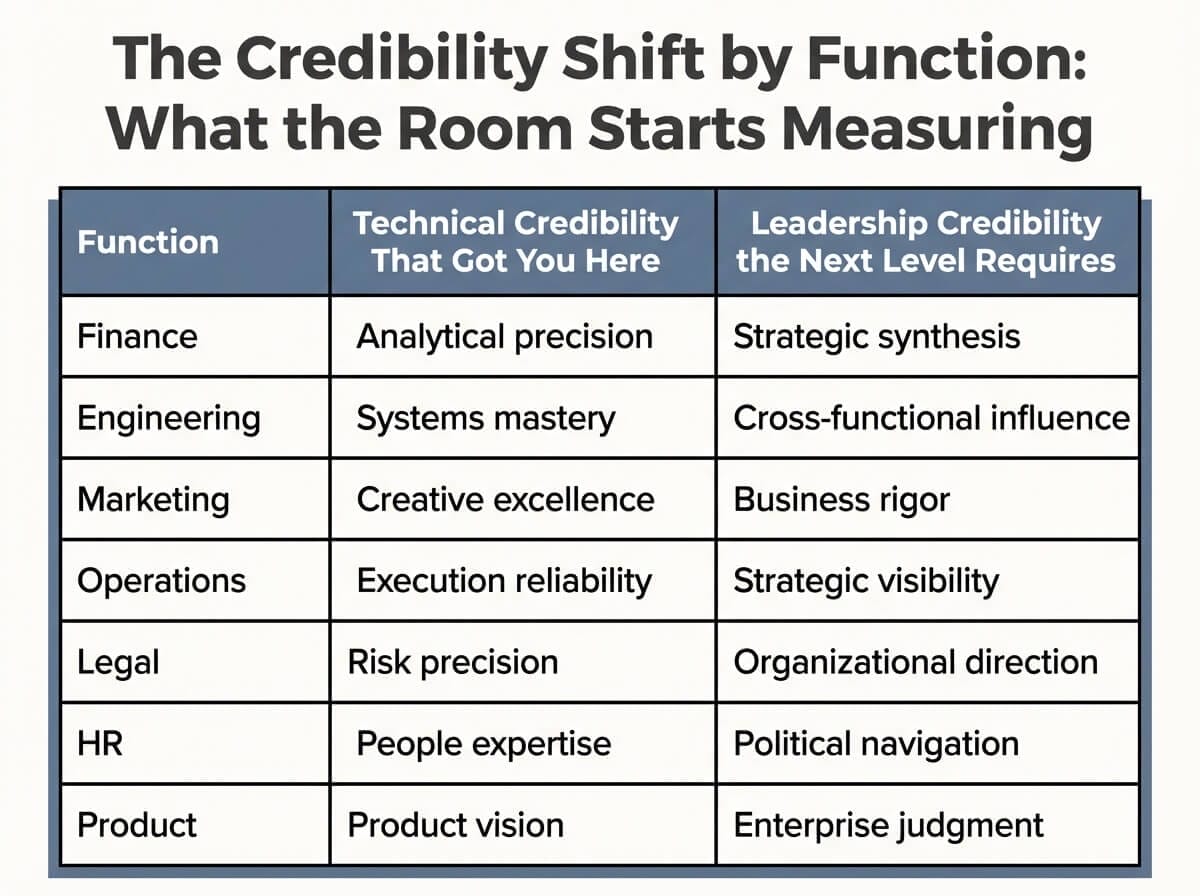
Technology: building. Code quality, elegant solutions, solving the hardest problems. “I solve hard problems.” When people trust you technically, they trust your hands. Your career taught you that shipping is identity.
Finance: precision. Accuracy, catching what others miss, building models that are right. “I see what others miss.” When people trust you technically, they trust your math. Your career taught you that being right is how you earn standing.
Legal: thoroughness. Airtight reasoning, finding every risk, preventing what others don’t see coming. “I find the problem before it finds us.” When people trust you technically, it means nothing gets past you.
Operations: reliability. Process excellence, efficiency, things running. “I make things run.” When people trust you technically, it means things work when you’re responsible for them. Your greatest contributions are things that didn’t happen.
Marketing: craft. Creative execution, campaign performance, making things that connect with audiences. “I make things that resonate.” When people trust you technically, it means the work lands. The idea, the copy, the campaign that moves the needle—that’s the currency.
HR: trust. Being the safe person, knowing the policy, holding confidences. “People come to me.” When people trust you technically, they trust you with what they can’t say to anyone else. Relational integrity is the currency.
Product: delivery. Features ship, users adopt, the thing works. “Teams trust I know what I’m talking about.” Getting the right things built is the currency. When people trust you technically, it means what you aimed at was worth aiming at.
Every one of these currencies is real. Every one of them earned you the promotion. And every one of them is about to become insufficient.
The Specific Shift Your Function Demands
The promotion to director or VP doesn’t ask you to stop being credible. It asks you to be credible in a way your career never trained you for. The old currency still matters—but it’s no longer enough. And the new currency feels, at first, like a betrayal of the thing that got you here.
Recognize What’s Being Asked of You?
If you’re sensing the rules changed but can’t name exactly how, that’s what a first conversation is for. We start by identifying the specific shift your function requires—not a generic framework.
| Function | Old Currency (IC) | New Currency (VP) | The Painful Shift |
|---|---|---|---|
| Technology | Code quality, personal technical skill | Team output, architecture that serves business strategy | The hands-on identity must release |
| Finance | Accuracy, models that are right | Translation—making numbers mean something to non-finance stakeholders | Precision must yield to narrative |
| Legal | Thoroughness, finding every risk | Enabling—deciding which risks to accept, not just cataloging them | The gatekeeper must become an enabler |
| Operations | Reliability, process excellence | Orchestration—cross-functional systems, organizational design | The optimizer must become an orchestrator |
| Marketing | Craft, creative execution | Strategy—brand stewardship, cross-functional influence on positioning | Creative identity subordinated to strategic identity |
| HR | Individual trust, being the safe person | Systems—talent strategy, organizational development at scale | Individual relationships yield to institutional capability |
| Product | Delivery, features shipped | Judgment—which bets to fund, which to kill, where to aim the domain | Delivery was a proxy metric nobody told you about |
The technology VP’s hands itch to refactor the code. They review every PR. They solve the hardest bug instead of building a team that solves hard bugs without them. Building gave clean, immediate feedback: it works or it doesn’t. The new work gives slow, uncertain feedback about other people’s judgment. The gap between those two feedback loops is where the identity crisis lives.
The finance director keeps building the forty-slide deck that proves the point when leadership wants a three-slide narrative that shapes a decision. Being right stops being enough. Being understood becomes essential. And leading with judgment instead of proof feels imprecise, which for someone whose career was built on precision, feels dangerous.
The legal director keeps writing comprehensive risk memos that catalog every exposure when the room above wants a recommended path forward. Every risk left unflagged feels like professional negligence because their formation built its entire value on being the person whose thoroughness was never in question. The shift from “I prevent risk” to “I help the business take smart risks” can feel like abandoning the thing that made them essential.
The operations director keeps optimizing individual processes instead of designing cross-functional systems. “My process” must become “the organization’s operating model.” The optimizer who made one function run clean must now make multiple functions run together, and the feedback loop shifts from “nothing broke” to “the organization can do something it couldn’t do before.”
The marketing director keeps crafting the copy. Art must serve business—which can feel like selling out the thing that made the work meaningful. Campaign-level thinking must become market-level thinking: brand stewardship, strategic positioning, cross-functional influence over product direction and pricing. The creative identity doesn’t disappear, but it must be subordinated to a strategic identity that doesn’t produce the same satisfaction.
Nobody told you the exchange rate. They just stopped accepting the old currency.
The HR director keeps being the go-to person for individual employee issues rather than building the systems that handle those issues at scale. Individual relationships, the currency that made them the trusted person in the room, must yield to institutional capability. The old currency gave direct, relationship-level feedback: people come to you. The new currency requires reading organizational-level signals that are harder to feel and slower to confirm.
The product director keeps defining features rather than defining domains. They point to features shipped successfully as evidence of performance, not realizing the room above evaluates whether they aimed at the right problems. Nobody told them delivery was a proxy metric. They thought delivery was the job.
Why You Keep Doubling Down on the Old Currency
The reason you’re still spending old currency isn’t weakness. It’s that the old currency is the only place you feel competent, and the new currency feels risky in a way your career isn’t equipped to handle.
When you spend old currency, you feel competent immediately. The model you built personally: right. The code you reviewed: clean. The risk memo you drafted: comprehensive. The campaign you crafted: beautiful. The process you fixed: running. Each time you invest in the old currency, you get immediate, familiar confirmation that you’re good at what you do. Each time you try the new currency—leading with judgment instead of data, enabling instead of building, orchestrating instead of optimizing—the feedback is slow, ambiguous, and unrewarding.
The cruel part: you can’t just drop the old currency entirely. The VP of engineering who stops understanding the architecture loses technical credibility with the team. The finance director who stops engaging with the models loses the precision credibility that gives them a seat at the table. The legal director who stops reading the contracts loses the thoroughness that makes their judgment worth hearing. You need enough of the old currency to stay credible while building enough of the new currency to earn standing at the next level. Two economies, running simultaneously, with no one telling you the exchange rate.
And the deepest reason the shift is hard: the old currency isn’t just what you do. It’s who you are. For the builder, building is identity. For the precision person, being right is identity. For the protector, preventing harm is identity. For the optimizer, things running is identity. When someone asks you to spend less on the old currency, they’re not asking you to change a behavior. They’re asking you to release a piece of your professional self. That’s not a skills challenge. That’s an identity challenge. And the generic advice to “think more strategically” doesn’t begin to address it, because it’s operating at the wrong level of the problem.
The thing that earned you the promotion is not the thing the promotion asks you to do.
The people above you figured this out, eventually, through years of trial and error. But they can’t quite articulate what shifted because the pattern is invisible to the person inside it. They’ll tell you “be more strategic” the way someone who learned to swim at four tells you “just relax in the water.” The advice is technically correct and practically useless because it doesn’t name the currency exchange you’re navigating. It doesn’t name what you’re losing and why letting go feels like losing control.
What Changes When Your Coach Gets This
A generic coach hears a marketing director say “I keep getting pulled into the work—I can’t seem to stop writing the copy myself” and provides delegation coaching. How to let go. How to trust the team’s creative output. How to spend time on higher-level work.
See How Tandem Coaches Differently
Our approach starts with understanding what your function’s credibility shift actually looks like. Not personality assessments. Not generic leadership frameworks. The specific currency the next level requires from someone with your formation.
A coach who understands what a career in marketing actually does to a person hears the same thing and recognizes the pattern underneath: “Writing the copy is where you feel like yourself. The creative execution that earned you every promotion until this one—the craft, the taste, the thing that connected with audiences—is the currency your career trained you to trust. Delegation isn’t the problem. The problem is that the new currency—strategic positioning, cross-functional influence, shaping how the market sees the whole company—doesn’t give you the same hit. It doesn’t feel like your work. It doesn’t feel like you.”
And then the question that shifts everything: “What would ‘your work’ need to become at this level for it to feel like it belongs to you?”
That reframe moves the conversation from behavioral—stop doing the work—to identity-level. Not “how do you delegate better?” but “what would the new currency need to feel like in order for you to own it?”
An operations director says “nobody sees what I do until something breaks.” A generic coach works on visibility strategies: communicate impact proactively, quantify operational excellence, present to leadership more often. A coach who understands what a career in operations installs hears the pattern: “Your career trained you to read one success signal—nothing breaks. That signal is inherently invisible. Your greatest contributions are things that didn’t happen. The room above reads a different signal: strategic impact, organizational capability, transformation readiness. The shift isn’t about making your current work more visible. It’s about changing what counts as your work. From ‘I make things run’ to ‘I design how the organization works.’ That’s not a communication problem. It’s a currency shift.”
The difference between those two coaching conversations is not technique. It is whether the coach understands the specific credibility your career built and the specific credibility the next level demands. One approach gives you a framework. The other names the promotion that changed the game and the exact currency exchange you’re navigating.
The patterns in this article connect to several related dynamics across careers and levels: the credibility currency that stops working at higher levels, when your credibility was your identity, what comes after the credibility question, and the promotion that exposed the credibility paradox.
This connects to a related perspective: how executive presence coaching complements formation-aware work.
The New Currency Doesn’t Replace the Old One
The precision, the craft, the thoroughness, the reliability, the trust, the technical depth, the delivery instinct—none of that goes away. It’s the foundation. The question is whether you can build something on top of it: a form of credibility that the next level recognizes and rewards.
That form is different for every function. The finance director’s new currency—translation—is fundamentally different from the technology VP’s new currency—team output—is fundamentally different from the marketing director’s new currency—strategic positioning. The structure of the shift is universal. The content of the shift is specific to the career that formed you.
And figuring out what your specific new currency looks like—not “be more strategic” in the abstract, but what strategic actually means for someone whose career installed the patterns yours installed—is easier when someone who understands your formation is in the room with you. Not to tell you what to do. To help you see why the old currency keeps pulling you back, and what the new one might feel like once it’s yours.
If that specificity matters to you, if “think more strategically” has never been enough, the next conversation isn’t about strategy. It’s about the career that made strategy feel like someone else’s language.
A Conversation About What the Room Is Measuring Now
A 30-minute call where your coach already understands the credibility shift—what it is, why it’s hard to see from the inside, and what changes when someone names the new currency clearly. No assessment. No intake form.
Book a Free Consultation →