
You Are Not Your Job Title — But Your Career Thinks You Are
When was the last time you did something at work that had nothing to do with your function — and felt like an imposter the moment you opened your mouth?
Not imposter syndrome in the usual sense. Not “I do not belong here.” Something more specific: the feeling that once you step outside the domain your career built you in, the version of yourself that shows up is thinner. Less sure. Less credible. The CFO who contributes confidently on capital allocation but goes quiet when the conversation turns to culture. The CTO who commands the room on architecture but stumbles through a board narrative about business value. The General Counsel who can hold any courtroom but cannot hold a strategic conversation without it becoming a risk assessment.
That thinning is not a confidence problem. It is an identity architecture problem. And it starts with what your career installed long before you noticed it was installing anything.
Key Takeaways
- Every function installs a specific professional identity — not just skills, but a definition of what it means to be good, credible, and yourself.
- Identity Architecture is the most deeply fused dimension of professional formation. Other patterns can be adjusted with practice. Identity requires expansion, not correction.
- The ceiling is not competence. It is repertoire. You may have the capability to lead beyond your function. You may not have a version of yourself that feels real doing it.
- Releasing identity is not a skill problem. You cannot learn your way out of an identity that no longer fits — you have to build a new one alongside it.
- A coach who understands what your career built into your sense of self asks different questions than one who treats the issue as a skill gap.
What Your Career Built Into You
Every function installs an identity. Not a skill set. Not a perspective. An identity — a definition of what it means to be good that fuses with the person’s sense of who they are. After enough years, the identity and the person become inseparable. The career did not just teach you to do something. It taught you to be something.
In technology, the identity is the builder. You are what you have shipped. The system that scales, the architecture that holds, the elegant solution to the impossible problem — these are not just accomplishments. They are proof that you are who you think you are. When you stop building, you do not just change what you do. You lose access to the thing that tells you, every day, that you are competent.
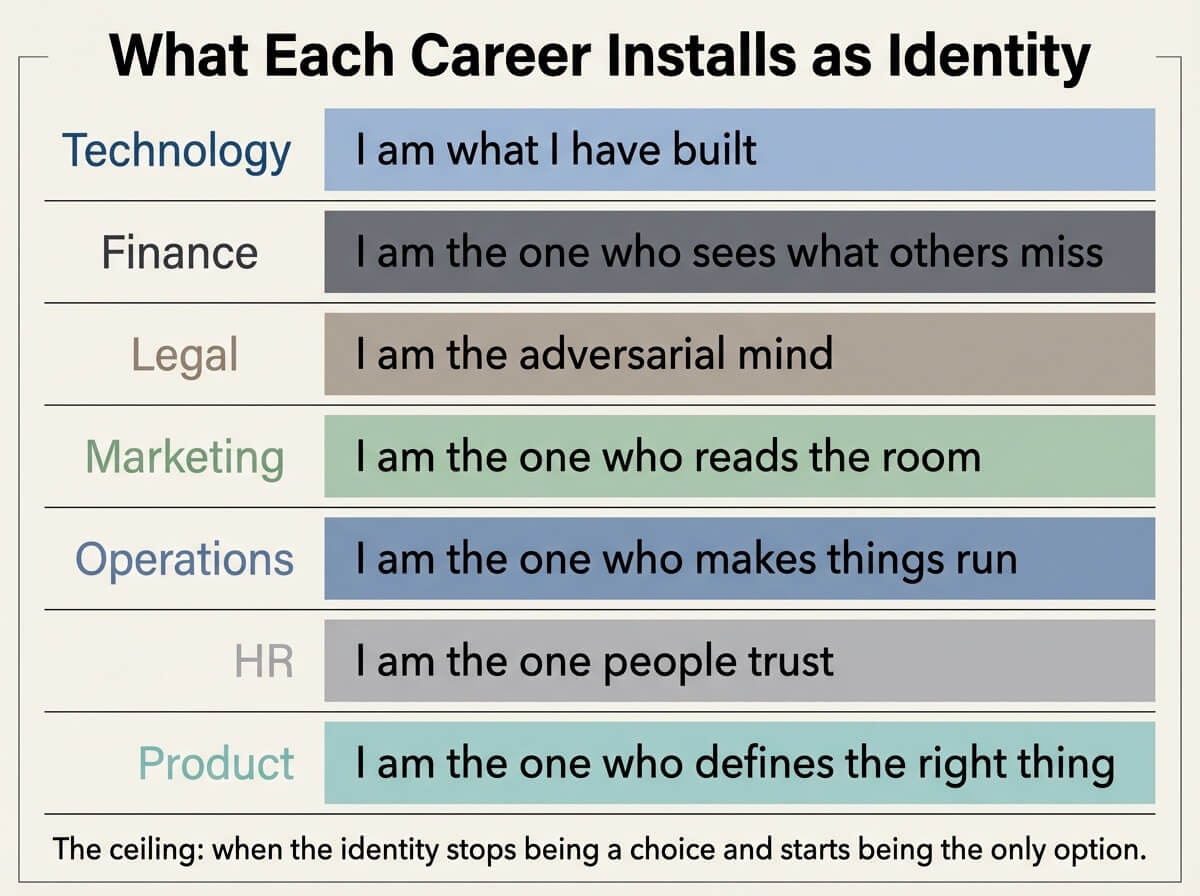
In finance, the identity is precision. You are the person who sees what others miss. The variance that does not fit. The assumption that was not tested. After fifteen years, this is not a skill you turn on and off. It is how you process the world. When someone pitches an idea without evidence, the finance-trained mind does not hear enthusiasm. It hears an unaudited claim.
In legal, the identity is the adversarial mind. Stress-testing every proposition is not a habit. It is how you define intelligence. The legal leader told to “be less adversarial” does not hear feedback about a behavior. They hear: think worse.
In marketing, the identity is the storyteller — the person who reads the room, crafts the narrative, and moves people. In operations, it is the person who makes things run — invisible when things work, noticed only when they break. In HR, it is the trusted person — the one everyone comes to. In product, it is the maker — the person who defines the right thing and gets it built.
Your career did not just teach you to do something. It taught you to be something. And the line between those two gets thinner every year until you cannot find it at all.
None of these identities are wrong. Each was earned. Each was adaptive — it matched what the environment rewarded. The problem is not what the identity is. The problem is that it was installed so deeply you stopped noticing it was a choice.
When Identity Becomes a Cage
The identity that defined excellence in one room constrains growth in the next. Not because the identity is wrong. Because it is too narrow for what the role now asks.
Recognize the Pattern?
If the line between what you do and who you are feels uncomfortably thin, that recognition is where coaching begins. We start by understanding what your career installed.
The CTO who cannot stop building does not have a delegation problem. They have an identity problem. Reviewing code is not about quality control. It is about staying connected to the part of themselves that feels real. When they delegate the architecture review and their senior engineer does it differently — maybe even well — the feeling that surfaces is not relief. It is loss. “If she can do it without me, what am I here for?” That question is not about the engineer. It is about who the CTO is if they are not the best builder in the room.
The CFO who cannot stop modeling does not lack strategic capacity. They lack a version of themselves that feels credible expressing judgment without data. “Here is what I think we should do” — said without a model behind it — violates everything their formation installed about what rigorous thinking sounds like. So they build one more scenario. Add one more sensitivity analysis. The model is excellent. The room is asking for something the model cannot produce.
The operations leader who cannot claim strategic space does not lack the strategic insight. They have it — they see more of the organization than almost anyone else at the table. But their identity says operations stays in the background. The career taught them that good work speaks for itself. It does not. Not at this level.
The ceiling is not competence. It is repertoire. These leaders have the capability to lead beyond their function. What they lack is a version of themselves that feels real doing it. That is a fundamentally different challenge than a skill gap — and it requires a fundamentally different kind of coaching.
The Hardest Part
You cannot learn your way out of an identity that no longer fits. Skills training addresses what you can do. Identity architecture addresses who you are when you do it. The distinction matters because the conventional response to a senior leader who is “stuck” is development: leadership programs, executive education, coaching on influence and presence. Those interventions build capability. They do not build a new version of the self that is willing to use the capability.
The engineer told to “think more strategically” does not lack strategy. They can think strategically when asked. What they cannot do is show up to a conversation about organizational direction and feel like themselves doing it. The strategic contribution feels like a performance. The technical contribution feels like home. Where this pattern starts — at the first major promotion — it is uncomfortable. By the time a leader reaches the C-suite, the identity architecture has twenty years of reinforcement behind it.
This is why the currency shift is so painful. It is not just that the old skill has diminishing returns. It is that the old skill was the source of professional self-worth. Releasing it does not feel like growth. It feels like giving up the thing that makes you, you.
The expansion required is not “become someone else.” It is: become someone who carries the old identity as one tool among several, rather than as the only definition of credibility. The builder who can also direct. The analyst who can also judge. The protector who can also navigate. Both/and rather than either/or. That expansion is the work. And it is harder than any skill acquisition because the resistance is not cognitive — it is existential.
Coaching That Gets This
Generic coaching hears “I feel like I am losing touch with what made me good” and offers reassurance or delegation frameworks. A coach who understands identity architecture hears the same sentence and recognizes a formation in the middle of an identity expansion that the leader experiences as an identity loss.
See How Tandem Coaches Differently
Our approach starts with identity architecture, not skill gaps. Not personality assessments. Not generic delegation frameworks. What your career built into your sense of self — and where it meets the limit.
The coaching question is not “How can you let go of the technical work?” The question is: “What does ‘in touch’ mean for you at this level? What would it give you?”
That question does not argue with the identity. It invites the leader to examine what the old behavior is actually providing — and whether the new role offers another path to the same thing. The CTO who keeps reviewing code is not reviewing code. They are maintaining access to the feeling of competence. The coaching work is helping them find another source of that feeling at the level they now occupy.
The question is not whether you can let go of the old identity. The question is whether you can build a new one that feels as real as the one your career installed.
This is what formation-aware coaching changes. Not the advice. The recognition. The coach who understands what a career in technology does to a person’s sense of self will hear “I keep going back to the code” and know that the sentence is not about code. It is about identity. And the questions that follow from that recognition are different — deeper, more precise, more respectful of what the career built — than the questions that follow from hearing it as a time-management problem.
This connects to a related perspective: psychological readiness and the professional identity layer.
What the Identity Holds
You read this because something about the title matched a pattern you have been noticing. The career built something real. The precision, the builder instinct, the protective reflex, the operational excellence, the trust people place in you — none of that was a mistake. It was adaptive. It worked.
It is also not everything you are. The career installed one version of excellence and called it the only version. The role you occupy now is asking for a wider definition. Not a different one. A wider one. The identity your career built is the foundation. The question is what you are willing to build on top of it.
If that question is live for you right now — if you have been sensing that the thing that made you credible is not the thing that will carry you forward — that is where coaching that understands professional formation begins. Not with a new skill. With a new relationship to the identity your career installed.
A Conversation About Who You Are Becoming
A 30-minute call where your coach already understands what your career built into your sense of self — and where that identity meets the demands of the role you occupy now.
Book a Free Consultation →