ICF Team Coaching Competencies: What They Look Like in Practice
What do ICF team coaching competencies look like in practice?
ICF team coaching competencies show up as observable behaviors in live sessions: stepping outside the team circle so members talk to each other instead of the coach, asking what hasn't been said when consensus arrives too fast, and helping the team trace its own interaction patterns rather than delivering the coach's insights directly.
A team has been debating a decision for twenty minutes. Three people have stated positions. Two haven't spoken. The coach asks the silent members: What are you noticing that hasn't been said? Developing the instinct for questions like this is what boosting your coaching skills is actually about. For coaches building that instinct through self-study, the 10 books every coach should read offer a curated reading path that reinforces these competencies.
That question, and the shift in attention it creates, is one competency in action. Not a definition memorized from a document, but an observable behavior that changes what happens next in the room. The competency is not the question itself. It's the awareness that prompted it: the coach noticed two people hadn't spoken and chose to surface that pattern rather than follow the three who had.
The ICF team coaching competencies describe what effective team coaching looks like. But reading the list and recognizing the behaviors during a live session are different skills. This article translates each competency area from framework language into the coaching moments where it shows up and where coaches most often miss it.
Key Takeaways
- ICF team coaching competencies extend the core coaching model to a multi-person client system where the team itself is the entity being coached.
- The biggest competency gap for transitioning coaches is becoming the focal point instead of stepping outside the circle and letting the team talk to each other.
- Each competency area has observable behaviors that distinguish team coaching from individual coaching applied to a group setting.
- ACTC certification validates competency against ICF standards for team coaching, not mastery of every team situation a coach will encounter.
What the Team Competencies Require
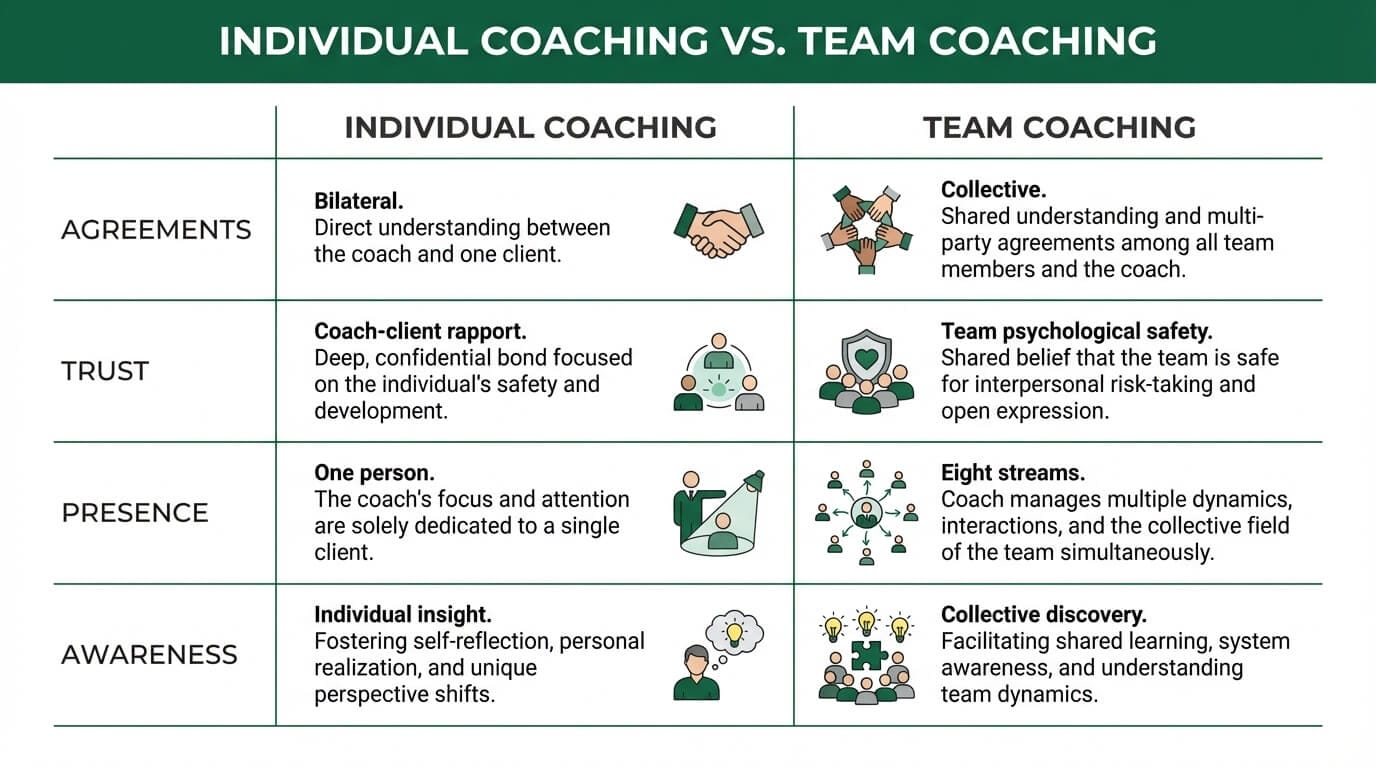
The ICF team coaching competencies are not a separate framework. They extend the eight core ICF competencies into a multi-person client context. The same foundations (ethical practice, coaching agreements, coaching presence, evoking awareness) apply. What changes is where you direct them. For agile practitioners building toward these competencies, it helps to start from the fundamentals: coaching is more than just asking questions, and understanding that distinction is what separates adequate from excellent Scrum Masters and agile coaches.
In individual coaching, your client is one person across the table. In team coaching, your client is the team as an entity. Not the individuals who compose it. The relationship between those people, the patterns they create together, the dynamics that emerge when they work as a unit. Every competency shifts when you make that move — which is why the executive application of Jensen Huang's purpose vs. task framework for AI career disruption is the strategic lens coaches bring to that system-level conversation.
Peter Hawkins and David Clutterbuck both describe team coaching as working with the team as a living system. The ICF competency model gives that idea behavioral specifics: what a coach does, session by session, to coach the system rather than the individuals inside it. The EMCC offers its own competency framework for team coaching, but the ICF model has become the standard that ACTC certification validates against. These competencies are most tested when the client is a senior leadership team, the setting that executive team coaching addresses directly.
The International Coaching Federation defines team coaching as "partnering in a co-creative and reflective process with a team and its dynamics and relationships in a way that inspires them to maximize their abilities and potential in order to reach their common purpose and shared goals." The definition is dense, but every clause is doing work: experienced team coaches treat the coaching engagement as a partnership with the whole system, never a facilitation service delivered to it.
The competencies are a map, not a recipe. They name categories of coaching behavior without telling you when to use which one. An experienced team coach reads the room and decides which competency to foreground based on what the team needs in that moment. A coach preparing for their credential learns to recognize these categories so they can develop each one deliberately.
The table below shows how each competency area changes when the client becomes a team:
| Competency Area | Individual Coaching | Team Coaching |
|---|---|---|
| Agreements | Bilateral: coach and client | Collective: coach, team, and sponsor |
| Trust & Safety | Coach-client rapport | Team psychological safety with each other |
| Presence | Tracking one person | Tracking eight people simultaneously |
| Evoking Awareness | Individual insight | Collective discovery the team couldn't see from inside |
| Growth & Accountability | Client designs actions | Team designs experiments together |
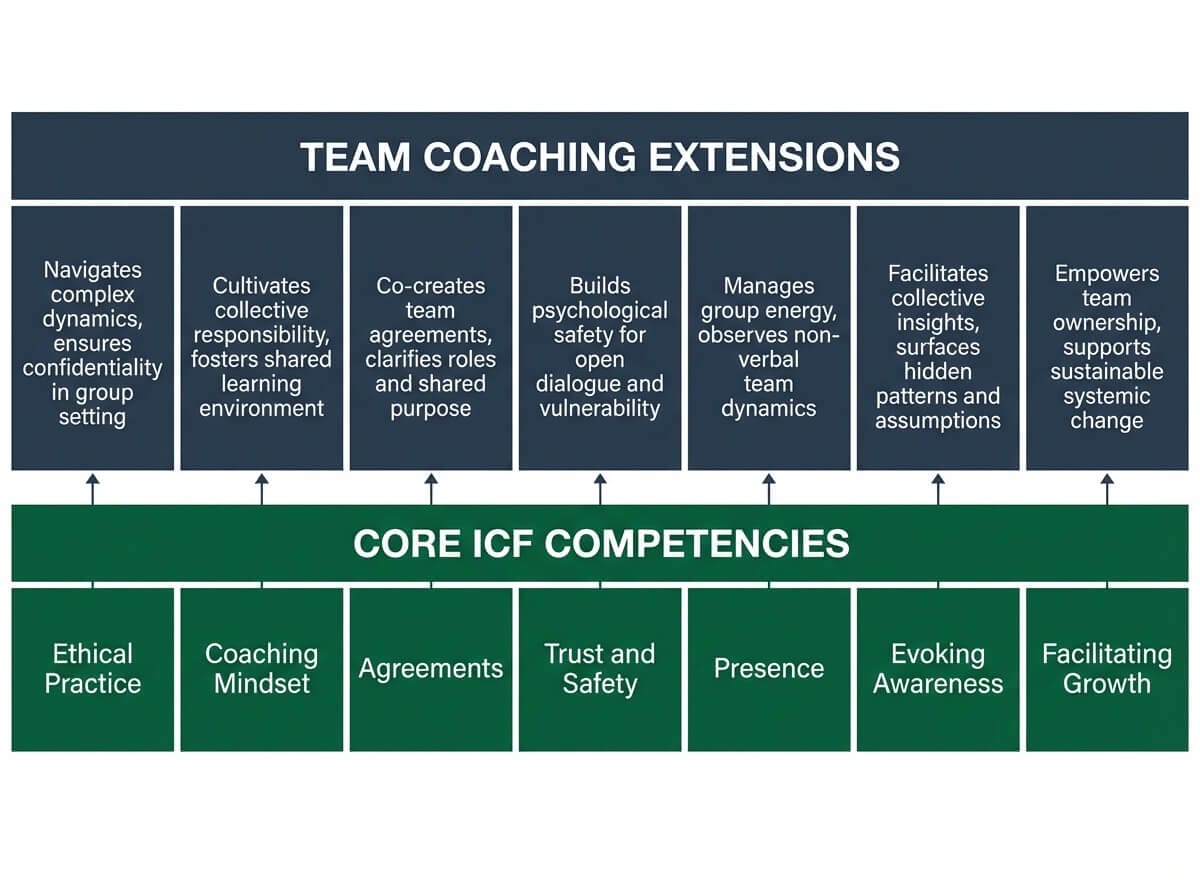
The shift is not incremental. Coaching one person and coaching a team require different attention, different positioning, and a different relationship with silence. The competencies name what to develop. The sections below show what each one looks like when a coach does it well and when they miss.
The Eight ICF Team Coaching Competencies
The ICF published a dedicated set of team coaching competencies in 2020, and they are not a longer list than the core model. They are the same eight competencies, grouped into the same four domains, with team-specific behavioral markers layered on top. Reading the full set as a map first makes the deep dives below easier to place: each one is a core competency you already recognize, redirected at a system instead of a person. If you want structured practice applying that redirection, our systemic coaching for executive teams course walks through it case by case.
Here is the complete framework, with the behavior that distinguishes the team version of each competency:
Foundation
- Demonstrates ethical practice — holds the team’s own sharing norms and names it when the organization’s goals conflict with what the team actually needs.
- Embodies a coaching mindset — trusts the team as a capable, resourceful, whole entity rather than a set of individuals to be assessed and corrected.
Co-creating the relationship
- Establishes and maintains agreements — contracts with sponsor, team, and coach as three parties, and renegotiates the agreement as the team develops.
- Cultivates trust and safety — builds the team’s willingness to be vulnerable with each other, not just rapport between coach and members.
- Maintains presence — tracks the whole system at once and stays outside the circle instead of becoming the point everyone talks to.
Communicating effectively
- Listens actively — hears the team’s collective message and the patterns between members, not only the loudest voice in the room.
- Evokes awareness — asks the question that lets the team see its own dynamics, rather than delivering the coach’s diagnosis of what is wrong.
Cultivating learning and growth
- Facilitates client growth — helps the team design and own its own experiments, then holds it accountable to its own commitments rather than the coach’s agenda.
The sections that follow take each competency area in turn and show what it looks like when a coach does it well and where coaches most often miss.
Ethical Practice with Teams
Ethical practice in team coaching adds a layer that individual coaching doesn't have: the tension between what the organization wants and what the team needs. In individual coaching, confidentiality is bilateral. In team coaching, the team sets its own sharing norms, and the coach holds those boundaries even when a sponsor pushes for specifics.
The hardest ethical moment comes when the organization has hired a coach to produce a particular outcome. The VP wants the team "aligned." The director wants "better collaboration." These are organizational goals, not coaching goals. The team may discover through coaching that alignment isn't their problem at all. The real problem is that their incentive structures reward individual performance over collective results.
When the environment contradicts the coaching, a competent team coach names it. Not to the team alone, but to the sponsor. That conversation, telling the person who hired you that the system around the team is the barrier, is the ethical practice competency at work. It requires professional courage that most coaching training doesn't prepare coaches for.
The team's right to self-determination also creates ethical complexity. Just because a manager says "go coach that team" doesn't mean the team wants coaching. If they feel punished by getting a coach, no amount of competency will produce results. The ethical response is to name that reality before the engagement begins, even if it means the engagement doesn't happen.
For deeper exploration of this competency area, see ethical practice in team coaching.
Coaching Mindset with Teams
Coaching mindset with teams starts with a belief that sounds simple and proves difficult: the team is capable, resourceful, and whole as an entity. Not the individuals. The team itself. Trusting the team's process even when it looks chaotic from the outside is where most coaches struggle.
The coach is not there to assess the team and tell it where it's making mistakes. The coach is there to partner. The team figures out its own goals, designs its own experiments, and decides what to change in its own environment. The coach's job is to help the team imagine bigger and better possibilities, not to prescribe the path.
A software delivery team illustrates this. They analyzed their own data and discovered that whenever work items exceeded a certain size, they consistently missed deadlines. They experimented with breaking work into smaller pieces. Delivery improved over several months. Then the team said: "Things have been better. We think we can go back to bigger work items." The coach's response: "That's your decision. It's your work."
Within two weeks, the team recognized the old approach wasn't working. They returned to smaller items voluntarily. No "I told you so." The coach allowed the team space to experience the reversion and build genuine conviction. Initially it may have been more like "yeah, we're not really sure," but after going back and finding the old way didn't work again, their mindset changed because they knew without a doubt.
The coach is not there to fix. The coach is there to partner.
That reversion learning is coaching mindset in practice. You hold the belief that the team will learn from its own experience, even when the experience includes going backward. For more on this competency, see embodying the coaching mindset in team contexts.
Agreements in Team Coaching
In individual coaching, the agreement is bilateral: coach and client define what they're working on and how they'll work together. In team coaching, agreements must be collective. The sponsor has goals. The team has goals. The coach has professional standards. All three need to be visible and compatible before coaching begins.
Contracting with the team as an entity means the team agrees on what it's working toward, not just the sponsor. This creates a structural tension that individual coaching avoids. The sponsor hired the coach. The team is the client. When sponsor goals and team goals diverge, the coaching agreement needs to hold space for that divergence rather than defaulting to whoever writes the check.
The common trap is letting the sponsor's agenda override the team's emerging needs. A sponsor wants "strategic alignment." The team starts coaching and discovers their real challenge is trust. They can't align on strategy because they don't trust each other's motives. The original agreement needs room to evolve as the team's understanding of its own situation deepens.
Revisiting agreements is not a sign of failure. Teams change. New members join. Organizational priorities shift. The coaching agreement is a living document, renegotiated as the team develops. The skills required to manage multi-stakeholder agreements are distinct from bilateral contracting, and they represent one of the clearest competency differences between individual and team work.
For practical guidance on this process, see team coaching agreements and the contracting frameworks used in ICF-aligned programs.
Trust and Safety in Team Settings
Trust in team coaching is not the same as individual rapport. It's the team's collective willingness to be vulnerable with each other, not with the coach. The coach creates conditions where trust can develop, but the team builds it through shared experience. You can't coach trust into existence. You can make it possible for trust to emerge.
Safety at the team level means the team can disagree without consequences. Not the absence of conflict, but the presence of enough safety that conflict becomes productive rather than political. The coach watches for the difference between genuine agreement and performative consensus, which looks like alignment but is actually polite avoidance of the conversation that matters.
A team tells you they're aligned. Then you watch them make a decision together and realize their "alignment" was everyone agreeing to avoid the topic that divides them. Consensus that comes too fast is usually performative. The competent team coach notices this and asks what hasn't been said.
Consensus that comes too fast is usually performative.
Three specific interventions build this competency: naming the unspoken ("I notice the team agreed quickly. What might we be leaving out?"), protecting dissenting voices ("You started to say something different. The team needs to hear that"), and slowing premature consensus ("Before we move forward, is everyone genuinely committed to this direction, or are we settling?").
These interventions feel uncomfortable. They disrupt momentum. They surface disagreement that the team was trying to avoid. And they are exactly what the trust and safety competency demands. The coach who avoids these moments to keep the session feeling positive is prioritizing their own comfort over the team's development. Real safety doesn't mean comfortable. It means the team can handle discomfort together without someone paying a price for honesty.
For a deeper treatment of this area, see building trust and safety in team coaching.
Presence and Listening at Scale
Presence in a room with eight people is fundamentally different from presence with one. You're tracking multiple verbal and nonverbal streams simultaneously. Who is leaning in. Who has crossed their arms. Who made eye contact with someone else when a particular topic came up. Whose tone of voice flattens when a certain subject surfaces. Individual coaching lets you focus all your attention on one person. Team coaching requires distributed attention.
The discipline is not following the loudest voice. The person speaking the most is often not the person the team needs to hear from. Active listening at the team level means hearing what the team is saying collectively, not just what individual members say. The gap between individual statements and team patterns is where coaching presence matters most.
Position yourself physically outside the team's circle, not at the head of the table. Where you sit shapes how the team relates to you. If you're at the center, they talk to you. If you're at the edge, they talk to each other.
The biggest presence failure in team coaching is the focal-point trap. In individual coaching, the pattern is natural: coach asks, client answers, coach asks, client answers. In team coaching, the goal is for the team to talk to each other, not to the coach. The coach steps in as needed but is not the pivot point. They stand on the outside, not at the center. The moment the coach becomes the person everyone is talking to, they've slipped back into individual coaching with an audience — a pattern the coaching vs. facilitation distinction makes concrete. Coaches with years of individual practice are especially prone to this pattern.
Recognizing the focal-point trap in real time and shifting your position is one of the hardest skills to develop in team coaching. For specific development strategies, see mastering presence as a team coach and the broader exploration of coaching presence in team settings.
Evoking Awareness and Growth
Evoking awareness at the team level is collective discovery. The team sees something about itself that no individual member could recognize from inside the system. In individual coaching, awareness is personal insight. In team coaching, the coach asks questions that make the team's own interaction patterns visible to the people creating them.
The distinction matters practically. A team coach doesn't deliver insights to the team. The coach asks the question that surfaces what the team already knew but hadn't voiced. Consider a team that declares alignment after a twenty-minute discussion. The coach asks: What hasn't been said? Silence. Then one person says what everyone was thinking but nobody was willing to put on the table. That's evoking awareness in a team context: not the coach's insight, but the coach's question creating space for the team's own discovery.
Awareness at the team level also means helping the team see its own interaction patterns. Eight people can each have a clear understanding of their own role and still miss the dynamic their interactions create. One team consistently produced high-quality work but delivered late. Each member believed they were efficient. The team pattern, excessive handoffs and implicit approval loops, was invisible from inside. The coach didn't point it out. The coach asked the team to trace a recent work item through every person who touched it. The team saw the pattern themselves.
Facilitating growth in team coaching means helping the team design its own experiments. Not the coach's recommendations, but the team's own hypotheses about what might work. The team decides what to try, how to measure it, and when to evaluate. The coach holds the team accountable to its own commitments, not to the coach's agenda.
This requires patience with process. A team might design an experiment that the coach suspects won't work. Coaching mindset says: let them try. If the experiment fails, the team learns from the failure. If the coach intervenes to prevent the failure, the team learns nothing except that the coach thinks they need protection. Most coaches coming from consulting or management backgrounds find this the hardest competency shift to internalize.
Team awareness is not the sum of individual insights. Eight people can each have a clear view of their own contribution and still miss the pattern their interactions create. The coach sees the pattern because they're positioned outside the system.
The evoking awareness in team coaching article explores specific tools and questioning strategies. For a practical team coaching guide that connects competencies to session design, or for the systemic approach to team coaching that informs how awareness moves through organizational layers, see those companion articles.
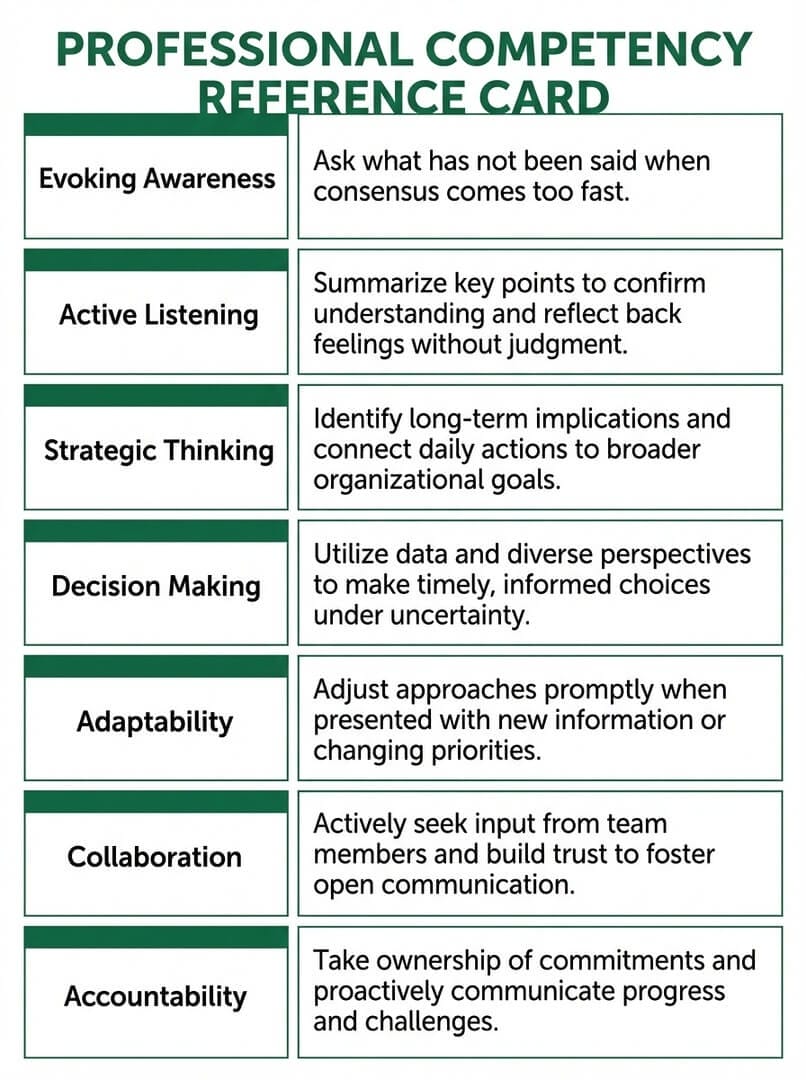
From Knowledge to Practice
Understanding the competencies and demonstrating them in a live team coaching session are separated by hundreds of hours of practice. Reading about presence doesn't prepare you for tracking eight people's nonverbal signals while resisting the pull to follow the loudest voice. Knowing the team is the client doesn't prevent you from sliding into individual conversations during a session.
Practice is the bridge. Coaching supervision specifically for team coaching helps coaches recognize their own competency gaps in real time. Mentor coaching, ideally with an MCC-level mentor, evaluates competency demonstration against ICF standards. Both are requirements for the Advanced Certified Team Coach (ACTC) credential, which validates that a coach can demonstrate these competencies consistently.
ACTC certification is honest about what it measures. It certifies competency against ICF standards, not mastery of every team situation a coach will encounter. The credential requires an existing ACC or PCC, specific training hours, documented team coaching experience, and supervised practice. It's a professional milestone, not a finish line.
Programs like Tandem's team coaching training program integrate PCC and ACTC preparation into a single pathway, which means coaches earn both credentials from one program. For coaches already holding a PCC who want to formalize their team coaching practice, the ACTC certification pathway provides the structure.
The competencies give you the what. Years of coaching teams give you the when: knowing which competency to foreground when a team is stuck in polite dysfunction versus when they're in productive conflict that needs space. For a practitioner’s perspective on weaving these competencies together in individual and agile contexts, see Cherie’s guide on mastering ICF core competencies.
Tracking the Impact of Your Coaching
Competency development shows up in what the team does between sessions. Teams that once routed every decision through the leader start holding open dialogue without a referee. Cohesion stops depending on the coach being in the room. Sponsors begin describing the engagement as leadership development for the whole unit rather than conflict repair. Watching for those signals is part of a coach's ongoing development too: they tell you whether you are creating a safe container for the team's work or quietly becoming its crutch.
What are the ICF team coaching competencies?
The ICF team coaching competencies extend the eight core ICF coaching competencies into a team context. They cover the same areas (ethical practice, coaching mindset, agreements, trust and safety, presence, active listening, evoking awareness, and facilitating growth) but reframe each one for coaching a multi-person client system rather than an individual. The ACTC credential validates a coach's ability to demonstrate these competencies with teams.
How do team coaching competencies differ from individual coaching competencies?
The foundational shift is that the client becomes the team as an entity, not the individuals who compose it. Agreements become multi-stakeholder (sponsor, team, coach). Trust becomes the team's collective psychological safety. Presence becomes tracking multiple people simultaneously. Awareness becomes collective discovery that no individual member could see alone. The competencies describe the same coaching behaviors applied to a fundamentally different client relationship.
Do I need ACTC certification to coach teams?
No. ACTC is an ICF credential that validates team coaching competency against international professional standards. Many coaches work with teams without it. The credential demonstrates to clients and organizations that your team coaching practice meets a recognized competency benchmark, useful for differentiation, but not a legal or regulatory requirement. An existing ACC or PCC credential is a prerequisite for ACTC.
What is the biggest mistake coaches make moving from individual to team coaching?
They keep coaching individuals. Instead of treating the team as a single entity and client, they default to having one-on-one conversations within the team setting. The second most common mistake is becoming the focal point, the person everyone talks to rather than stepping outside the circle and letting the team talk to each other.
How many ICF team coaching competencies are there?
Eight, grouped into four domains, mirroring the structure of the ICF Core Competencies. Foundation covers ethical practice and coaching mindset; co-creating the relationship covers agreements, trust and safety, and presence; communicating effectively covers active listening and evoking awareness; and cultivating learning and growth covers facilitating client growth. The team coaching competencies add team-specific behavioral markers to each of these eight rather than introducing new categories.
What certification validates ICF team coaching competencies?
The Advanced Certified Team Coach (ACTC) is the ICF credential that validates team coaching competency against professional standards. It requires an existing ACC or PCC credential, dedicated team coaching training, documented team coaching experience, and supervised practice with mentor feedback. The ACTC certification pathway is how coaches formalize a team coaching practice they are already building.
Ready to Develop These Competencies?
Tandem's ICF-accredited programs include training, mentor coaching, and supervision for ACC, PCC, and ACTC credentials.
View Programs & Pricing →