
Leadership Through Change: What’s Actually Required
The COO walked into my coaching session already confident about the restructuring. She’d led acquisitions, technology pivots, market expansions—her track record earned the board’s trust. But halfway through our second session, she stopped mid-sentence. “One of my directors asked me yesterday if I actually believe this restructuring is right. I realized I didn’t have an answer that felt true.”
The question wasn’t about the business case. She could defend the rationale in her sleep. The question was about her—whether she’d processed what this change meant, what she was asking people to give up, what she herself was uncertain about. She’d spent three months planning the change but hadn’t done a day of her own work around it.
This is the gap that stalls most organizational change. Leaders assume competence transfers across contexts. It doesn’t. The capabilities that make someone an effective executive in steady-state often become obstacles when leading through change.
Key Takeaways
- Your competence in steady-state can become your biggest liability during change—do your own processing work before leading others through theirs
- Teams process at their own pace, not yours—the months you spent working through the change can’t compress into a single all-hands meeting
- Holding space for uncertainty is active leadership work, not a soft skill—it’s what separates transitions that take root from changes that stall
- Technical expertise creates a processing speed gap that looks like resistance but is actually the time people need to rebuild mental models
The Competence Trap
The executives who struggle most with change aren’t weak leaders. They’re often the strongest—the ones whose pattern of solving problems creates the expectation that they’ll solve this one too. But change isn’t a problem to solve. It’s a transition to lead people through, and that requires a different capability.
Three competencies that create success in stable environments become liabilities during organizational change—which is why building resilience for change leadership is a distinct developmental priority:
Decisive action. In steady-state, decisiveness builds confidence. During change, people need processing time. When a leader moves too quickly from announcement to execution, the organization experiences whiplash. What the leader experiences as momentum, teams experience as being rushed through something they haven’t integrated yet.
Having answers. Technical expertise builds credibility. But during change, the most important work isn’t having the right answer—it’s helping people develop their own understanding. When leaders provide all the answers, they shortcut the sense-making process teams need to go through. People can recite the talking points without believing them.
Confidence. Certainty reassures people in familiar territory. During change, pretending to have certainty when you don’t creates disconnection.
Teams can tell when a leader hasn’t worked through their own ambivalence. The dissonance between what’s being said and what’s being felt becomes the real message.
This isn’t about personality. It’s about capability that develops through practice and supported reflection—exactly what coaching for change leadership provides. Most leadership development doesn’t address this gap because it treats change as one more competency to add to the list. It’s not. It’s a context where existing competencies need modulation, and that’s harder than learning something new.
The Leader’s Own Change Journey
Most change management frameworks describe organizational stages—awareness, desire, knowledge, ability, reinforcement. Kotter lays out eight steps. Prosci maps the journey from current state to future state. What these models rarely address is the leader’s own readiness to lead through each stage.
Name Your Loss, Uncertainty, and Ambivalence
If you can defend the business case but it doesn’t feel true yet, a consult can help you identify what you still need to process.
William Bridges made a critical distinction: change is external, transition is internal. The organization goes through a change—new structure, new process, new technology. People go through a transition—they have to let go of the old way, work through the neutral zone where nothing feels settled, and eventually integrate the new. Leaders are people too. They have their own transition to complete before they can hold space for others’.
Three processing requirements most senior leaders haven’t worked through:
Their own loss. Change often means letting go of the identity, competence, or control that got them where they are. The VP who built the legacy system now being replaced. The executive whose division is being reorganized. The leader who excelled at the old way and has to learn publicly. Until they process what they’re losing, they can’t acknowledge what others are losing without defensiveness.
Their own uncertainty. Leaders are paid to provide direction. Admitting uncertainty feels like failure. But during change, genuine uncertainty is appropriate—about whether this will work, about unintended consequences, about what will be harder than expected. Making peace with not knowing everything isn’t weakness. It’s what allows honest conversation with people navigating the same uncertainty.
Their own ambivalence. Most leaders have mixed feelings about changes they’re implementing. It’s the right strategic move AND it disrupts relationships they value. It will improve outcomes long-term AND it will be painful short-term. Working through that ambivalence—not resolving it but integrating both truths—is what allows them to acknowledge complexity without undermining commitment.
Most leadership development doesn’t address this internal work. It focuses on building change leadership skills—communication, coalition building, managing resistance. Those skills matter. But they’re techniques that rest on a foundation of personal processing. You can’t lead others through change you haven’t processed yourself.
Where are you in your own change process? Before leading others, honest self-assessment matters.
Why Technical Excellence Doesn’t Transfer
Technical excellence builds credibility in steady-state by rewarding fast answers, pattern recognition, and decisive action. In change contexts, those same strengths become liabilities. Experts process information faster than their teams, mistake cognitive speed for resistance, and apply problem-solving reflexes to transitions that require tolerance for ambiguity instead.
After working with dozens of organizational changes, three patterns show up repeatedly:
The problem-solving reflex. The most accomplished problem-solvers struggle most during change. They’ve built careers on diagnosing issues and implementing fixes. When people resist or hesitate, their instinct is to treat it as a problem to solve. But resistance during change usually isn’t a problem to fix—it’s information. What people are concerned about, what they’re afraid of losing, what hasn’t been adequately addressed. Leaders who move immediately to “overcoming resistance” miss the data that would make adoption more effective.
The expertise trap. Deep technical knowledge creates credibility in steady-state. During change, it can create isolation. Experts process new information faster because they have frameworks to integrate it into. They underestimate what others need to learn because they’ve already done the cognitive work. I’ve watched technically brilliant executives get frustrated when their teams “don’t get it” after one explanation—not recognizing that expertise creates a processing speed gap that feels like resistance but is actually just the time required to build new mental models.
The speed mismatch. Senior leaders typically hear about changes months before announcement. They sit in the decision rooms, see the analysis, work through the trade-offs. By the time they announce, they’ve processed through awareness, understanding, even some acceptance. Then they’re surprised when the organization can’t get on board in a week.
The gap isn’t commitment—it’s processing time. What took the leadership team three months to work through, they expect the organization to absorb in three meetings.
None of this is incompetence. These are capable leaders applying patterns that work in other contexts. The capability gap is specific: leading people through transition requires tolerating ambiguity, holding space for processing, and modulating strengths that normally serve them well. That’s not intuitive. It develops through experience, reflection, and coaching support focused specifically on this context.
The Emotional Labor of Holding Space
Holding space during change means staying present while people process loss, uncertainty, and ambivalence — without rushing them, dismissing concerns, or moving prematurely to solutions. It is active, skilled work. Leaders who haven’t done their own processing first cannot hold space for others without collapsing into false reassurance or impatient pushing.
The gap between technical competence and change leadership becomes visible in specific moments. Three composite scenarios I’ve seen repeatedly:
The dismissive response. An engineering director raises a concern about implementation timelines during a sponsor meeting. The executive responds, “We’ve addressed that in the project plan,” and moves to the next topic. Technically accurate—the plan does account for timeline risk. But the director wasn’t asking whether it had been considered. He was testing whether his concerns would be heard. The entire team watching that exchange concluded their concerns won’t be. One dismissive moment just taught the organization that raising issues is futile.
The town hall that backfired. A CEO delivers a polished presentation about the restructuring—clear vision, compelling rationale, professional delivery. During Q&A, someone asks about job security. The CEO gives a hurried answer about “right-sizing for market conditions” and quickly moves to the next question. The content was true, but everyone in the room heard the discomfort. What they learned wasn’t the answer—it was that the question made leadership uncomfortable, which tells them the real answer is worse than what’s being said.
The skip-level revelation. A VP conducts skip-level meetings to gauge change adoption. The directors repeat the talking points flawlessly. She’s pleased until one director admits, “I can explain why this makes sense for the company, but I haven’t figured out yet how to explain to my team why their work will be different and better.” The entire leadership layer had confused communication with enrollment. They’d distributed the message without integrating the meaning.
Each scenario reveals the same pattern: leaders who haven’t done their own processing work can’t hold space for others to do theirs.
Holding space isn’t passive. It’s the active work of staying present while people process—without rushing them, dismissing their concerns, or moving prematurely to solutions.This is the hardest emotional labor in change leadership, and the capability that distinguishes leaders who guide successful transitions from those who announce changes that never fully take root.
What does it look like when coaching for difficult conversations develops this capability? Leaders learn to hear the question behind the question, to recognize when silence means processing versus resistance, and to modulate their own need for closure.
Coaching as Development Path
Change leadership capability isn’t taught in MBA programs. It isn’t covered in most leadership training. According to the International Coaching Federation, fewer than 4% of credentialed coaches hold the Master Certified Coach credential—the level that represents coaching hundreds of clients through complex transitions and developing the pattern recognition that comes only from sustained practice.
The capability develops through experience plus reflection plus real-time practice in context. This is what MCC-led executive coaching provides that methodology training doesn’t:
Processing support for the leader’s own reactions. Before you can help your team work through their ambivalence, you need space to work through yours. Coaching creates that container. Not to resolve the tension or make it comfortable, but to develop your capacity to hold complexity. When a leader has processed their own mixed feelings, they can acknowledge the organization’s without becoming defensive.
Real-time capability development during actual change. Leadership development that happens in a classroom stays theoretical. Coaching happens in the context where you need the capability—preparing for the difficult conversation, debriefing the meeting that didn’t go as planned, recognizing when your instinct to push is exactly the wrong move. This is where capability becomes integrated, not just intellectually understood.
System-level perspective. Most leaders are inside the system they’re trying to change. This is where executive team coaching provides a structured intervention—an MCC coach has supported organizational transitions across industries, business models, and change types. That pattern recognition shows you what you’re not seeing—the dynamics you’re too close to notice, the signals the organization is sending that you’re missing, the places where your own processing gap is creating bottlenecks.
MCC-level coaches bring something beyond years of experience: developed capability to work at the level of what enables change, not just what describes it. This is coaching through organizational change, and it’s fundamentally different from consulting that tells you what to do or training that teaches you frameworks.
The question isn’t whether you need coaching or methodology. You need both. Change management frameworks provide structure and process rigor. Coaching develops the human capability that makes those frameworks executable. It’s AND, not OR. Most organizations invest heavily in the methodology and wonder why adoption still stalls. They’ve optimized the what without developing the who.
This is leadership development for change context. Not leadership development in general, but the specific capabilities required when context demands holding space, tolerating uncertainty, and processing complexity before asking others to do the same.
What Change Leadership Actually Requires
Change leadership requires doing your own work before asking others to do theirs — processing personal loss and uncertainty, tolerating ambiguity without performing confidence, and reading silence as an invitation to explore rather than a signal to push. These are specific, developable capabilities that distinguish transitions that take root from changes that stall.
The difference between default leadership and change leadership shows up in daily decisions, not just the launch event.
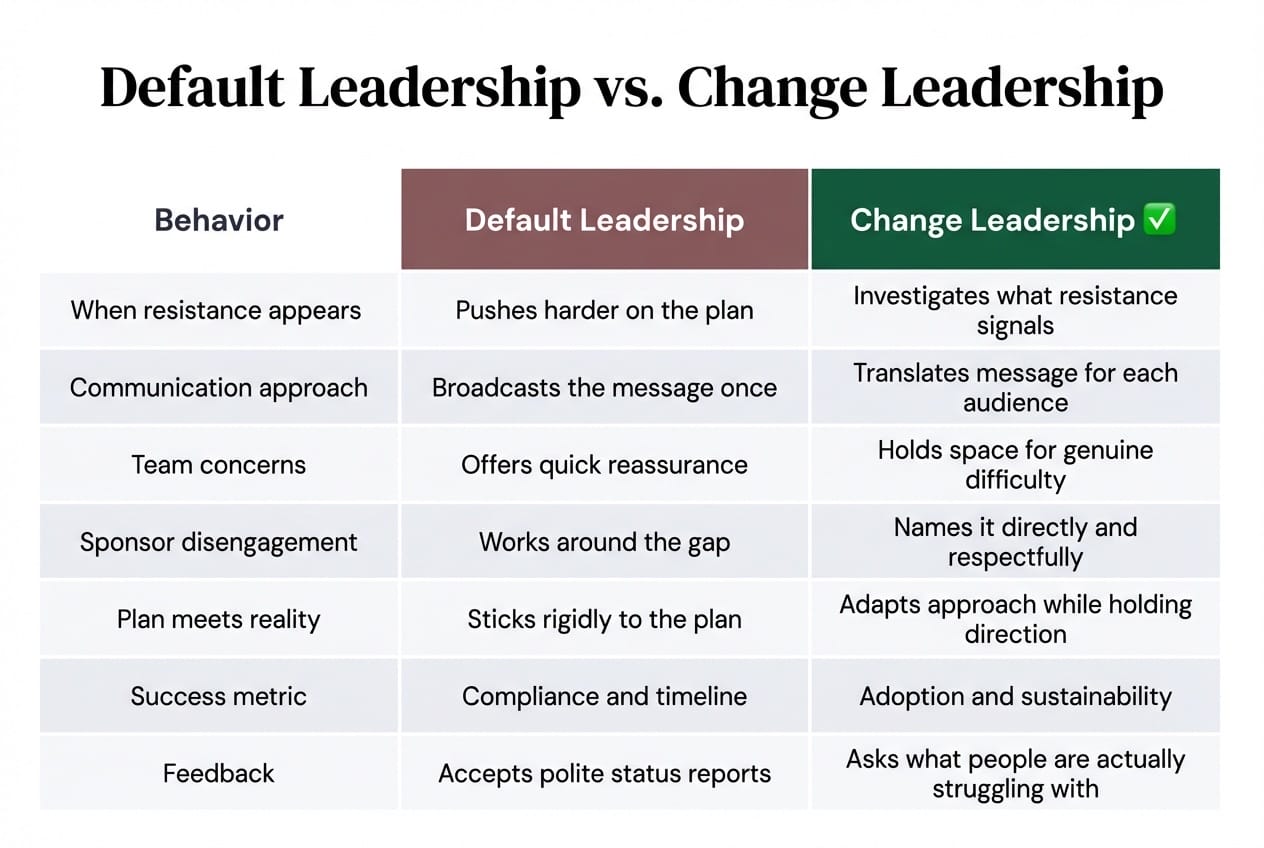
| Default Leadership Approach | Change Leadership Capability |
|---|---|
| Announce with confidence | Announce with conviction and acknowledge complexity |
| Have all the answers | Have some answers, admit genuine uncertainty about others |
| Move quickly | Match pace to organizational processing capacity |
| Interpret silence as acceptance | Read silence as requiring exploration |
| Delegate communication to the change team | Maintain personal visibility and accessibility |
| Check adoption via dashboards | Check understanding via direct conversation |
| Wonder why adoption stalled six months later | Organization changes because leader supported their transition |
The difference isn’t personality—introverts and extroverts both can develop change leadership capability. It’s not charisma or communication skill, though those help. The difference is specific, developable capability: doing your own work first, building tolerance for uncertainty, practicing the conversations that feel uncomfortable, getting feedback on what you’re not seeing, and adjusting.
What does development look like in practice? It’s the executive who realizes mid-meeting that her urgency is creating defensiveness, and shifts. It’s the sponsor who can say “I don’t know yet” without losing credibility. It’s the leader who hears resistance as data instead of obstacle. It’s the capability to hold space for processing without collapsing into either false reassurance or impatient pushing.
This capability isn’t built in a workshop. It develops through supported practice in the actual moments where it’s needed. Coaching doesn’t give you the answers—it develops your capacity to navigate the questions, hold the tension, and lead people through transitions you’re still working through yourself.
The Question Behind the Question
Leading through change demands a different capability than leading in steady-state. Do your own work first — process your own loss, uncertainty, and ambivalence before asking others to process theirs. Hold space for the team’s transition without rushing them to resolution. Change is the context where helping others find answers matters more than having your own.
The question isn’t whether you’re ready to lead change. You weren’t taught this capability. The question is whether you’re willing to develop it.
Development happens through supported practice, reflection on what you’re not seeing, and coaching in the real moments where holding space feels hardest. If you’re leading significant change and recognizing gaps between what’s required and what you’ve developed, we should talk. Tandem’s MCC coaches have supported executives through transformations that tested every leadership capability they had. We don’t have a change methodology. We develop the leaders who make methodologies work.
Leading Change Without Whiplash?
Use a free consult to map where you’re pushing too fast, where uncertainty needs airtime, and what to practice next.
Book a Free Consultation →