Is Hiring an Executive Coach Worth It? Let’s Find Out!
Is hiring an executive coach worth it?
Three conditions make it worth it: the leader has genuine authority to act, the organization supports the change, and the leader is willing to be challenged. When all three are present, coaching produces measurable behavioral change. When any one is absent, you are paying for expensive conversations. Start there, not with ROI percentages.
The 700% ROI figure appears on nine out of ten executive coaching pages. It comes from a 2009 ICF/PricewaterhouseCoopers study of 2,165 coaching clients who self-reported the value they received. People who already decided coaching was worth the money said it was worth the money. That is directional evidence, not the number a VP of People should present to the CFO when requesting $200,000 for a coaching initiative.
The more useful question is not “what percentage return does coaching produce?” It is: what specific outcomes does coaching produce, how do you measure them before and after, and under what conditions does it fail? When you have answered those questions, the list of best executive coaches gives you credential-grounded options to evaluate. Those answers are less tidy. They are also more honest.
Key Takeaways
- The three most-cited coaching ROI studies share an attribution problem: they cannot isolate coaching’s contribution from other variables affecting executive performance.
- Coaching outcomes fall into three distinct categories (satisfaction, behavioral, and organizational), and most providers only measure the easiest one.
- The largest financial return from coaching is often the senior departure that did not happen, an outcome no ROI study captures. For CMOs specifically, where role scope and AI disruption compound that retention risk, the CMO coaching guide addresses the specific ROI drivers.
- Five identifiable conditions predict coaching failure. Naming them before an engagement saves six figures and a year of misdirected effort. For the affirmative side of that ledger, the benefits of leadership coaching documents what well-structured engagements consistently produce. Once you decide to proceed, knowing how to measure leadership development gives you the before-and-after data that turns self-reported ROI into defensible evidence.
The Research: What the Studies Actually Say
Three studies get cited in nearly every coaching ROI discussion. Each has value. Each has limits that the citations usually omit.
Manchester Inc. (2001) studied 100 executives at a single Fortune 100 company. Findings: 5.7x return on investment, with an average financial return of $100,000 per executive coached. The study combined self-reported outcomes with organizational performance data, making it stronger than pure self-report. The limitation: one company, one program, one moment in time. Generalizing from a single Fortune 100 firm to all executive coaching is a stretch the study itself does not make.
MetrixGlobal (2001/2004) studied 43 executives at one Fortune 500 firm and reported two figures: 529% ROI on tangible outcomes and 788% when intangible benefits like job satisfaction and organizational commitment were assigned dollar values. The 788% figure is the one that gets cited. The 529% figure (tangible outcomes only) is more defensible. Assigning a monetary value to “organizational commitment” introduces estimation error significant enough that the number should carry a disclaimer every time it appears. It rarely does.
ICF/PricewaterhouseCoopers (2009) surveyed 2,165 coaching clients and found a median self-reported ROI of 700%. This is the study behind the headline figure. It is also the weakest form of outcome evidence: a survey asking people who chose coaching whether they think coaching was valuable. Selection bias and perception bias are baked into the methodology.
The problem these studies share is not that the numbers are fabricated. The problem is attribution. Executive coaching rarely operates in isolation. It runs alongside role transitions, organizational changes, market shifts, team dynamics, and the executive’s own maturation. Isolating coaching’s contribution when it is one variable among a dozen is methodologically fraught. The numbers should be read as directional. Coaching probably produces meaningful returns for most executives who meet the right conditions, but the numbers are not precise accounting — and that return calculation shifts considerably when the executive is navigating the pressures documented in AI transformation of executive careers and strategic positioning for leadership roles.
The 2025 numbers update the market, not the evidence. The ICF 2025 Global Coaching Study, run by PricewaterhouseCoopers across more than 10,000 participants in 127 countries, put global coaching revenue at $5.34 billion and counted 122,974 practitioners, up roughly 17% and 15% respectively since the 2023 edition. More than half of coaching clients are now employer-sponsored. Those figures are current and they are large, but none of them measure whether coaching worked. A growing market is evidence of demand, not of return, and reading it as ROI evidence would repeat the attribution problem described above. What it does establish is that the organizations holding the budget keep renewing the spend, which is revealed preference at scale rather than a controlled result. The full breakdown sits in our coaching industry statistics.
Three Types of Outcomes Coaching Produces
The word “ROI” collapses three distinct categories of coaching outcomes into a single number. Distinguishing between them changes how you evaluate any coaching proposal.
Need an Outcome Framework That’s Defensible?
We’ll help you define satisfaction vs. behavioral vs. organizational metrics before coaching starts—so you can measure more than NPS.
| Outcome Category | How Measured | What It Tells You | Limitation |
|---|---|---|---|
| Satisfaction | Post-engagement surveys, NPS ratings, self-report | The executive valued the experience | Does not indicate whether anything changed in the organization |
| Behavioral | 360-degree feedback shifts (pre/post), stakeholder observation, decision quality | The executive changed specific behaviors others can observe | Does not confirm whether behavioral changes translated to organizational performance |
| Organizational | Direct-report retention, team engagement, decision velocity, initiative completion | The system around the executive changed, not just the executive | Almost impossible to isolate coaching from other organizational factors |
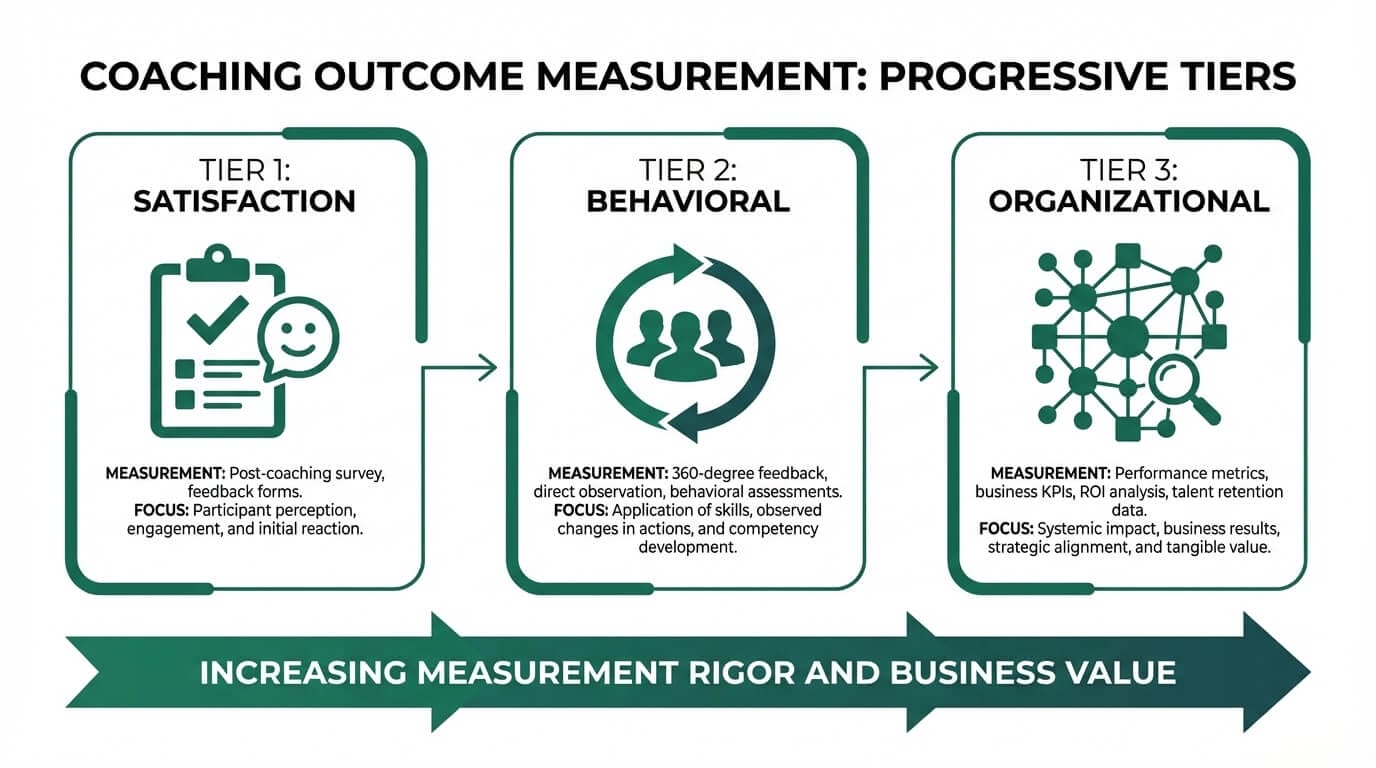

Team coaching ROI follows the same logic but compounds across the leadership group — the five executive team coaching strategies show how that multiplier works in practice. Most coaching firms measure satisfaction. It is the easiest data to collect and the least useful for building a business case. Behavioral measurement requires a pre/post assessment framework built into the engagement from the start, which means the measurement decision must be made before coaching begins, not after.
Organizational outcomes are the gold standard, but honest practitioners acknowledge that coaching contributes to these results alongside other factors. The claim is contribution, not sole causation.
When a prospect asks us what the ROI of coaching is, we ask which category they mean. For ADHD executives, emotional regulation improvements produce organizational results that cut across all three outcome categories — ADHD executive coaching covers the broader framework, and ADHD and emotional intelligence in leadership coaching maps the specific mechanism. Most have never been asked that question. The category they choose tells us more about what they actually want from coaching than any intake questionnaire. It also shapes how we design the engagement’s measurement framework from the first session. For more on setting measurable leadership development goals that connect to these outcome categories, see our executive coaching guide.
What the Research Misses: The Practitioner Counter
Published research measures what can be surveyed. Two of the most significant coaching outcomes resist quantification.
One underappreciated ROI driver is attention quality: leaders who stop context-switching make better decisions and develop reports faster. The context switching cost solutions for executives quantifies that cost in terms coaching buyers can use. The departure that did not happen. A VP who leaves over a fixable leadership challenge costs the organization 1–2x their annual salary in replacement costs plus 6–12 months of institutional knowledge loss. Coaching that retains one senior leader for two more productive years does not appear in the ROI studies. This is partly why the C-suite transition is the highest-ROI coaching moment — the cost of a failed transition dwarfs any engagement fee. After coaching 200+ executives, the pattern is consistent: the largest financial return is not the improvement. It is the departure that did not happen.
Cherie saw this firsthand with an organizational leader who had deep industry knowledge and a loyal following among employees. The board was dissatisfied with certain aspects of the executive’s approach; the executive was frustrated with the board. No succession plan existed, and the board did not have the competency to hire for a role they did not fully understand. If that executive had left, the entire company would have been in a difficult position. Coaching helped both parties find ways to communicate more productively and move forward. The organization stayed intact. That outcome does not fit into a percentage, but it was worth more than any ROI figure the engagement could have generated.
The organizational ripple. Individual coaching changes one person. When the goal is to shift team dynamics rather than one leader’s behavior, leadership team development addresses that scope directly. The signature shift happens when that change alters a team dynamic. The VP who learns to pause before reacting changes how the entire product team handles disagreement. The director who stops solving every problem changes how ten direct reports develop judgment. This is what separates coaching from training: training teaches skills to the individual; coaching changes how the individual interacts with the system. For the organizational case for the broader investment, see the overview of benefits of leadership development programs.
After coaching 200+ executives, the pattern is consistent: the largest financial return is not the improvement. It is the departure that did not happen.
What Tandem Actually Measures
Rather than citing industry statistics, here is the measurement framework we build into every engagement through our ASPIRE process.
At intake (Assess phase): Four assessments before the first coaching session. ProfileXT maps behavioral tendencies across 20 dimensions. Genos Emotional Intelligence measures six domains. 360-degree feedback collects stakeholder perspectives from direct reports, peers, and the executive’s manager. LEAD NOW! assesses leadership competency across four quadrants. Combined, these instruments identify the 3–4 development dimensions where the gap between current behavior and role requirements is largest.
At midpoint (Reflect phase): Targeted pulse checks with 3–5 key stakeholders. Not a full 360. Focused questions on the specific dimensions identified at intake. Behavioral shift tracking against the development plan.
At close (Evolve phase): Repeat 360-degree feedback on targeted dimensions only. Stakeholder interviews asking one question: what has changed in how this leader operates? Direct-report retention data at 12 months.
We do not claim to isolate coaching’s contribution from every other factor affecting performance. What we track is whether the specific dimensions we targeted at intake shifted in a direction stakeholders can observe. When measurement includes understanding what formation-aware coaching looks like, the depth of change accelerates. That is a more modest claim than 700% ROI, and it is a more honest one.
Most executives score high on analytical drive and low on interpersonal attunement on the ProfileXT. The coaching conversation about what that gap costs them in stakeholder alignment is usually the first time they have connected those two data points.
For a closer look at the tools that drive coaching outcomes, see our assessment toolkit overview. To understand how Tandem structures coaching engagements, visit our executive coaching page.
When Executive Coaching Is NOT Worth the Investment
Coaching fails under specific, identifiable conditions. When the presenting challenge is interpersonal rather than organizational, relationship coaching may be the more precise intervention. Five of them come up repeatedly. Naming them is more useful than pretending they do not exist.
1. The leader lacks genuine authority to act. If organizational constraints prevent the executive from changing how they operate, coaching creates awareness without an outlet. The result is frustration, not growth.
2. The organization is the problem, not the individual. A toxic culture, misaligned incentive structures, or a dysfunctional board cannot be fixed by coaching one person. When coaching is used as a substitute for organizational intervention, it fails, and the leader is often blamed for the failure.
3. The presenting issue is clinical, not developmental. Clinical anxiety, depression, or trauma responses require therapy, not coaching. Skilled coaches recognize this boundary. The market rarely discusses it because it conflicts with the narrative that coaching solves everything. For more on the distinction, see how executive coaching compares to life coaching and other modalities.
4. The political environment makes change impossible. If the executive’s development would threaten power dynamics the organization is unwilling to address, coaching becomes performative: safe development that does not challenge the status quo.
5. The executive is not willing to be challenged. Coaching requires hearing things you have been avoiding. When an executive uses coaching as validation rather than development, the engagement produces comfortable conversations and nothing else.
We say this in discovery conversations. If one of these five conditions is present, we recommend an alternative. For the extended discussion, see situations where coaching is not the answer.
When coaching is used as a substitute for organizational intervention, it fails. The leader is often blamed for the failure.
How to Build a Business Case for Executive Coaching
If the conditions above are not present, the next question is how to get organizational buy-in. One thing worth knowing before you walk in: employer-sponsored engagements are now the majority of the coaching market, better than half of all clients according to the ICF 2025 Global Coaching Study. You are not asking your organization to do something unusual. Four elements make a defensible business case.
Define the problem, not the solution. The business case starts with the leadership gap, not “we want to buy coaching.” Frame it: “Our VP of Product has lost two direct reports this year. Replacement cost is $180K per departure. The 360 data shows a specific pattern. We need a targeted intervention.”
Specify measurement before the engagement. Require any coaching provider to name what they will measure and how, before the first session. If they cannot articulate a pre/post assessment framework, the engagement is accountability-free.
Benchmark the cost against alternatives. Executive education programs ($15K–$50K) rarely produce individual behavioral change. Replacement hiring at the VP level costs $180K–$300K. Coaching is the targeted intervention between “do nothing” and “replace the person.” For specific pricing ranges by credential level and engagement type, see our executive coaching cost breakdown.
Set a decision point at 90 days. At three months, there should be enough stakeholder feedback and behavioral observation data to determine whether the trajectory justifies continuing the engagement. Do not commit to a full 12-month engagement without building in a checkpoint where both sides assess progress against the original goals.
Executive Coaching ROI: Common Questions
Is executive coaching worth the money?
When three conditions are met (the leader has genuine authority to act, the organization supports the change, and the leader is willing to be challenged), coaching produces measurable behavioral change in the majority of engagements. When any of those conditions is absent, it produces expensive conversations.
What is the average ROI of executive coaching?
Published studies report 529%–788% (MetrixGlobal, 2001/2004) and 700% (ICF/PwC, 2009). These figures are based on self-reported data and should be treated as directional, not precise. The methodology context matters as much as the number.
How do you measure executive coaching effectiveness?
Three categories: satisfaction outcomes (post-engagement surveys), behavioral outcomes (360-degree feedback shifts), and organizational outcomes (retention, engagement, performance metrics). The category you measure determines the quality of the answer you get.
How long before executive coaching shows results?
Behavioral shifts are typically observable within 3–4 months. Organizational outcomes require 6–12 months. Satisfaction data is available immediately but is the least useful measure of coaching effectiveness.
When is executive coaching not worth it?
When the leader lacks authority to change, the organization is the actual problem, the issue is clinical rather than developmental, the political environment blocks change, or the executive is not willing to be challenged. Any of these conditions makes coaching unlikely to produce meaningful results.
Is executive coaching worth the cost for a new or remote team lead?
Often more so. New and remote team leads face the steepest behavior-change curve: they are building authority without the in-person cues that make leadership read clearly. Coaching gives them a private space to test decisions and a faster feedback loop than learning by trial and error in front of a team. Set against one avoided mis-hire or a stalled team, the cost is small.
Before you decide whether coaching is the right investment, consider a different question: what is the cost of the current pattern continuing for another twelve months? The NLP techniques used in leadership coaching are one lens on how coaches identify and interrupt those patterns efficiently. Not in abstract terms. In the specific terms that matter to your organization: the decisions deferred, the talent lost, the strategic opportunities that went to a competitor because the leadership team could not align quickly enough. That number usually clarifies the investment question faster than any ROI study.
Build a Coaching Business Case Your CFO Buys
Bring your outcome categories, measurement plan, and 90-day decision point—we’ll pressure-test fit and ROI assumptions.
Book a Free Consultation →