
The 8 ICF Core Competencies: A Practitioner Guide
The competency that surprises people most is not active listening or powerful questioning. It is presence. Most coaches assume they already have it. That assumption is the first thing a performance evaluation surfaces. (For a full walkthrough of the credentialing process, see the ICF certification guide.)
And the competencies that get the least attention are not the ones you would expect. Coaching agreements and accountability, the parts of a session that most coaches treat as administrative bookends, turn out to be where significant coaching development actually happens. Coaches rush through them. Assessors notice.
The 8 ICF core competencies are not a compliance checklist. They are a professional framework for what coaching is, how a coaching relationship works, and what separates coaching from advising, consulting, or therapy. ICF developed them to create a shared language for what competent coaching looks like, regardless of specialty, context, or credential level—including in change management coaching contexts.
The 2025 ICF Core Competencies update refined the model with 5 new sub-competencies, 11 revisions, and one change that sparked real controversy. This article covers what each competency means in practice, what changed in 2025, and how competency expectations shift across ACC, PCC, and MCC credential levels.
Key Takeaways
- The 8 ICF core competencies are an integrated system, not a checklist. Each competency supports the others, and partial demonstration produces partial coaching.
- Presence (Competency 5) is consistently the hardest to develop and the first thing performance evaluations surface. It cannot be rehearsed with scripts or AI tools.
- Agreements and accountability are where real coaching happens, not administrative bookends. Coaches who rush through contracting miss the session’s potential before it starts.
- The 2025 update’s most consequential change: “shares knowledge” replacing “shares insights” in Competency 7. The boundary is “without attachment,” not avoidance of expertise.
- The same 8 competencies apply at every credential level. What changes from ACC to PCC to MCC is the depth of demonstration expected, not the framework itself.
What the ICF Core Competencies Are
The ICF core competencies define 8 coaching behaviors organized into 4 domains. Together they describe what a competent coach does in a session, how the coaching relationship functions, and what distinguishes professional coaching from other helping professions. ICF developed them to establish a shared professional language and a measurable standard that applies across specialties, cultures, and credential levels.
The four domains group the competencies by function:
| Domain | Competency | What It Addresses |
|---|---|---|
| A. Foundation | 1. Demonstrates Ethical Practice | Integrity, confidentiality, professional boundaries |
| 2. Embodies a Coaching Mindset | Ongoing reflective practice, self-awareness, coach development | |
| B. Co-Creating the Relationship | 3. Establishes and Maintains Agreements | Session contracting, goal-setting, relationship closure |
| 4. Cultivates Trust and Safety | Psychological safety, respect for identity and context | |
| 5. Maintains Presence | Full engagement with the client in the present moment | |
| C. Communicating Effectively | 6. Listens Actively | Hearing beyond words to meaning, emotion, and energy |
| 7. Evokes Awareness | Powerful questions, observations, sharing knowledge | |
| D. Cultivating Learning and Growth | 8. Facilitates Client Growth | Actions, accountability, integrating learning—including leadership development activities |
The original ICF model had 11 competencies. In 2019, ICF consolidated them into 8 and organized them into these 4 domains. The September 2025 update kept the same 8-competency structure but added 5 new sub-competencies, revised 11 existing ones, and introduced a comprehensive glossary of defined terms.
The distinction that matters for working coaches: the competencies are not a set of techniques to perform. They are a description of what happens when coaching works. Many coaches treat them as items on a checklist, something to demonstrate during a performance evaluation and then set aside. That approach misses the point entirely.
The competencies describe an integrated model where each behavior supports the others. A coach who demonstrates trust and safety but lacks presence is performing a partial version of coaching. Active listening without evoking awareness is empathetic conversation without coaching depth. Evoking awareness without ethical practice risks the coach imposing their own perspective. The competency framework is designed as a system, not a menu. Understanding how the 8 competencies interact is as important as understanding each one individually.
The 8 ICF Core Competencies Explained
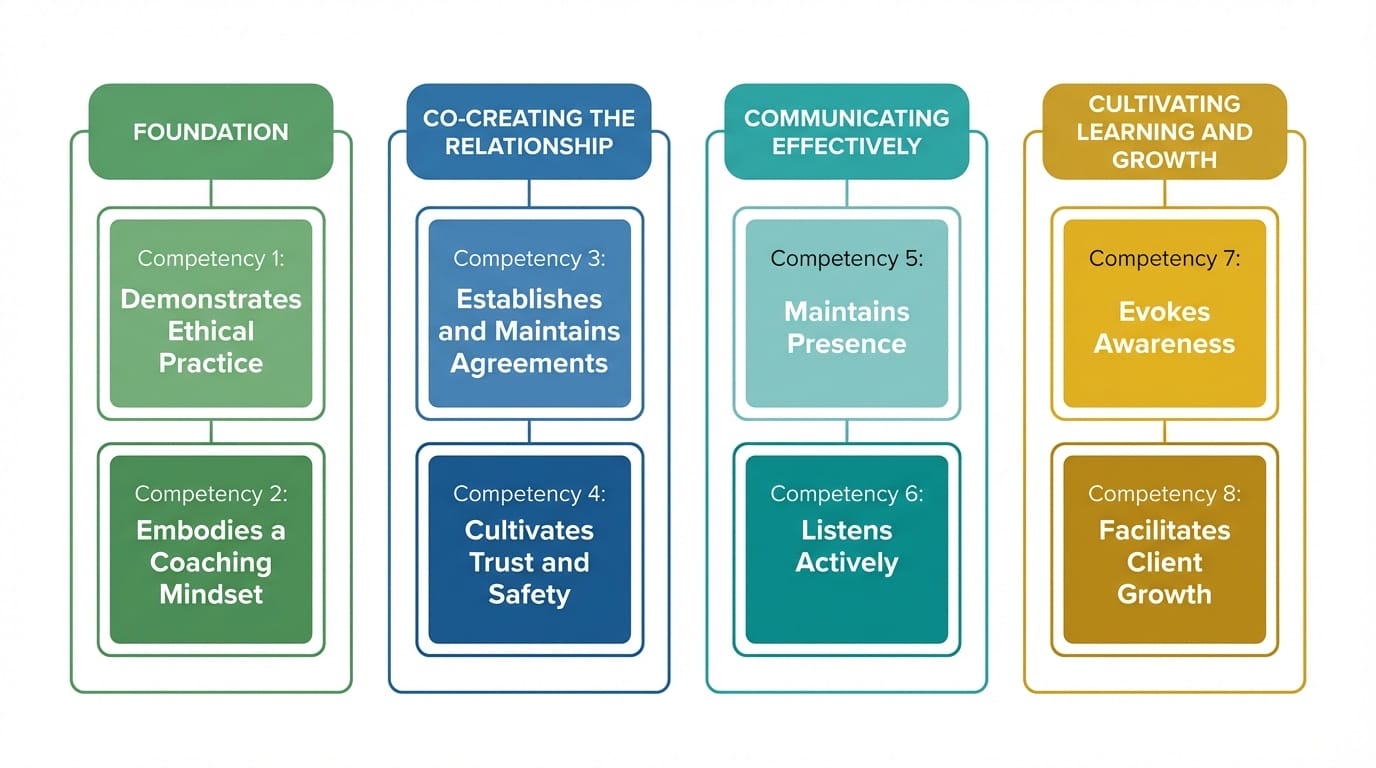
Each of the 8 competencies addresses a different dimension of coaching practice. The official definitions describe what the competency involves. What follows is a practitioner translation: what each competency means during a live coaching session, where coaches typically struggle, and how development looks at different credential levels.
1. Demonstrates Ethical Practice
Ethical practice covers integrity, confidentiality, professional boundaries, and adherence to the ICF Code of Ethics. It sounds straightforward until a real ethical situation surfaces. A client shares information about a colleague that changes what you know about the organization. A sponsor asks for details the client shared in confidence. A client develops feelings toward the coach that shift the professional dynamic.
Ethical practice is not about memorizing the Code. It is about recognizing ethical moments in real time and responding with integrity when the stakes are personal. Coaches who treat ethical practice in coaching sessions as a compliance item tend to miss the moments that actually test their ethics. The distinction between coaching, therapy, and consulting also lives here. Knowing when a client needs a referral rather than more coaching is itself an ethical skill. This competency develops through supervised practice and reflective conversations with mentor coaches, not through reading codes of conduct.
2. Embodies a Coaching Mindset
The coaching mindset requires ongoing reflective practice, self-awareness, and a commitment to the coach's own development. The 2025 update expanded this competency's definition to explicitly include working with coaching supervisors or mentor coaches and staying aware of current best practices, including the use of technology. Two new sub-competencies (2.09 and 2.10) require the coach to nurture openness and curiosity in themselves and the client, and to remain aware of how their own thoughts and behaviors influence the coaching.
In practice, this is the competency that separates coaches who are still developing from coaches who have plateaued. A coach with a strong coaching mindset notices their own reactions during a session: when they feel the pull to fix, advise, or rescue. They recognize when their assumptions about the client are driving the conversation rather than the client's actual needs. The 2025 addition of explicit bias awareness (sub-competency 2.04 now names "biases" alongside context and culture) makes this self-examination a formal requirement rather than an implicit expectation.
The expanded definition also addresses coach well-being. Marker 2.07 now extends from "mentally and emotionally prepares for sessions" to maintaining emotional, physical, and mental well-being before, during, and after each session. That expansion reflects something the profession has been slow to name: coaching is emotionally demanding work, and the coach's own sustainability is a competency issue, not just a personal one.
3. Establishes and Maintains Agreements
Agreements cover everything from the overarching coaching relationship to the individual session contract. Most coaches treat coaching agreements and contracting as the introduction and wrap-up, not as real coaching. They rush through the opening question ("What do you want to work on today?") and accept the first answer without exploring whether it is the real goal.
That instinct is wrong. Significant discovery happens during contracting. When you partner with a client to define what they actually want from a session, you are coaching. The first stated goal is rarely the real goal. A client who says "I want to work on time management" may actually need to work on saying no to their manager. A coach who accepts the first goal without exploration has already missed the session's potential. Goal-setting is coaching. Accountability is coaching. The agreement and the closing are not bookends around the real work. They are part of the real work.
The 2025 update added sub-competency 3.12: revisiting the coaching agreement when necessary to ensure the approach meets the client's needs. This codifies what experienced coaches do naturally and newer coaches often skip.
The first stated goal is rarely the real goal. A coach who accepts it without exploration has already missed the session’s potential.
4. Cultivates Trust and Safety
Trust and safety means creating the conditions where a client can be honest about what they are experiencing, including things they have not admitted to themselves. It requires sensitivity to context, culture, and identity. It requires the coach to acknowledge and support the client's feelings without judgment while maintaining appropriate professional boundaries.
The distinction that matters: trust is not the same as rapport. Rapport is comfortable. Trust is what allows a client to say something uncomfortable. A coach can build rapport in five minutes. Building the kind of psychological safety where a client will challenge their own assumptions takes longer and requires the coach to earn it repeatedly. This competency is closely linked to presence. Without genuine presence, trust becomes performative. The client can tell the difference between a coach who is truly with them and one who is following a rapport-building protocol.
The 2025 update sharpened this competency's attention to cultural context and identity. Coaches working across cultures, industries, or generational lines cannot assume that what creates safety for one client works for another. A direct communication style that feels empowering to one leader can feel confrontational to another. The updated markers ask coaches to demonstrate sensitivity to these differences rather than applying a universal trust-building approach.
5. Maintains Presence
Coaching presence is consistently the hardest competency to develop. It is the last one that clicks for most coaches. Presence means being fully engaged with the client in the present moment, remaining focused, observant, and responsive without retreating into your own agenda, technique, or assumptions.
What makes it difficult is that presence cannot be faked or rehearsed. You can memorize the definition. You can practice powerful questions until they are second nature. But presence is about what happens inside you when the client says something unexpected, when the silence gets uncomfortable, when your own assumptions get activated. Coaches who practice with AI tools or scripts develop solid mechanics, and those mechanics are valuable. But mechanics free up mental bandwidth; they do not create presence. Coaching presence in practice can only be developed with a real person in a real coaching conversation where something genuinely uncertain is happening.
The 2025 update added sub-competency 5.03: remaining aware of what is emerging for both self and client in the present moment. That addition makes explicit what presence requires at a deeper level.
6. Listens Actively
Active listening in coaching sessions goes well beyond hearing words. It means attending to what the client communicates through tone, pace, energy shifts, body language, and what they choose not to say. It includes reflecting and summarizing in a way that confirms the client feels heard without reducing their experience to a paraphrase. The 2025 update made a subtle but meaningful tense change in sub-competency 6.02: from "communicated" (past tense) to "is communicating" (present continuous), reinforcing that listening is about tracking what is happening now rather than cataloging what was already said.
The common pitfall is summarizing too much. Coaches who are anxious about silence or afraid of missing something fill the space with reflections. The client stops talking and starts confirming the coach's interpretation. That is the opposite of active listening. It shifts ownership from the client to the coach. The skill is knowing when to reflect and when to stay quiet. For many coaches, silence is more powerful than any reflection they could offer, but tolerating that silence is a skill that takes practice to develop.
When the client stops talking and starts confirming the coach’s interpretation, ownership has shifted. That is not listening. That is the coach thinking out loud.
7. Evokes Awareness
Evoking awareness combines powerful questioning with observation, insight facilitation, and the sharing of knowledge. This is the competency that sparks new understanding in the client. The coach's questions, observations, and shared perspectives create conditions for the client to see their situation differently. It is also the competency that candidates struggle with most during the credentialing exam, because they can define it fluently in the abstract but have difficulty recognizing it in realistic coaching scenarios.
The 2025 update changed marker 7.11 from "shares observations, insights, and feelings" to "shares observations, knowledge, and feelings." That single word change is the most consequential revision in the entire update. It signals that ICF recognizes what experienced coaches have always done: brought their expertise into the coaching conversation. The controversy about this change is real and worth understanding. More on that in the 2025 update section below.
8. Facilitates Client Growth
Growth facilitation covers designing actions, managing accountability, and helping clients integrate learning across sessions. This competency closes the loop that begins with agreements (Competency 3). Where agreements define what the client wants to accomplish, growth facilitation tracks whether the coaching is producing the kind of progress the client defined. The 2025 update added sub-competency 8.07 (partnering with clients to sustain progress throughout the coaching engagement) and changed the wording of 8.08 from "celebrates" to "acknowledges" the client's progress.
That shift from celebration to acknowledgment is subtle but meaningful. It reflects a move away from performative enthusiasm and toward authentic, client-centered recognition. Not all cultures express celebration the same way. Authentic acknowledgment respects the client's internal experience rather than imposing the coach's emotional response.
The 2025 ICF Competency Update: What Changed

ICF released the updated core competency model in September 2025. The structure remains the same: 8 competencies, 4 domains. The changes are at the sub-competency level, with 5 additions, 11 revisions, and one updated definition that carries real implications for how coaching is taught and evaluated.
The biggest changes:
- Competency 2 (Embodies a Coaching Mindset) received the most revisions. Its definition now explicitly includes ongoing professional development and working with supervisors or mentor coaches. New sub-competencies 2.09 and 2.10 address nurturing openness and recognizing how the coach's own thoughts and behaviors influence the client. Bias awareness is now explicit where it was previously implied.
- Competency 3 (Establishes and Maintains Agreements) added sub-competency 3.12 on revisiting the coaching agreement when necessary. Coaches are now expected to articulate their coaching philosophy (3.01), not just define what coaching is.
- Competency 5 (Maintains Presence) added sub-competency 5.03 on awareness of what is emerging for both self and client in the present moment.
- Competency 7 (Evokes Awareness) changed marker 7.11 from "shares observations, insights, and feelings" to "shares observations, knowledge, and feelings." The word "learning" was replaced with "insights" on the client side.
- Competency 8 (Facilitates Client Growth) added 8.07 on sustaining progress across the engagement and changed "celebrates" to "acknowledges" in 8.08.
The Competency 7 change drew the strongest reaction. Many coaches argued that "shares knowledge" blurs the line between coaching and consulting. The concern is understandable but misplaced. The marker still includes the phrase "without attachment," which is the actual boundary. A consultant says "here is what you should do." A coach says "here is something I have observed in similar situations. What does that bring up for you?" The knowledge enters the room. The client decides what to do with it. Coaches are hired for their life experience, professional expertise, and perspective. Sharing that knowledge from the coaching stance, with open invitation and without attachment, does not become consulting.
For coaches mid-credential who trained on the 2019 framework: the changes are meaningful but not disruptive. Review the ICF core competencies comparison document to identify where your training may need updating. The core model is the same. The sub-competency language has evolved to reflect how coaching practice has changed.
How the Competencies Connect to Certification
Systems Coach Program — $3,999
Bridge from ACC to PCC and ACTC credentials. Systems and team coaching curriculum with mentoring and supervision. Requires 60 hours of ICF-accredited training.
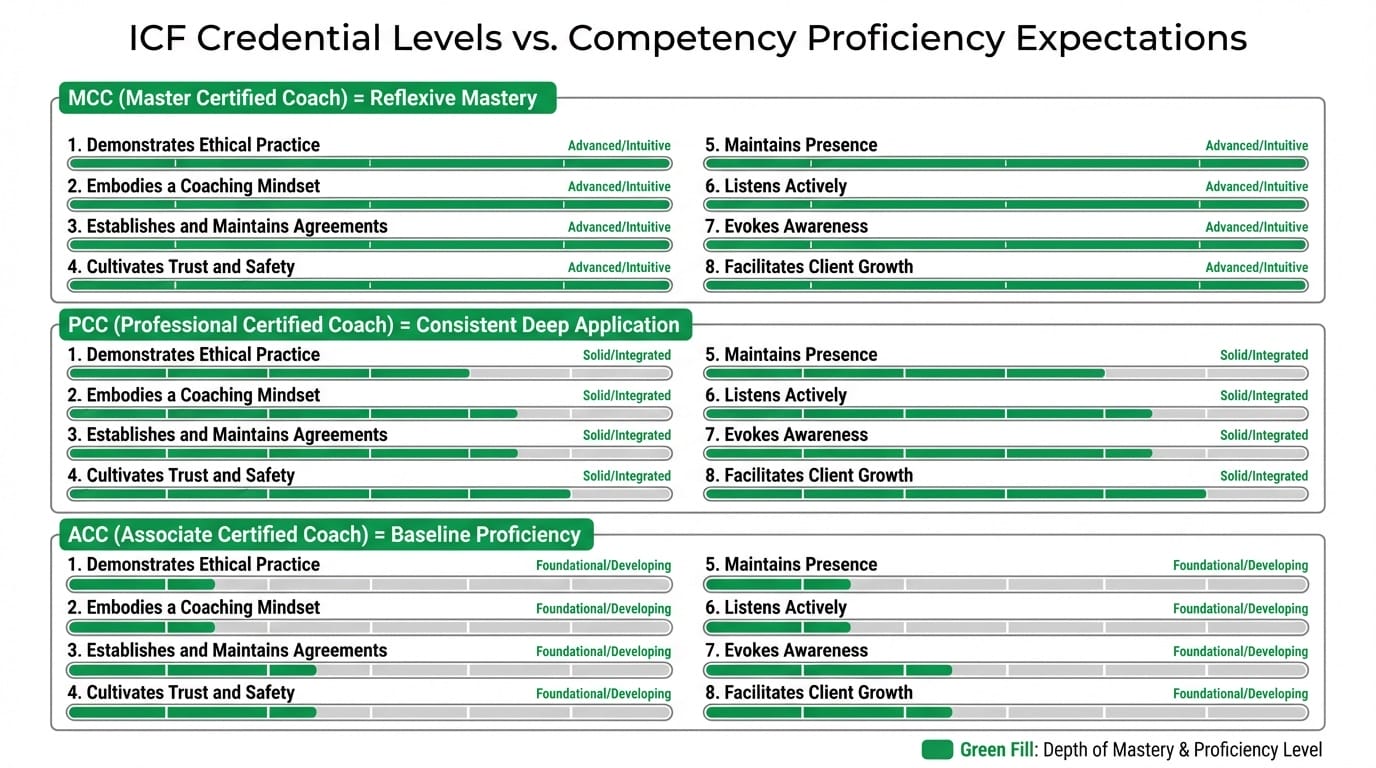
The same 8 competencies apply at every ICF credential level. What changes is the depth of demonstration expected. ACC requires baseline proficiency. PCC requires consistent, deep application measured against specific PCC Markers behavioral criteria. MCC requires that competency has become reflexive, operating without conscious effort.
For the ICF performance evaluation process, assessors review a recorded coaching session and evaluate competency demonstration against specific behavioral indicators. They are listening for evidence that the competencies are present in the coaching, not that the coach can name them. A coach might ask a textbook powerful question, but if they ask it because it was next on their mental checklist rather than because it emerged from genuine curiosity about what the client just said, an experienced assessor hears the difference.
Passing recordings show the coach tracking the client, not their own process. The questions follow the client's energy. The coach responds to what is actually happening in the conversation. There is genuine silence, not coached silence where the coach is counting to five internally, but real space where the coach trusts the client to think.
Failing recordings share consistent patterns. The coach drives toward a predetermined outcome. The agreement section is thin. The closing is perfunctory. The most common marker for insufficient demonstration: the coach talks too much. Not sharing knowledge or observations, but filling space, summarizing what the client already said, or offering reassurance instead of holding space for discomfort.
The credentialing exam tests a related but different skill. It is a recognition question, not a knowledge question. The exam asks whether you can identify competent coaching in realistic scenarios, not whether you can produce it under pressure. Candidates who can define "Evokes Awareness" fluently often struggle to select the correct response when reading a coaching scenario. That distinction changes how you study. ICF credentialing exam preparation built around realistic scenario practice outperforms flashcard-based memorization of competency definitions.
How to Develop the Competencies
The gap between knowing a competency definition and demonstrating it in a live session is the central challenge of coach development. Every coach can describe “Maintains Presence.” Fewer can maintain it when a client says something that activates their own assumptions. Coaching hours are development opportunities, not boxes to check.
Mentor coaching is where competency feedback actually lands. A mentor is not evaluating whether you know the competencies. They are evaluating whether your coaching changes when you know someone is watching. The gap between coached performance and actual coaching is what mentor coaching is designed to surface. When a mentor coach gives you feedback that your agreement section was thin or that you filled a pause where the client needed space, that observation is specific, situated, and harder to ignore than any textbook insight. That feedback loop does more for competency development than any amount of independent study.
A mentor is not evaluating whether you know the competencies. They are evaluating whether your coaching changes when you know someone is watching.
AI practice tools have a specific role. They develop mechanics: question formation, reflection techniques, paraphrasing. Those mechanics are valuable because they free up mental bandwidth. But coaching presence cannot be practiced without a real person. Neither can the ability to tolerate silence, to track a client's energy shifts, or to hold complexity without rushing to simplify. These skills require a human partner.
The development arc is nonlinear. Some competencies click early. Ethical practice and active listening tend to be accessible for most coaches from the beginning. Agreements and accountability develop through intentional practice once coaches stop treating them as administrative steps. Presence and evoking awareness take the longest, often not fully developing until well past the initial credential. Competency development is not a checklist that proceeds in order from 1 to 8. A coach might demonstrate strong active listening from day one but spend years working on presence.
Peer coaching practice groups complement mentor coaching by providing a lower-stakes environment to experiment. Trying a new approach to contracting or deliberately sitting with longer silences is easier when the person across from you is a fellow learner rather than a client or evaluator. The combination of peer practice for experimentation and mentor coaching for calibrated feedback produces faster development than either approach alone.
For coaches applying competencies outside one-on-one sessions, the framework adapts to different contexts. Coaching skills for organizational change draw heavily on presence, trust-building, and evoking awareness. Coaching strategies grounded in ICF competencies emphasize agreements and growth facilitation. The 8 competencies are the foundation; how they express depends on context.
Frequently Asked Questions
How many ICF core competencies are there?
ICF defines 8 core competencies organized into 4 domains: Foundation, Co-Creating the Relationship, Communicating Effectively, and Cultivating Learning and Growth. The original model had 11 competencies; ICF consolidated them into 8 in 2019 and updated the sub-competency language again in September 2025. The 4-domain, 8-competency structure applies across all credential levels.
What changed between the old and new ICF competencies?
The 2025 update added 5 new sub-competencies, revised 11 existing ones, updated the definition of Competency 2 (Embodies a Coaching Mindset), and introduced a glossary of defined terms. The most discussed change: Competency 7 (Evokes Awareness) now says "shares knowledge" where the previous version said "shares insights." The 8 main competencies and 4-domain structure remain the same.
Which ICF competency is hardest to develop?
Maintains Presence (Competency 5) is consistently the last to develop and the one performance evaluations surface first. Presence cannot be rehearsed or faked. It requires the coach to stay fully engaged with the client in real time without retreating into technique, assumptions, or agenda. AI practice tools build coaching mechanics but cannot develop the kind of presence that only real human coaching conversations produce.
Are the ICF core competencies the same for ACC and PCC?
The 8 competencies are identical across every credential level. What changes is the depth of demonstration expected. ACC requires baseline proficiency: the coach shows that they understand and can apply each competency. PCC requires consistent, deep application measured against specific PCC Markers. MCC requires competency to operate reflexively, without conscious effort. Same framework, rising standards.
ACC Certification — $3,999
60+ training hours, mentor coaching, and supervision included. Everything ICF requires for your Associate Certified Coach credential.
See ACC Program Details →