
12 Executive Presence Exercises by Gap Type
Most executive presence advice stops at tips. Make eye contact. Project confidence. Speak with authority. These are not wrong. They are unactionable. A tip tells you what to be. An exercise tells you what to practice, how to practice it, and how to know when it is working.
Below are 12 exercises organized by the type of presence gap they target: expression (strong thinking that stays invisible), authority (compensating through volume instead of commanding through selectivity), and context (a style that does not match the culture). Each includes a solo protocol and a behavioral indicator so you can measure change instead of guessing at it.
Key Takeaways
- Effective presence exercises target a specific gap type, not generic “confidence” or “body language.”
- Expression gap exercises make internal processing visible to stakeholders who currently experience detachment.
- Authority gap exercises replace proving behaviors with strategic restraint that increases the weight of every contribution.
- Context gap exercises build the ability to read and adapt to different organizational definitions of presence.
- Behavioral change happens in weeks, but perception change takes quarters. Measure both.
Expression Gap Exercises: Making Your Thinking Visible
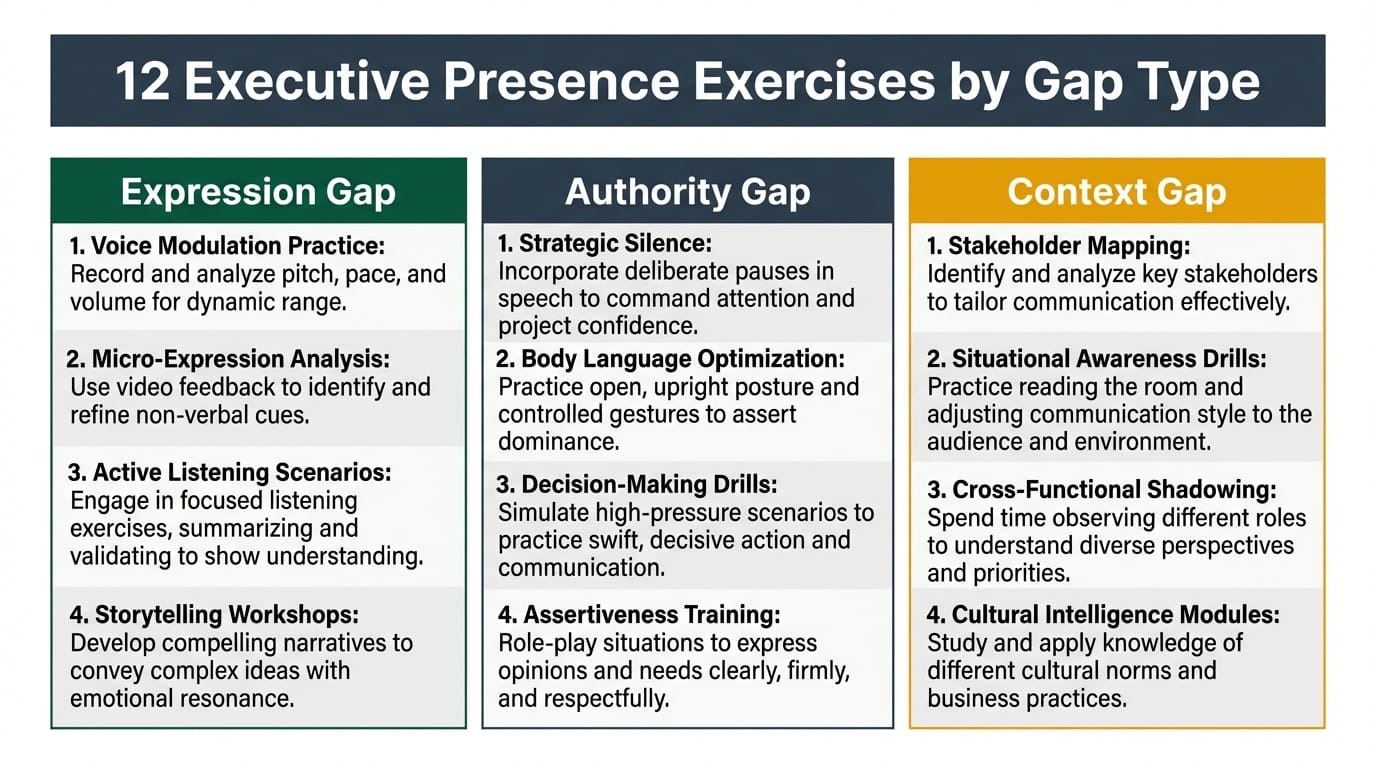
These four exercises target the most common assessment finding: leaders who process deeply but display little. Their teams experience detachment where the leader experiences engagement. The gap is not about thinking quality. It is about thinking visibility. These exercises work within the ACE Framework categories that 360-degree feedback reveals when self-reported awareness and observed communication diverge.
1. Thinking-Out-Loud Protocol
Targets: The gap between reasoning and its visibility. You reach strong conclusions, but others only see the output.
Choose one decision per day that you would normally announce as a conclusion. Instead, narrate your reasoning for 60 seconds: the context, the options you considered, and why you chose this path. Do this in a standing meeting, not a prepared presentation.
Measurement: Within two to three weeks, listen for stakeholders paraphrasing your reasoning in their own communications. When your logic shows up in someone else’s explanation, the expression gap on that topic has closed.
2. Decision-Narration Practice
Targets: Announcing conclusions without the reasoning path. Teams experience this as autocratic even when the analysis is sound.
For one week, end every significant decision with two sentences: “I chose this because...” and “What I considered and set aside was...” Apply this to written communication too: emails, Slack messages, project updates. The practice forces externalized reasoning in contexts where speed usually wins.
Measurement: Track follow-up questions on your decisions. A shrinking question count means your reasoning is landing the first time.
3. Emotional Expression Calibration
Targets: The mismatch between what you feel about a message and what your face communicates. Leaders with high emotional awareness but low display often deliver critical feedback with a neutral expression, which receivers read as indifference.
Record yourself delivering three message types: positive recognition, constructive feedback, and a strategic recommendation. Watch with the sound off. Can you tell which is which from facial expression and posture alone? Most leaders with an expression gap cannot. Adjust by 10 to 15 percent. Record again.
Measurement: After a month, ask two trusted colleagues whether your delivery has started matching your message. Specific feedback (“I could tell you were pleased about Q3”) signals calibration is working.
4. Silence-Reading Drill
Targets: The reflex to fill silence with more content. Leaders with expression gaps misread room silence as disagreement when it is processing time.
In your next five meetings, when silence follows something you said, wait seven full seconds. Observe: Are people looking at notes? Nodding slowly? These are processing signals, not objection signals. After each meeting, write down what happened during the silences. Over five meetings, you will start distinguishing processing silence from confused silence from uncomfortable silence.
Measurement: You stop filling productive pauses with elaboration. Team members contribute more after your statements because you gave them space.
Your team does not experience your reasoning. They experience your silence.
Authority Gap Exercises: Occupying the Role You Already Have
These four exercises address the proving pattern: leaders who compensate with volume. They add to every conversation, prepare elaborately for every meeting, and argue positions when the role requires asking questions.
Turn Proving Into Strategic Restraint
If your airtime, ask-to-tell ratio, or delegation discipline keeps slipping, a quick consult can help you pick the highest-leverage protocol.
5. Speaking-Less-Saying-More Practice
Targets: Over-contribution. If you speak in every agenda item, the room stops weighing your input.
For two weeks, contribute on no more than half the topics in any meeting where you are not the primary decision-maker. When you do speak, cut your typical word count by a third. One clear statement per topic instead of several supporting points.
Measurement: Ask a peer to observe one meeting and note whether the room’s attention shifts when you speak. If people lean in, restraint is working.
6. Delegation Authority Script
Targets: Delegating tasks but retaining decision authority, which signals to observers that you do not trust your people.
Pick one decision per week and delegate it fully. Use this script: “This is your call. Here is the context I would consider. I will support whatever you decide.” Then do not revisit it unless asked. The script is simple. The discipline is not. Leaders with authority gaps frequently delegate and then check in, which undoes the transfer.
Measurement: After four weeks, count how many delegated decisions you revisited versus how many ran to completion. A decreasing revisit rate means you are occupying a senior role instead of performing a supervisory one.
7. Meeting Contribution Audit
Targets: An inaccurate self-assessment of how much you dominate conversations. Most proving leaders underestimate their airtime by 30 to 50 percent.
Across five meetings, track three things: how many times you spoke, whether you asked or told, and whether you facilitated or directed. An ask-to-tell ratio below 1:1 at senior levels often correlates with stakeholder feedback about “not listening” or “always having to be the smartest person in the room.”
Measurement: A shift in the ratio across four weeks. More questions, fewer declarations, more facilitation of other people’s contributions.
Authority exercises address how you occupy your role, not how confident you feel. A leader who scores high on confidence assessments can still show an authority gap if they compensate through proving behaviors. The target is behavior, not belief.
8. Expertise-Restraint Protocol
Targets: The reflex to demonstrate competence by having the answer. At senior levels, always having the answer signals you are still operating as an individual contributor.
In your next ten problem-solving interactions, respond with a question before offering a solution: “What options are you considering?” or “What would you recommend?” Hold your expertise for situations where only you have the context. This aligns with the ICF core competency model principle that powerful questioning develops capability, which is what senior presence requires.
Measurement: Within three weeks, team members start bringing recommendations instead of problems. The shift from “What should I do?” to “Here is what I think, does this track?” means the protocol is working.
The room stops weighing your input the moment you contribute to every conversation.
Context Gap Exercises: Reading and Adapting to the Room
These four exercises address the culture mismatch pattern: effective leaders whose style gets penalized after a role change or a company move. 360-degree feedback for these leaders shows split ratings that map to subcultural boundaries, not behavioral inconsistency. The leader did not change. The audience did.
9. Organizational Culture Read
Targets: Operating on default style instead of reading what the environment rewards. Leaders with context gaps are often measured against an implicit template they did not know existed.
Before your next three high-stakes meetings, answer three questions in writing: What communication style does this group reward? Who has presence here and what do they do differently? What behavior would get penalized here that works in another context? Five minutes of preparation trains you to read the room before performing in it.
Measurement: After each meeting, note whether your preparation matched reality. Within a month, you should predict cultural norms before walking in.
10. Stakeholder Mapping for Presence
Targets: The assumption that presence means the same thing to every audience. Your board, your direct reports, and your peers define effective leadership differently.
List your five most important stakeholders. For each, write one sentence describing what they consider “strong presence.” Your CFO might value brevity and data. Your CHRO might value listening. Your board chair might value certainty and forward vision. Compare: are you delivering the same style to all five?
Measurement: Choose two misaligned stakeholders and adjust for four weeks. Improved feedback from those specific people confirms mapping translated into behavioral flexibility.
11. Style-Switching Practice
Targets: Rigidity. Leaders with context gaps have one effective mode and deploy it everywhere.
Identify two meetings in the same week that require different styles (a board update and a team brainstorm, for example). Before each, write three words describing the leadership style that room expects. After each, rate yourself: did your style match? The point is not performing a different personality. It is adjusting within your authentic range.
Measurement: Track self-ratings over four weeks. An upward trend means you are reading context and adjusting before feedback tells you something went wrong.
12. Feedback-Seeking Protocol
Targets: The absence of real-time perception data. Leaders with context gaps rely on annual or quarterly reviews instead of continuous feedback.
After two interactions per week (one peer, one direct report), ask: “How did I come across in that conversation?” Not “How did the meeting go?” which invites content feedback. The question targets presence specifically. Accept the answer without defending. Write it down.
Measurement: Accumulate eight to ten data points per month. When feedback converges on consistent themes, you have found the perception pattern. When those themes shift, the exercises are working.
How to Build an Exercise Routine
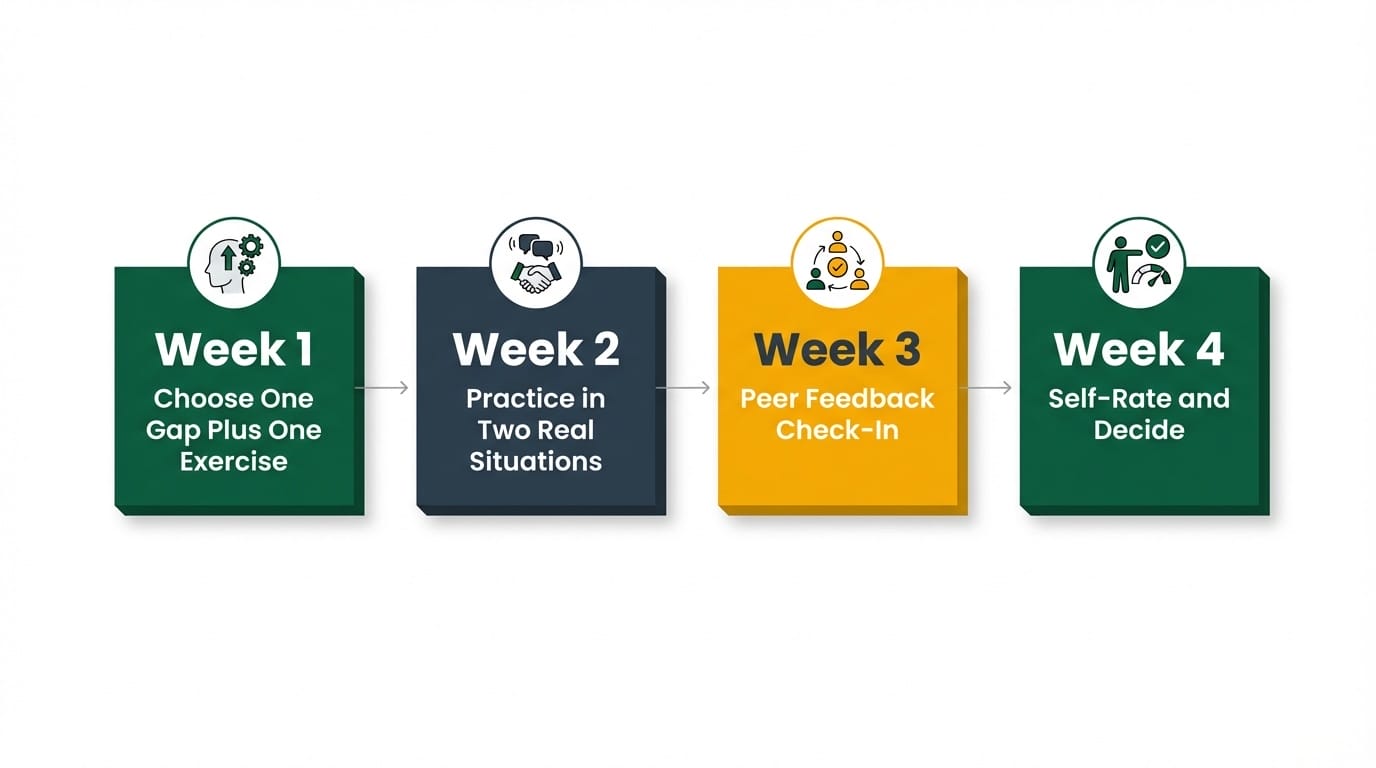
An executive presence assessment reveals which gap type to prioritize. Without assessment data, start with the pattern matching your most recent feedback. If people say you are hard to read, start with Expression. If they say you dominate or over-prepare, start with Authority. If your feedback changed when you changed roles, start with Context.
Pick one exercise. Practice it in real work situations for four weeks. Rate yourself weekly (1 to 5 on protocol execution in at least two situations). Monthly, ask one peer whether they have noticed any change. This external check matters because developing executive presence means closing the gap between behavior and perception, and only outside observation confirms whether perception is shifting.
Be realistic about timelines. Surface behaviors (speaking patterns, contribution frequency, posture) shift within two to four weeks. Perception takes one to two quarters. The room’s story about who you are updates slowly. Leaders who quit after three weeks because “nothing changed” are measuring the wrong thing.
Once one exercise produces measurable results, add a second from a different gap type. These exercises complement other leadership development activities and pair well with executive presence coaching for structured accountability and assessment-driven targeting.
Frequently Asked Questions
What are the best exercises for executive presence?
The best exercises depend on your gap type. Expression gap exercises (like the Thinking-Out-Loud Protocol) work for leaders whose reasoning is strong but invisible. Authority gap exercises (like the Meeting Contribution Audit) work for leaders who over-contribute. Context gap exercises (like the Feedback-Seeking Protocol) work for leaders whose style does not match their environment. Start with the gap that matches your most recent feedback.
How often should you practice executive presence exercises?
Daily practice in real work situations produces the fastest results. Choose one exercise and apply it in at least two interactions per week for four weeks before adding a second. Weekly self-rating and monthly peer check-ins create the feedback loop that keeps practice on track.
Can body language exercises improve executive presence?
Body language contributes to presence, but isolated drills rarely produce lasting change. The Emotional Expression Calibration exercise integrates body language into a broader Expression gap protocol where posture and facial expression serve a communication purpose. Body language works when it is part of a gap-specific exercise, not practiced in a vacuum.
How long does it take for presence exercises to change how others perceive you?
Behavioral change happens in two to four weeks with consistent practice. Perception change takes one to two quarters. The delay exists because the people around you have an established narrative about your leadership style, and that narrative updates slowly even when behavior shifts quickly. Measure both: track behavior weekly and perception monthly.
The difference between a tip and an exercise is a protocol and a measurement. Generic advice says “be more confident.” A gap-typed exercise says which behavior to change, gives you a repeatable drill, and tells you how to know it is working. Start with one exercise from the gap type that matches your feedback. Measure for four weeks. If the behavioral indicator does not appear, the exercise may be targeting the wrong gap, which is exactly what assessment data clarifies.
Not Sure Which Gap Type You Have?
Book a free consult and we’ll pinpoint your presence pattern from recent feedback, then choose the 1 exercise to run for 4 weeks.
Book a Free Consultation →