
Executive Presence Examples: What Coaches See in Practice
You have read the definitions. You know that executive presence involves confidence, communication, and composure. Now you want to know what it actually looks like in a meeting room, in a board presentation, in a crisis—and what it looks like when it is missing.
The challenge with most executive presence examples is that they describe traits, not behaviors. “Projects confidence” or “commands respect” tells you what the endpoint should look like without showing you the path from here to there. The examples in this article work differently. They are drawn from coaching practice, organized around the specific types of presence gaps that assessment data reveals, and designed to help you recognize your own situation rather than an idealized version of someone else’s.
Strong executive presence and its absence share one underlying mechanism: the gap between how a leader intends to show up and how people experience them. Understanding that gap (which dimension it falls in, what drives it, and what coaching addresses) turns abstract feedback into a development plan.
Key Takeaways
- Executive presence is a perception gap: the distance between a leader’s intentions and how people experience them in the room.
- Strong presence examples share a common pattern: the behavior matches what the audience needs in that specific context.
- Four failure patterns appear consistently in 360-degree assessment data: the Invisible Thinker, the Over-Preparer, the Culture Mismatch, and the Proving Leader.
- EP expectations change at each organizational level. A leader who demonstrates strong presence as a VP may struggle at the C-suite because the definition shifted.
- Some “lack of executive presence” feedback reflects the organization, not the individual. Assessment determines which one requires the work.
What Strong Executive Presence Looks Like
Strong executive presence is recognizable not by how loudly a leader speaks but by how precisely they read what the moment requires. Real coaching contexts reveal four behavioral patterns: what strong presence looks like in action, where the gaps appear in assessment data, and what the coaching work addresses in each case.
The Board Presentation
A VP of Operations presents quarterly results to a board that has seen twenty versions of this report. Other presenters cycle through slides quickly, filling silence with narration. This leader does not. She opens with three sentences about the one number that changes the conversation, sets her notes aside, and addresses the room directly. Her body language is settled—weight evenly distributed, eye contact that moves deliberately from person to person, not scanning the room in search of approval. When a board member interrupts with a skeptical question, she pauses before answering. Not to think through an unfamiliar problem, but to signal that the question has weight. The pause itself carries authority.
This is the expression dimension of presence: making internal confidence visible through deliberate behavior. The board reads it as command, though the word is never used.
Crisis Communication
A supply chain crisis hits during a peak operational period. The executive team is moving fast, with competing priorities, vendor escalations, and customer pressure pulling in different directions. The operations leader does the opposite. She slows down. In the crisis meeting, she is the first to stop talking and the last to propose a solution. Active listening is visible: she summarizes what each person said before responding, asks one clarifying question that reframes the problem, then lays out a decision framework in two minutes. Her calm does not read as disengagement. It reads as the authority of someone who has seen this before.
This is the authority dimension: the leader who does not need to fill every silence or solve every problem because the room already knows their analysis will be worth waiting for.
Cross-Functional Influence
A product leader needs alignment from legal, finance, and marketing on a launch timeline. She has no authority over any of these functions. In the meeting, she does not use the weight of her title or her relationship with the CEO. She maps the impact of the decision on each stakeholder’s real priorities (risk exposure for legal, budget cycle for finance, campaign timing for marketing) and presents options that make alignment genuinely easier than resistance. The influence lands not because of confidence but because of precision.
This is the context dimension: reading what each audience needs and delivering exactly that. Targeted exercises for each gap pattern can build it systematically.
Virtual Town Hall
The CEO of a 2,000-person organization runs a quarterly virtual town hall. Her camera angle places her eyes at the top third of the frame. She speaks to the lens, not the chat window or her notes. Her pacing is ten percent slower than conversational, a deliberate adjustment for a medium that flattens energy. When she pauses for questions, she reads the question aloud before answering, giving remote attendees who missed it a second chance to follow. These are not performative adjustments. They are context adaptations: behaviors calibrated to the specific constraints of a mediated channel where presence signals are compressed and easily lost.
The pause before a hard question often carries more authority than the answer.
Four Failure Patterns That Reveal Presence Gaps
When leaders receive “lack of executive presence” feedback, the phrase covers several different underlying patterns. Four appear consistently in 360-degree assessment data. Each maps to a distinct gap in the ACE assessment framework, and the coaching approach that addresses one is not the approach that addresses another. Acting on the wrong one does not close the gap.
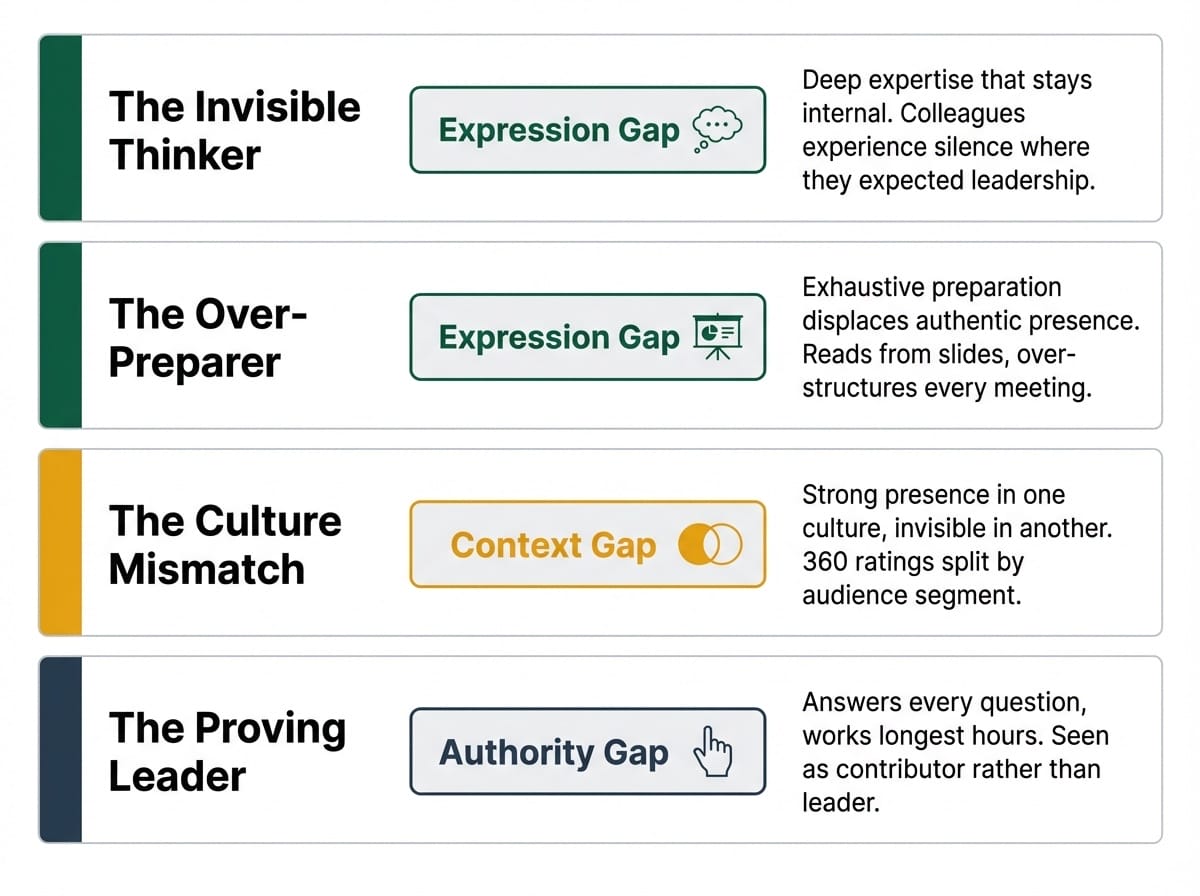
The Invisible Thinker (Expression Gap)
The feedback arrives in performance reviews and promotion decisions: “brilliant but not visible,” “needs to step up,” “doesn’t command the room.” Colleagues experience this leader as withdrawn or disengaged in meetings, even as they rely on her analysis in every strategic document the team produces.
The Invisible Thinker processes deeply and displays little. The thinking is rich; the expression is minimal. She reaches strong conclusions and announces them without narrating the path. She observes a meeting dynamic and adjusts her behavior without explaining why. Her self-awareness scores on Genos EQ assessments are high; she notices exactly what is happening in the room. The gap is in emotional expression: the distance between what she is thinking and what the room can see her thinking.
The coaching approach targets the expression gap specifically. Not confidence, which is not the problem. Not communication in the generic sense. The work is making the reasoning process visible in real time—narrating the thinking, not just announcing the conclusion. What a presence gap assessment typically reveals is that the ability is already there; the inhibition is learned, and it can be unlearned.
The Over-Preparer (Expression Gap)
This leader’s presence gaps do not come from too little preparation. They come from too much. His feedback reads: “stiff in presentations,” “talks to his slides,” “rehearsed rather than real.” Colleagues describe competence but not presence.
The Over-Preparer compensates for expression anxiety through exhaustive preparation. He reads from slides in board presentations, over-structures every meeting with agendas nobody actually follows, and scripts one-on-one conversations. The preparation is high quality. But the preparation has become the performance, and it displaces the authentic presence that stakeholders are actually assessing.
Assessment data reveals a consistent pattern: high analytical rigor, high preparation behaviors, low spontaneity and adaptability in stakeholder interactions. The coaching approach does not target preparation discipline, which is genuine strength. It targets the belief that preparation is presence, and the practice of trusting competence enough to set the notes aside.
The Culture Mismatch (Context Gap)
This leader has strong presence in her previous environment. The feedback in the new one arrives as confusion: “she comes across as aggressive,” or the reverse, “she seems too passive, she doesn’t assert herself.” Neither description would have made sense three years ago.
The Culture Mismatch pattern is the clearest example of context gap: behaviors that read as authority in one organizational culture read as threat or weakness in another. A startup founder who joins a Fortune 500 board brings directness that the startup rewarded. The board culture rewards measured deliberation. The same communication style that generated credibility in one room generates friction in another. Her 360-degree feedback splits cleanly by audience, with high marks from colleagues who share her background and low marks from stakeholders embedded in the new culture.
The coaching approach begins with organizational mapping, not behavior change. The work is helping the leader develop a reading of what this specific culture calls “executive,” then building the repertoire to move between registers. Understanding what executive presence coaching addresses in cases like this goes well beyond communication technique.
The Proving Leader (Authority Gap)
This leader has been the most technically capable person in every role he has held. His feedback is paradoxical: colleagues respect him deeply but do not experience him as a leader. “He does everyone’s job better than they do, but he never seems to be in charge.”
The Proving Leader answers every question in a meeting, volunteers for every high-stakes task, and consistently works the longest hours on the team. His assessment data shows strong expertise scores and low authority scores. He is demonstrating competence in a role that now requires him to occupy authority. The behaviors that built his career (being the most prepared person in the room, having the right answer, delivering beyond expectations) are now actively working against the perception he needs to create.
The coaching approach targets the shift from expert identity to leader identity. Specifically: the practice of restraint. Not answering every question. Not taking every task. Trusting that the team’s work reflects on the leader, and that the leader’s job is to enable the team, not replace it.
The pattern that got you here is what’s limiting you now.
How Executive Presence Changes Across Organizational Levels
The same leader can demonstrate strong executive presence at the director level and receive significant presence feedback at the VP level, not because she regressed, but because the definition changed. Presence expectations shift materially at each organizational transition, and leaders who do not recognize the shift often find themselves performing the previous version of the role.
Develop Stronger Leaders
Partner with MCC-credentialed coaches who understand organizational challenges from the inside.
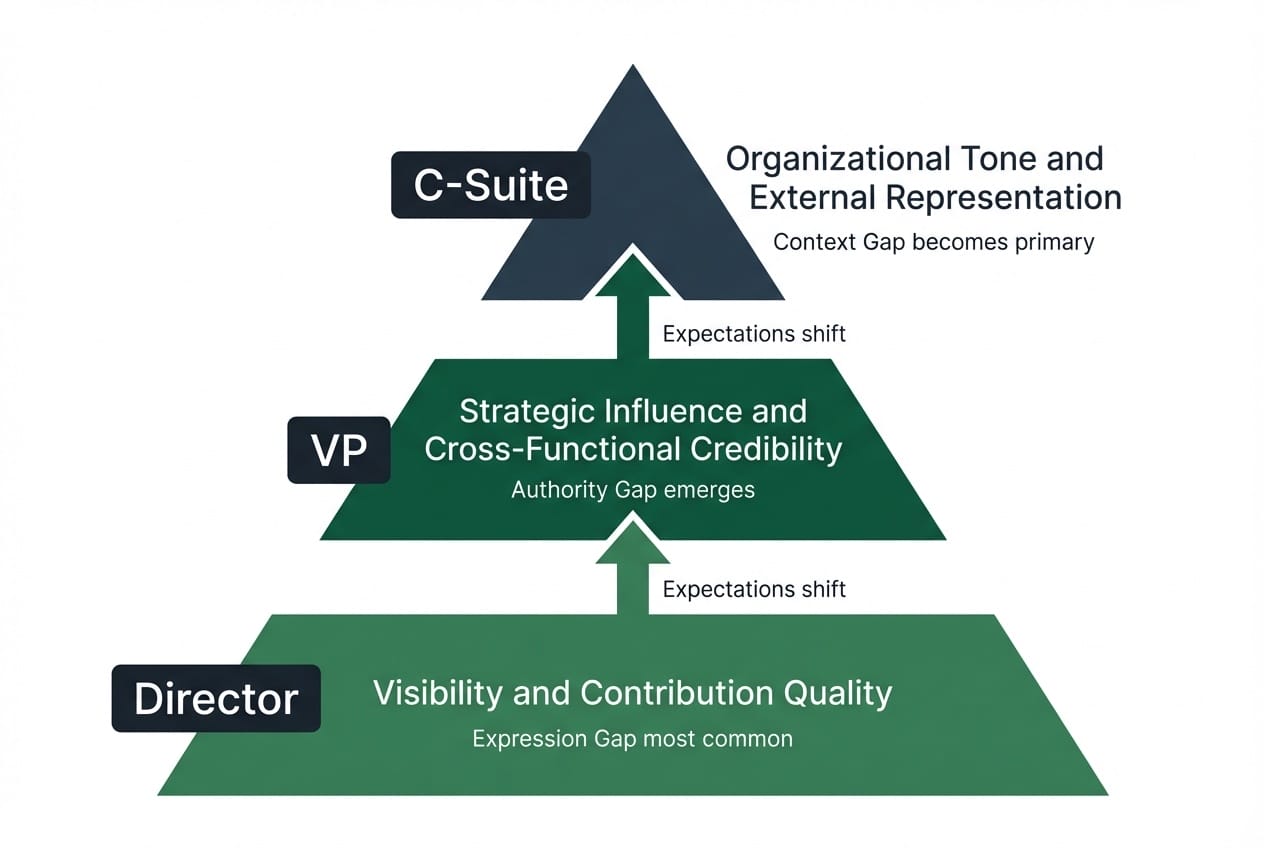
Director Level: Visibility and Contribution Quality
At the director level, presence is primarily about visibility and the quality of individual contributions. Can you speak with authority in cross-functional rooms? Do you contribute in meetings with senior leadership in ways that signal strategic thinking, not just operational competence? The expression gap is the most common finding at this level: technically strong leaders who have not yet developed the habit of making their analysis visible to the people who need to see it.
VP Level: Strategic Influence and Cross-Functional Credibility
At the VP level, the presence question shifts from “does this person contribute?” to “does this person move others to act?” Influence without positional authority becomes the central presence signal. The authority gap emerges here: leaders who built their reputation through individual expertise now need to earn credibility through the quality of their organizational thinking and their ability to align people who do not report to them.
As one client described the transition: “I kept trying to do what had always worked: have the best answer, deliver the best work. But nobody seemed to notice anymore. What they noticed was whether people followed my lead, not whether my analysis was correct.”
C-Suite: Organizational Tone and External Representation
At the C-suite level, presence shifts to what the leader represents rather than what they produce. Coaching at the CEO level often begins with this reframing: the way an executive walks into a board meeting shapes what the board believes about the company’s health. The way she responds to an investor in a difficult quarter sets the emotional context for how the entire organization interprets its situation. Presence is no longer personal credibility. It is organizational signal.
The context gap becomes the primary assessment finding at this level. The behaviors that generated presence at the VP level (demonstrating command of the function, showing depth of expertise) can actively undermine C-suite presence if they continue unchanged. The transition requires learning to stop proving and start embodying. For a broader view of how presence fits into overall leadership development, leadership development examples across other competencies show how the pattern repeats at each level transition.
Executive Presence in Different Contexts
Executive presence is not a fixed set of behaviors. What reads as strong presence in one context reads as weakness, aggression, or irrelevance in another. The context gap is the assessment finding that most often surprises leaders, because the behavioral patterns that produced their success were calibrated to a specific environment.
Industry Variation
In tech organizations, directness and speed read as presence. In financial services, the same behaviors read as impulsive and lacking judgment. In regulated, client-facing environments, the presence standard is measured deliberation: the appearance of knowing everything before saying anything. In nonprofits, where organizational authority is more distributed, both registers can alienate.
Virtual and In-Person Settings
The medium changes which presence signals are visible. In person, posture, movement, spatial positioning, and the management of physical space all carry presence information. Virtual settings compress these signals. What survives compression: eye contact (achieved through camera angle, not screen position), vocal pacing, the ability to manage energy in a flat medium, and the discipline not to check email while speaking.
Leaders who have strong in-person presence often struggle in virtual settings because they continue transmitting signals that the medium cannot carry. The adjustment is not about being “more” something; it is about understanding which signals the channel can and cannot support.
Crisis Versus Steady-State
Presence under pressure reveals gap patterns that remain invisible in normal operations. The Proving Leader who manages steady-state operations effectively may over-function in a crisis, taking tasks, filling every silence, solving problems that belong to the team. What reads as reliable in normal conditions reads as controlling under pressure. The context has shifted; the behavior has not.
Cross-Cultural Contexts
Behaviors that signal authority in one culture signal aggression or arrogance in another. Cross-cultural leadership research on power distance (the degree to which less powerful members of organizations accept and expect unequal power distribution) shows that presence behaviors calibrated to low-power-distance cultures (directness, challenge, informality) actively undermine credibility in high-power-distance environments, and vice versa. A leader who moves across cultures without recalibrating is not experiencing a presence deficit. She is experiencing a context gap that requires organizational mapping, not behavior change.
When Lack of Executive Presence Is the Wrong Diagnosis
Sometimes feedback about lack of executive presence is accurate and individual: a real gap in expression, authority, or context that coaching can close. Sometimes it reflects organizational dynamics, cultural acculturation, or rater bias that has nothing to do with the leader’s actual capability. The assessment determines which.
A leader who arrives in a new environment with strong presence in her previous context may receive presence feedback not because her presence has declined but because she has not yet decoded what this specific culture calls “executive.” The coaching work in this case begins with the organization, not with her.
The gender dimension is particularly significant here. Research on executive presence for women consistently shows that presence expectations encoded in feedback often reflect dominant-culture norms rather than leadership effectiveness. Women who communicate with the relational directness that research links to team trust may receive presence feedback from evaluators whose definition of presence is indexed to a different behavioral register. The feedback is real. Its attribution to the individual is not always accurate.
Not all executive presence feedback is about the individual. Some of it is about the room.
Analyzing 360-degree feedback for audience patterns, not just aggregated scores, is what distinguishes these cases. When feedback scores are consistent across all rater groups, the gap is likely individual. When scores split by audience (high from some groups, low from others) the gap is likely contextual or organizational. Acting on individual-development interventions in a contextual case does not close the gap. It addresses the wrong problem.
For leaders whose feedback is accurate and individual, the path from recognition to change runs through understanding which gap applies and practicing behaviors that close it. The place to start is developing executive presence through structured, gap-typed practice rather than generic confidence work.
Frequently Asked Questions
What is an example of executive presence?
A VP presenting to skeptical board members sets her notes aside, addresses the room directly with deliberate eye contact, and pauses before answering questions in a way that signals the question has weight. She is not performing confidence; she is demonstrating that she does not need the slide deck to carry the room. The board experiences authority before she makes a single recommendation.
What does lack of executive presence look like?
Lack of executive presence most often shows up as a gap between capability and perception. Two common patterns: the Invisible Thinker, whose strong analysis stays internal and whose colleagues experience detachment; and the Proving Leader, who answers every question and works the longest hours but gets feedback that he does not seem to be “in charge.” Both have genuine capability. The gap is in how the room experiences them, not in what they actually know.
Can executive presence be developed?
Yes, with one important qualification. Generic confidence coaching changes surface behaviors but rarely closes the underlying gap. The development approach that produces behavioral change starts with identifying which gap the assessment data shows (expression, authority, or context) and then targets practices specific to that gap type. Executive presence training grounded in assessment is more effective than generic presence programs, particularly for leaders who already know the feedback is real but cannot identify what specifically needs to change.
How do I know which executive presence gap I have?
The most reliable indicator is 360-degree stakeholder feedback analyzed for patterns rather than just scores. If feedback is consistent across all rater groups, the gap is likely in expression or authority. If feedback splits (high from some audiences, low from others) the gap is likely contextual. A structured presence gap assessment that maps behavioral data to specific gap types gives you the diagnostic precision to target the right area rather than practicing generic presence behaviors that may not apply to your situation.
Not Sure Where to Start?
Book a free consultation to discuss your goals and find the right path forward.
Book a Free Consultation →