
When the Fixer Becomes the Leader
Six months into the first permanent role. Financially sound business, competent team, no fires. And it feels worse than walking into a client site in week two of a restructuring.
The restlessness is real. The impulse to reorganize something - anything - is real. The sense that the organization is moving too slowly, that obvious problems are going unaddressed, that someone needs to step in and make the hard calls - that is the career talking. Those same instincts that were always exactly right, that boards and PE sponsors paid a premium for, now feel like static in a room where nothing is actually broken.
What follows is not about adapting faster or learning corporate culture. It is about what a career in turnaround consulting installed - the patterns your career built into how you think, lead, and define yourself - and why those patterns create a specific ceiling when the crisis ends and the permanent role begins. Coaches working with this population benefit from understanding what coaches need to understand about formation before the first session.
Key Takeaways
- A turnaround consulting career installs a formation - identity, time horizon, authority patterns, stress responses - that is a genuine competitive advantage in crisis but has no steady-state mode.
- The consulting-to-corporate ceiling is not a skills gap. It is a formation running in the wrong context: compressed time horizons meeting multi-year expectations, temporary authority meeting shared decision-making, action identity meeting maintenance reality.
- Under stress, turnaround-formed leaders intensify - manufacturing urgency, taking over, importing crisis energy - because the formation has no answer to stability.
- The coaching question that reaches the formation level: not “how do you delegate better” but “who are you when nothing needs fixing?”
What the Turnaround Career Installs
A note on precision: this article describes the turnaround and restructuring formation - the world of Alvarez & Marsal, AlixPartners, FTI Consulting, and firms where professionals step into interim CRO, CFO, and CEO roles to stabilize companies in crisis. This is not strategy consulting. McKinsey and BCG build a different formation - analytical, advisory, structured around recommendations rather than operations. The turnaround formation is built on doing, not advising. That distinction matters for everything that follows.
The identity anchors to impact through action. Not “I am a strategist” or “I am a finance expert.” The anchor is closer to: I am the person who walks into chaos and creates order. This is not a self-description most turnaround professionals would articulate unprompted. But ask them when they feel most like themselves - most competent, most alive, most certain of their value - and the answer is almost always some version of the first week on a distressed engagement, when the problems are visible and the mandate is clear.
The career compresses time. Engagement windows of six to eighteen months are the only temporal context the formation ever rewarded. Building culture over three years, developing talent pipelines with five-year payoffs, making strategic bets that will not validate for a decade - these are not things the career asked for. The formation installed a time horizon calibrated to quarters and engagement milestones, not fiscal years and succession plans. Understanding how trust currency shifts during formation transplants clarifies why the transition feels harder than it should.
Then there is the temporary authority pattern. During an active engagement, the turnaround professional carries more directive authority than most permanent C-suite executives. The board or PE sponsor explicitly empowered them for hard decisions. Between engagements, zero positional authority. No title, no team, no organizational standing. No corporate role oscillates like this.
The formation becomes comfortable wielding enormous power and having none. It is the middle - shared, negotiated, permanent authority - that the career never installed.
These are not weaknesses. They are precisely why PE firms and boards hire turnaround professionals. The compressed time horizon means decisions get made. The action identity means execution happens. The strength that got you here is real. The question is what happens when the context changes and the strengths keep running.
When the Formation Meets Permanent Corporate Life
The identity has no maintenance mode. Building, sustaining, growing a stable business are not just unfamiliar skills - they are unfamiliar identity states. When identity becomes the ceiling, the friction is not about what you can or cannot do. It is about who you are when the thing you were built for is not needed.
One consulting leader described it this way: “Am I missing something? Am I not seeing something under the cover, below the surface? Will it blow up in my face?” Because when you go in and fix things, it is out in the open. And now it is quiet - sometimes even too quiet - and that is suspicious. That permanent sense of anxiety is the formation’s attentional filter running in a stable environment: trained to scan for what is broken, reading silence as threat.
| Formation Pattern | What It Installed | What Corporate Requires |
|---|---|---|
| Time horizon | 6-18 month engagement windows | 3-5 year strategic plans, culture investments |
| Authority mode | Total or zero (mandate-based) | Shared, negotiated, ongoing |
| Accountability | Advise and move on | Own outcomes indefinitely |
| Identity mode | Fix, restructure, stabilize | Maintain, build, grow |
The temporal mismatch is structural. Boards ask for three-year plans and culture investments with five-year payoffs. The formation’s default is six to eighteen months. This is not unwillingness to think long-term - it is a genuine cognitive stretch the career never required. Letting go feels like losing control, and extending the time horizon feels like losing focus.
The authority gap may be the most disorienting. Steady-state medium authority in a permanent role feels neither powerful enough nor urgent enough. The turnaround formation is comfortable with extremes: full operational control during an engagement, zero authority on the bench. The middle - shared decision-making, ongoing negotiation, influence through relationship rather than mandate - is the one mode the career never practiced.
At the C-suite level, these patterns compound. Isolation increases, the information environment distorts, and the very qualities that made you effective in restructuring - speed, directness, decisive action - can read as impatience, bluntness, and unwillingness to listen in a context that runs on consensus and relationship. The Director-to-C-Suite formation shift is demanding enough for leaders who grew up in corporate roles; for a turnaround-formed leader, it is a double transition.
The Stress Signature
Every professional formation has a characteristic stress response. For the turnaround formation, the dominant pattern is intensification: the formation gets louder.
Not Sure Where to Start?
Book a free consultation to discuss your goals and find the right path forward.
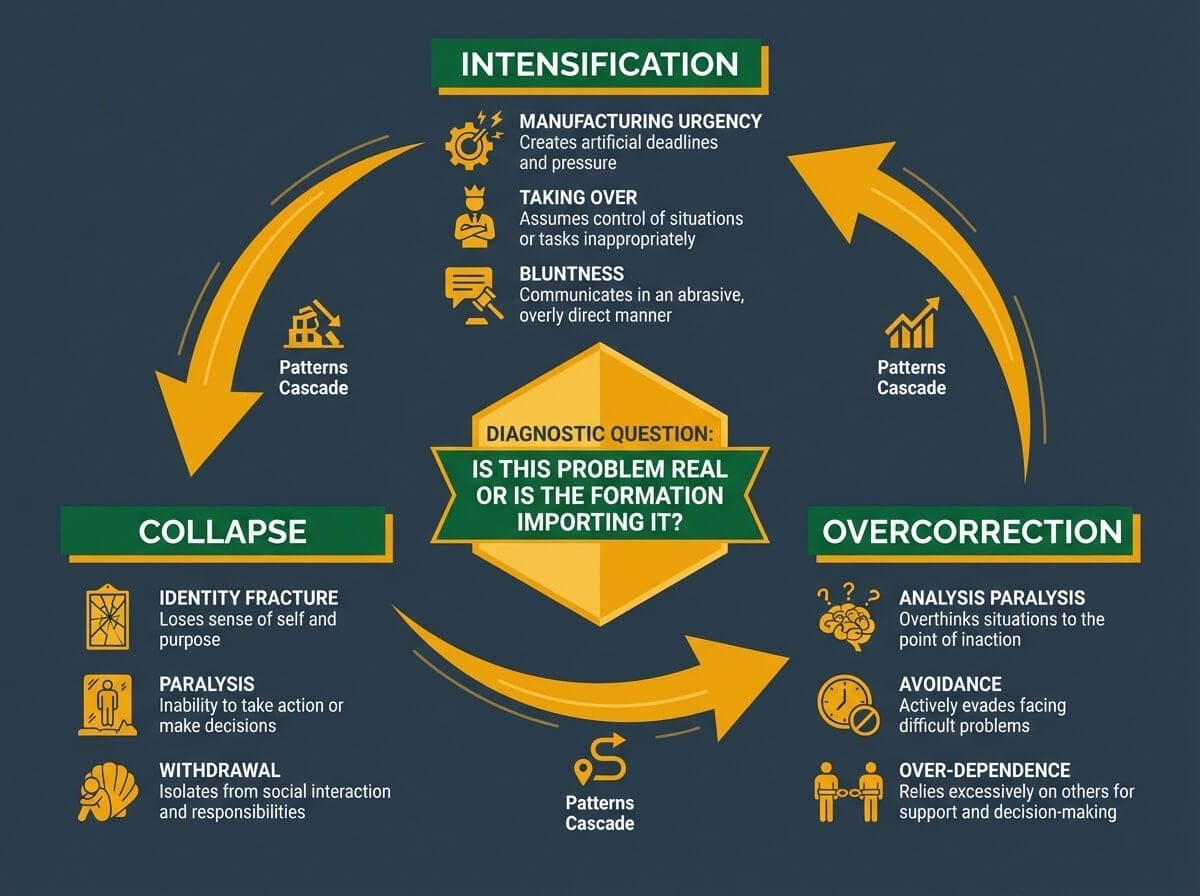
What intensification looks like in a permanent corporate role: the leader starts finding things that are broken. Stable teams get reorganized. Working processes get replaced. Crisis energy gets imported into environments that are not in crisis. Directness - the candor that boards and sponsors valued - sharpens into bluntness. The leader takes over workstreams personally, reverting to the interim-CEO muscle that fires whenever something feels wrong.
Not bad intent. Not poor judgment. An identity built on fixing that ran out of things to fix. The formation has no steady-state mode, so it creates the conditions where its strengths become relevant again.
The diagnostic question: Is this problem real, or am I importing urgency because the formation needs it? Most turnaround-formed leaders cannot answer this question at first. Naming the distinction is the beginning of the work.
Two other patterns show up less frequently but matter for coaching. Collapse looks like the opposite of the formation: the decisive leader suddenly cannot act. The action instinct goes silent. They request more data, more analysis, more time - all things their formation disdains. This often surfaces during a prolonged bench period or after a transition that is not going well. “Maybe I don’t know how to do this anymore.”
Overcorrection looks like the formation in reverse. The direct communicator starts hedging everything. The independent operator seeks permission for every move. The person who made decisions with sixty percent of the data suddenly needs ninety-five. The formation swings to the opposite pole - usually after the intensification pattern created visible damage and the leader over-indexed on the correction.
What Formation-Aware Coaching Sees
Generic coaching prescriptions for this profile - delegate more, slow down, think longer term - are not wrong. They are incomplete. They treat behaviors without reaching the formation that generates them. Telling a turnaround-formed leader to “be more patient” is like telling a CFO to “worry less about the numbers.” It sounds like reasonable advice until you understand that impatience is not a personal preference - it is what the career installed as the definition of professional excellence.
A coach who understands this formation sees something specific: an action identity running without a crisis context to validate it. A temporal formation that never got stretched beyond eighteen months. An authority mode that oscillates between extremes and has no practice with the middle. The coach does not diagnose the leader. The coach recognizes the pattern - and asks the question the formation was never designed to answer. The waterline principle is especially important here: the turnaround-formed leader responds well to direct insight, which makes the consulting pull stronger for the coach.
The most powerful reframe one of our coaches has used with this population came from naming what the career took away, not what it gave:
You have been going through all these transitions all your professional life and you actually never saw the results. You saw the bud, you never saw the flower. You never smelled it, you never took the time to take it in, to take in its beauty.
Every engagement ends at stabilization, not at flourishing. The turnaround professional exits before the restructured company becomes healthy. They see the crisis resolve but never see what grows after. A permanent corporate role is the first time the formation encounters post-engagement life - the life where the flower actually opens.
The coaching outcome is not abandoning the formation. It is expanding what it can do. The pattern-recognition capacity that finds what is broken can also find what is nascent. The same attentional scan - what is misaligned, what is underperforming, what needs resources - works as well for growth as it does for crisis. The skill transfers. The orientation shifts. And the leader who can name “I am manufacturing urgency because the formation needs it” has already begun the work that formation-aware coaching makes possible.
These are not leaders who need to be fixed. They are leaders whose capabilities have a specific scope - a scope that was extraordinarily valuable in the contexts it was built for. The question is not what skills to develop. The question is what the formation tells you to do here, and whether that is actually the right move.
That question - not delegation frameworks or time management techniques - is where the real work starts. And it starts best with a coach who understands what the career installed.
Not Sure Where to Start?
Book a free consultation to discuss your goals and find the right path forward.
Book a Conversation →