Invisible Until Something Breaks: The Operations Leadership Paradox
The weekly sync is ten minutes old and already winding down. Across the table, the CEO is scrolling through next quarter’s innovation priorities. You are sitting on a quarter where you rerouted an entire supply chain after a primary vendor collapsed, rebuilt the deployment pipeline when the old one started dropping orders during peak season, and navigated a warehouse staffing crisis that should have shut down fulfillment for a week. Zero customer impact. Zero revenue loss. Zero headlines. The CEO looks up: “Good quarter. Clean. Let’s talk about the innovation rollout timeline.” You nod and pull up the project plan. You do not mention that the reason the innovation team has a functioning infrastructure to innovate on is because you rebuilt it last month at two in the morning.
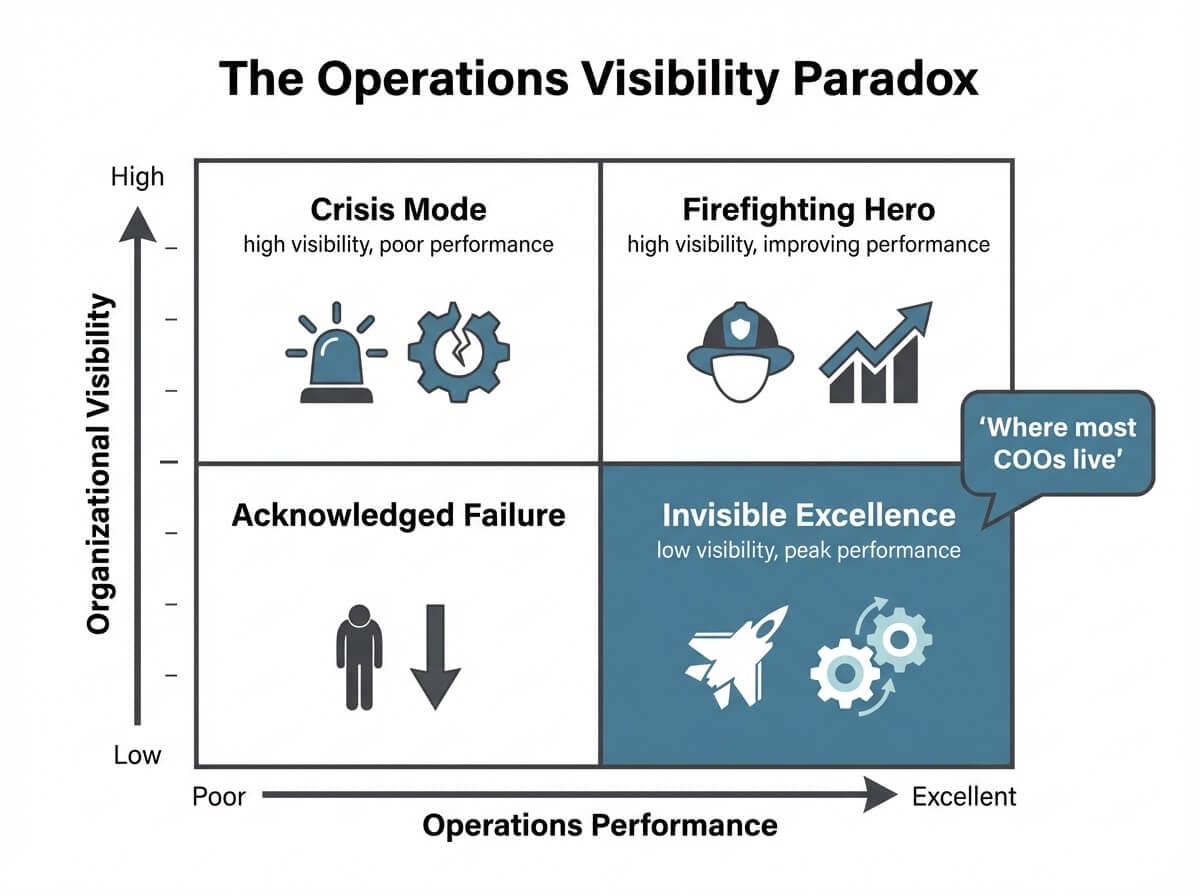
Operations is noticed when something breaks. This quarter, nothing broke. So you are invisible. And when the CEO asks the leadership team who is driving the company forward, your name does not come up. Because the answer to “what did you accomplish this quarter?” is “nothing went wrong,” and that is not a story anyone tells.
If you have spent fifteen or twenty years in operations and that silence lands somewhere deeper than your head, this article is for you. Not because you need to learn to speak up. Because the patterns your career installed are producing exactly this result. And the room you are sitting in now rewards a different kind of signal than the one your formation knows how to send.
Key Takeaways
- A career in operations doesn’t just teach systems thinking. It installs a specific relationship with invisibility, accountability, and self-worth that defines success as the absence of failure.
- The reliability that earned your credibility as a director is the same thing creating a ceiling in the C-suite. The strength and the limitation are the same pattern.
- The shift from running the organization to designing it is not about “being more strategic.” It is about recognizing that a career built on invisible excellence now requires a new kind of signal.
- A coach who understands what a career in operations does to a person will ask different questions than one working from a generic leadership playbook.
What a Career in Operations Installs
You didn’t just learn to think in systems. Systems became how you see the world. Process flows, dependencies, bottlenecks, throughput. Somewhere between your first capacity plan and your hundredth post-mortem, the ability to map how things work fused with your sense of self so completely that the two became indistinguishable. When the system runs, that’s you. When it breaks, that’s also you. Self-worth lives in operational excellence, and operational excellence is defined by what doesn’t happen. The crisis that was prevented. The outage that was avoided. The quarter where nothing went wrong because you made sure of it.
When someone says “you need to take more credit for your work,” they think they are offering helpful advice. You hear them asking you to perform rather than produce. Because your career defined success as the absence of signal. Visible self-promotion violates the code. The people who brag about their contributions are the people whose contributions require explanation. Yours shouldn’t.
Your greatest contributions are things that didn’t happen. That is an extraordinary professional achievement and a terrible communication strategy.
Your career also trained you to read one signal channel with continuous precision: whether things are running. System uptime. SLA compliance. Process throughput. You can tell at any moment whether the operation is healthy. But there is a channel you were never trained to read: whether your strategic perspective is valued. Whether leadership sees you as an operator or an architect. Your default interpretation when you are excluded from strategy conversations: “I’m too busy running things.” The alternative reading, that you haven’t made your strategic thinking visible because your formation trained you that visibility is the opposite of value, doesn’t occur.
Notice how you process a room. You catch process dependencies and bottlenecks before anyone else speaks. You map flows end to end. What counts as evidence: process metrics, SLA data, throughput numbers. What doesn’t count: aspirational timelines, untested assumptions, the product team’s optimistic resource estimate. When someone says “execution is too slow,” you hear “we need to optimize the process.” It rarely occurs to you that the process is fine and the strategy it serves is wrong. Your career trained you to fix the machine. Not to question whether the machine is building the right thing.
And then there is the accountability trap. Your authority is structurally paradoxical: direct authority over execution, advisory over strategy. You are accountable for the downstream results of upstream decisions you did not make. When product ships late, operations absorbs the impact. When sales overpromises, operations delivers on a commitment someone else made. When finance cuts mid-quarter, operations loses the resources for work already underway. Your career trained you to absorb these failures quietly and fix them, because that is operational excellence. It also means your professional life has been defined by cleaning up messes created by functions that get more strategic credit than you do.
Where Reliability Becomes a Ceiling
| Career Level | Currency | What Earns Standing | The Identity |
|---|---|---|---|
| IC / Manager | Process excellence | Reliability, efficiency gains, SLAs met, fires put out fast | “I make things run” |
| Director / VP | Cross-functional orchestration | Scaling systems across business units, leading change management, aligning operations with business strategy | “I make things run at scale” |
| C-Suite | Organizational architecture | Org design, transformation leadership, operating model innovation, deciding how the company works | “I design how the organization works” |
Recognize the Pattern?
If that description landed with uncomfortable clarity, that’s what a first conversation feels like too. We start by naming what operations installed—not asking you to abandon it.
Every career level has a currency. As a manager and early director, yours was process excellence and reliability. You kept things running. You hit SLAs. You optimized for efficiency and built contingency into every plan. “I make things run” was both your reputation and your identity. It worked.
At director and VP, the game changed. The currency became cross-functional orchestration: scaling systems across business units, coordinating between functions that each think their timeline is the only one that matters, leading change management rather than optimizing the current process. “My process” must become “the organization’s operating model.” But you kept optimizing individual processes rather than designing cross-functional systems. Kept being the person who fixes things when they break rather than the person who builds resilience so things break less. Kept defining success by SLA compliance when the new level defined success by organizational capability. The gap showed up as feedback you could not quite decode: “think more strategically.”
At the C-suite level, the game changes again. The board does not want your operational metrics. They want organizational design. Transformation leadership. Operating model architecture. The COO who keeps the trains running perfectly but never questions where the tracks go has reached the ceiling of the old currency. The shift requires you to stop scaling what exists and start designing what the organization needs to become. That often means dismantling systems you built and are proud of. Operational excellence is the floor, not the destination.
This is not about acquiring new skills. It is about recognizing that running the organization and designing it are different currencies, and the room stopped accepting the old one at face value two levels ago. It is the same structural trap that catches rising leaders who cannot release the work that made them credible, except at the C-suite level, the cost is not just your time. It is your strategic standing.
Under pressure, the pattern hardens. More processes. More checkpoints. More standard operating procedures. “I make things work” becomes “I control how things work.” You monitor more intensely. Dashboards hourly instead of daily. Status reports that nobody reads but you cannot stop producing. You tighten execution, add approval layers, volunteer for more operational scope to prove indispensability. The pattern that defines you amplifies. It looks like leaning into your strengths. It burns out the person maintaining the currency while the room quietly concludes that you are an exceptional operator who is not ready for the strategic conversation.
The Voice the Room Doesn’t Hear
The leadership team is discussing the three-year strategy. Each function presents their vision. Technology talks about platform evolution. Marketing talks about market positioning. Finance talks about capital allocation. When it is your turn, you talk about operational capacity to deliver on the vision. The CEO nods and moves on. You provided the most realistic assessment in the room, the one that actually accounts for whether the organization can execute what everyone else imagined, and it registered as logistics, not strategy. Nobody asked “What should we build the organization to become?” They asked “Can you deliver what we’ve decided?”
The career that trained you to be invisible is now asking you to be visible. And every piece of executive presence advice feels like it was written for someone whose success is measured by how much noise they make, not how little.
You have long-horizon capability that nobody knows about. You resist long-term strategic planning not because you cannot do it, but because experience taught you that long-term plans are the first casualty of other functions’ failures. You have watched three-year infrastructure investments get cut mid-quarter because sales missed a number. You have seen transformation roadmaps dismantled when a new CPO arrives with a different vision. So when the CEO asks for your ten-year view, you give a cautious answer. Not because you lack vision. Because every time you have invested in a long-horizon idea, someone else’s short-term crisis has overwritten it. The caution is not a weakness. It is earned.
And here is the paradox nobody names. Your career trained you to succeed in silence. Systems that work without drama. Problems solved before anyone notices. Quiet reliability as professional identity. And then the organization asks you to have executive presence and strategic voice. The skills that made you promotable, invisible excellence, operational discipline, the 2 AM rebuild nobody knows about, are the opposite of what gets rewarded in the room you now sit in. The room wants articulation, vision, strategic narrative. Your formation trained you to produce results, not to narrate them. And the gap between producing and narrating is not a communication skill. It is a structural contradiction between what your career installed and what leadership now requires.
What Changes When Your Coach Gets This
Consider a COO who tells their coach: “I never get the recognition I deserve. The biggest wins of my career are things nobody saw.”
See How Tandem Coaches Differently
Our approach starts with understanding what your career installed. Not personality assessments. Not generic executive presence frameworks. Your operations formation—and where it runs out of road.
A coach working from a generic leadership playbook hears a visibility problem. They offer personal branding advice: how to communicate your contributions, how to tell the story of your impact, how to make your work visible to leadership. The COO hears: stop producing and start performing.
A coach who understands what a career in operations does to a person hears something different. They recognize a structural paradox: this leader’s entire career defines success as the absence of signal. Asking them to “make contributions visible” is asking them to violate the professional code their career was built on. The coaching question is not “How could you be more visible?” It is: “Your success is defined by things not happening. How does anyone, including you, know when you are doing exceptional work versus adequate work? What is the difference signal?”
That question does not ask for self-promotion. It asks the COO to develop a new kind of signal, one that registers impact without requiring them to perform visibility in a way that feels inauthentic. Not “tell people how great you are” but “build a language for operational contribution that the room can actually hear.” The distinction matters because the first approach makes the COO feel like a fraud. The second one builds on the operational identity rather than asking them to abandon it.
The difference between these two coaching approaches is not technique. It is whether the coach understands that operational excellence is structurally invisible, and that asking an operations leader to self-promote is asking them to betray the very instinct that made them excellent.
Or consider the moment a coach says: “You need to carve out time for strategic thinking. Work on the business, not in the business.” The COO hears time management advice. Delegate more. Say no. Create a “strategic block” on the calendar. Useful perhaps, but it misses what is actually happening.
A different coach hears the COO say “the CEO wants me to think more strategically but I’m too busy keeping things running” and recognizes something specific. Not a time management problem. A learned defensiveness. This leader has long-horizon capability. They resist it because their experience taught them that long-horizon plans get overwritten by other functions’ short-term crises. The resistance is earned, not innate. The coaching question: “You’ve seen long-term plans fail when other functions export their problems into your timeline. What would a long-horizon plan look like that accounts for that reality instead of pretending it won’t happen?”
That question honors the operational reality rather than dismissing it. It does not say “think bigger.” It says “build strategy that is as resilient as your operations—strategy designed to survive the chaos your career taught you is always coming.” The COO does not need permission to be strategic. They need a way to be strategic that does not require them to pretend the organization is more stable than they know it to be.
The difference between those two approaches is whether the coach understands what twenty years of absorbing other functions’ failures actually does to a person’s relationship with the long term. A coach who gets this will not try to fix your caution. They will help you see it as earned wisdom that needs a new expression, not a limitation that needs to be overcome.
The patterns in this article connect to several related dynamics across careers and levels: when invisibility is the only success signal you trust, what changes when the system runs well but nobody notices, the COO’s voice in the leadership team conversation, and how operational training shapes the problems you prioritize. For the coach’s perspective on these dynamics, see the operations formation: a coach’s guide.
A Different Kind of Conversation
That systems mind served you. It kept the organization running when everything around it was breaking. It built the infrastructure that everyone else’s strategy depends on. It is also the reason the room sees you as the person who keeps the lights on rather than the person who decides where the building goes.
What changes is not the operational excellence. It is the relationship between running the organization and designing it. Whether the person who knows how things actually work gets to shape what they become. That shift does not require you to become someone louder, more political, more visible in the way your formation finds inauthentic. It requires a different kind of signal, one the room can hear without asking you to stop being the person who rebuilt the infrastructure at two in the morning.
If you recognized yourself in this article, that recognition is the starting point. The patterns your career installed are specific, predictable once understood, and workable once named. The next step is a conversation with someone who understands what a career in operations does to a person: the systems identity, the accountability trap, the invisibility. Someone who can help you build on it rather than apologize for it. That conversation is available whenever you are ready for it.
A Conversation That Starts Where Operations Shaped You
A 30-minute call where your coach already understands what operations installs and where invisible excellence creates a ceiling. No assessment. No intake form. Just a conversation that starts where your career actually shaped you.
Book a Free Consultation →