
Why HR Leaders Are Everyone’s Coach and Nobody’s Priority
The restructuring announcement is forty minutes old. You knew it was coming. The CEO consulted you two weeks ago on severance modeling, asked you to draft the communication plan, had you map which teams would lose headcount. You modeled the people cost of every scenario. But you learned the strategic rationale for which scenario they chose the same way every other executive did: in the meeting. The decision was made in a smaller room, a room you were not in. You had the data. You did not have the conversation.
Within an hour, three executives stop by your office. The CTO wants to talk through retaining key engineers. The CMO needs help messaging the change to their team. The CFO asks about the severance timeline. Everyone comes to you. Nobody asks what you think about whether the restructuring was the right call in the first place.
On the drive home, it settles. You are the most consulted person in the building and the least influential person in the room where it mattered. If you have spent fifteen or twenty years in HR and that sentence lands somewhere deeper than your head, this article is for you. Not because you lack strategic capability. Because the patterns your career installed are producing exactly this result. And the room you sit in now trades in a different currency than the one your formation taught you to spend.
Key Takeaways
- A career in HR doesn’t just teach people skills. It installs advocacy as identity—a deep pattern where being needed by people is how you measure professional worth, and that pattern has diminishing returns at the enterprise level.
- The empathy and relational attunement that made you trusted by individuals is the same thing making you marginal in the strategic conversation. The strength and the ceiling are the same pattern.
- The shift from people advocate to enterprise strategist is not about “being more commercial.” It is about translating what you already see into a denomination the boardroom can act on.
- A coach who understands what a career in HR does to a person will ask different questions than one working from a generic leadership playbook.
What a Career in HR Installs
You didn’t just learn to care about people. Caring about people became who you are. Somewhere between your first employee relations case and your thousandth difficult conversation, the belief that organizations succeed through people fused with your professional identity so completely that the two became indistinguishable. When the executive team makes a decision that ignores the people dimension, it doesn’t register as a difference of opinion. It registers as something closer to a moral failure. And when people come to you—for advice, for mediation, for a safe space to think through something they cannot say out loud to anyone else—that is when you feel most like yourself. “People come to me” is not a job description. It is an identity.
Your career trained you to read one signal channel with extraordinary sensitivity: how people are doing. Employee sentiment. Trust quality. Whether a team is fracturing beneath the surface or holding together through something hard. You can read a room’s emotional temperature before anyone has said a word. You know which leader’s team is quietly updating their résumés. You know which executive is about to lose their best people. You see things about the organization that nobody else in the C-suite can see.
But there is another channel your career never trained you to read with the same fidelity: whether that people insight is translating into business impact. Whether the leaders around you see you as strategic or supportive. Your default interpretation when you are excluded from a decision: “They don’t value people.” The alternative—that you haven’t yet learned to express people insight in the language the room trades in—is harder to see from inside the pattern.
Your career trained you to see what others miss about people. It also trained you to miss what others see about how influence works.
Notice how you process a room. When a restructuring is proposed, you are already mapping the second and third-order human consequences before anyone else has finished reading the slide. Who will leave. Which teams will lose trust. Where institutional knowledge will disappear. You organize what you hear through relational mapping: how will this affect the people, and how will the people’s response affect the system? That relational lens catches consequences other lenses miss entirely. It is also the reason the room sometimes hears your input as caution rather than strategy. Every change has too many human consequences. The people-impact analysis can expand until it becomes the case against doing anything at all.
And risk, for you, is distributed through relational networks. You do not manage uncertainty by eliminating disruption. You manage it by building the human system’s capacity to absorb it. That is not timidity. It is the professional adaptation of someone who has spent a career watching what happens when organizations move faster than their people can hold.
Where Advocacy Becomes a Ceiling
| Career Level | Currency | What Earns Standing | The Identity |
|---|---|---|---|
| IC / Manager | Employee trust | Being the person people come to. Confidentiality. Policy expertise. Individual advocacy. | “People come to me” |
| Director / VP | Organizational development | Talent strategy. Data-informed people decisions. Systems that create trust at scale, not one conversation at a time. | “I shape the systems that shape how people work” |
| C-Suite | Culture architecture | Workforce strategy in enterprise-value language. How human capital decisions drive competitive advantage. | “I build the human capability the strategy requires” |
Recognize the Pattern?
If that description landed with uncomfortable familiarity, that’s what a first conversation feels like too. We start by naming what HR installed—not asking you to stop advocating for others.
As an HR generalist and manager, the currency was being the person people come to. Employee trust. Confidentiality. The ability to hold difficult conversations that nobody else in the organization would touch. “People come to me” was the measure of professional worth, and it was real. That trust takes years to build and is genuinely valuable.
At director and VP, the game changed. The currency became systems thinking: organizational development, talent strategy, data-informed people decisions. Not being the person everyone trusts, but building the systems that create trust at scale. But you kept being the go-to person for individual employee issues rather than building systems that handle those issues without you. Kept defining success as “people trust me” when the new level defined success as “the talent strategy is producing measurable business results.” The gap showed up as feedback you have heard a dozen times: “Think more commercially.”
At the C-suite level, the game changes again. The board does not want your organizational development programs or engagement scores. They want workforce strategy articulated in the language of enterprise value creation. How human capital decisions drive competitive advantage. How culture architecture enables or constrains the business strategy. The CHRO who still leads with people programs and sentiment data when the board needs a strategic partner who connects workforce decisions to enterprise outcomes has brought the wrong currency to the boardroom.
This is not about caring less about people. It is about recognizing that people advocacy and enterprise strategy are not opposites. The question is whether you are spending your people insight as individual trust—one relationship, one conversation, one crisis at a time—or converting it into the strategic currency the boardroom trades in. Same insight. Different denomination.
Under pressure, the advocacy identity hardens. You insert yourself into more situations as the “people voice.” You over-mediate conflicts that could self-resolve. You generate more process around every people decision. More check-ins, more pulse surveys, more “how are you doing” conversations. You over-protect people from organizational stress, shielding teams from hard truths, delaying difficult messages because the human cost feels too high. The pattern that defines you amplifies. It looks like caring until it becomes the thing slowing the organization down. In the worst version, you use the moral authority of the people-advocate position to slow or block decisions you cannot influence through other means. The people-impact assessment becomes a veto. And the room quietly concludes that HR is an obstacle rather than an ally.
Everyone’s Coach and Nobody’s Priority
You are the most trusted person in the building and the least powerful person in the room where decisions get made. Everyone comes to you after the meeting. Nobody invites you to the meeting before the meeting. The CEO consults you on how to communicate a decision, not on whether to make it. You have access to more organizational truth than anyone in the C-suite and less influence over what the organization does with it.
People come to you. That is both the source of your power and the shape of the ceiling.
Your cross-functional peers have learned to use your language against you. When you raise a concern about a restructuring, someone says “we need to balance people needs with business needs”—as though people needs were a nice-to-have and business needs were the real thing. You know the people dimension IS the business dimension. But you haven’t found the words that make the room hear it that way. You keep presenting in the language of empathy and advocacy. The room trades in the language of value creation and competitive advantage. Same insight. Wrong currency.
The feedback you keep getting is some version of “you need to be more commercial” or “think like a business leader, not an HR leader.” What nobody tells you is that you already think commercially. You know that a failing talent pipeline will destroy the strategy. You know that the culture problems in the engineering organization are a retention time bomb. You know that the leadership bench is thinner than the succession plan claims. You just keep saying it as “we’re losing good people” instead of “our human capital runway is eighteen months shorter than our strategic plan assumes.” The translation problem is linguistic, not conceptual. And nobody has helped you see it that way because the feedback always lands as “you’re not strategic enough” rather than “you’re spending the right insight in the wrong denomination.”
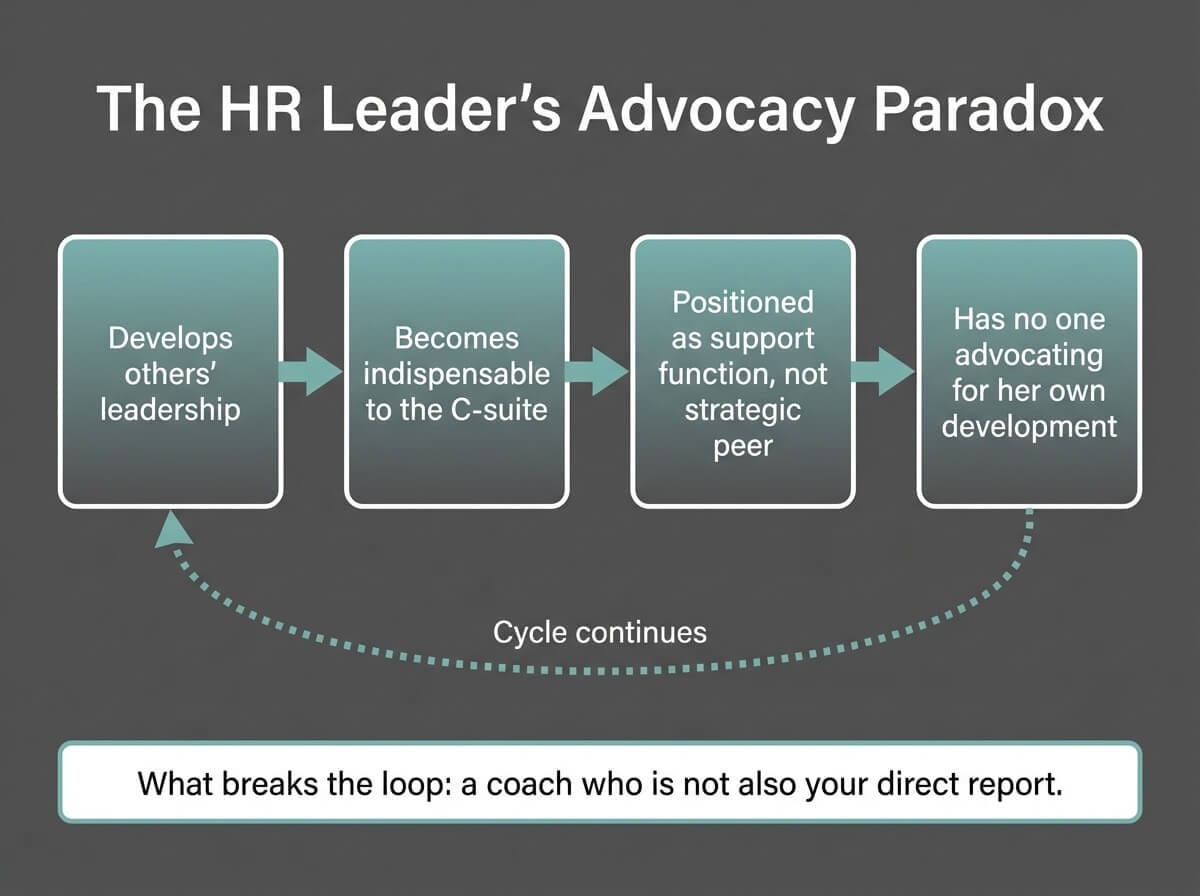
And here is the structural irony nobody names. You are the function that builds development for everyone else. You commission coaching for the CEO. You design leadership programs for the senior team. You create mentoring infrastructure for high-potentials. You are everyone’s coach and nobody’s priority. The person the entire organization comes to for development has no development infrastructure for themselves. That is not an oversight. It is the pattern completing itself. The advocacy identity defines worth through being needed, and asking for help feels like a contradiction of the professional self that everyone depends on.
What Changes When Your Coach Gets This
Consider an HR leader who tells their coach: “I can’t get the executive team to see HR as a strategic function. They treat us like a support function and it doesn’t matter how much data I bring.”
See How Tandem Coaches Differently
Our approach starts with understanding what your career installed. Not personality assessments. Not generic executive presence frameworks. Your HR formation—and where it runs out of road.
A coach working from a generic leadership playbook hears a positioning problem. They offer stakeholder management advice: build a business case for HR initiatives, present data on talent ROI, get a sponsor on the executive team. Useful, perhaps. But it misses the pattern underneath.
A coach who understands what a career in HR does to a person hears something different. They recognize a specific structural dynamic: a leader whose relational depth is both the source of their unique insight and the lens that prevents the room from hearing it as strategic. The coaching question is not “How can you position HR more strategically?” It is: “You see the people dimension that nobody else in that room sees. How do you translate that into language the board can act on?”
That question does not teach positioning skills. It surfaces the currency translation and the identity challenge embedded in making that shift. The CHRO does not lack strategic thinking. They lack the habit of expressing what they already know in the denomination the room trades in. The relief is specific: “I don’t need to become more strategic. I need to translate what I already see.” That is a fundamentally different starting point than “I need to be less of a people person and more of a business person,” which is what most coaching conversations for HR leaders accidentally become.
The difference between these two coaching approaches is not technique. It is whether the coach understands that people advocacy is a formation-level value system built over decades, not a “soft skill” that needs to be balanced with “hard skills.” Telling an HR leader to be tougher is like telling a CFO to care less about the numbers. It misreads the architecture.
Or consider the moment a coach says: “You need to stop being the people pleaser and make tougher calls.” The CHRO hears: your values are a weakness. Everything your career was built on is the problem.
A different coach says: “The tension between people advocacy and business alignment is not a weakness in you. It is the tension your function lives inside every day. When those two pull in opposite directions, how do you decide which way to go?” The distinction matters. One asks the client to abandon their identity. The other names the structural tension and invites the client to develop a more deliberate relationship with it. Not “stop caring about people” but “your people insight is the one dimension nobody else in that room can see. The question is whether you are spending it as individual trust, one conversation at a time, or converting it into strategic currency at the enterprise level.”
The CHRO who hears that question does not feel diagnosed. They feel recognized. The advocacy is honored. The ceiling is named. And the path forward builds on what they are rather than asking them to become someone they are not. That identity shift is the difference between coaching that feels like criticism and coaching that feels like expansion.
The patterns in this article connect to several related dynamics across careers and levels: when your role is to serve everyone else’s development, the CHRO’s feedback problem, the HR voice your leadership team treats as background, and what HR leaders find different when they reach the C-suite. For coaches preparing to work with HR leaders, see understanding HR formation for coaching.
A Different Kind of Conversation
You have spent your career being the person everyone comes to. The empathy, the trust, the ability to read what is happening beneath the surface. That is real, and it got you here. It is also the reason you keep being consulted after the decision is made instead of before.
What changes is not the advocacy itself. It is whether advocacy stays the whole building or becomes the foundation you build on. Whether the person who understands people better than anyone in the C-suite gets to shape how the organization invests in its human capability at the enterprise level. That shift does not require you to stop caring. It requires a different denomination for the caring you already do.
If you recognized yourself in this article, that recognition is the starting point. The patterns your career installed are specific, predictable once understood, and workable once named. The next step is a conversation with someone who understands what a career in HR does to a person: the advocacy identity, the currency that stops converting, the structural invisibility of being everyone’s coach and nobody’s priority. That conversation is available whenever you are ready for it.
A Conversation That Starts Where HR Shaped You
A 30-minute call where your coach already understands what HR installs and where advocating for everyone else becomes a ceiling for you. No assessment. No intake form. Just a conversation that starts where your career actually shaped you.
Book a Free Consultation →