How to Develop Executive Presence: A Diagnostic Framework
How do I develop executive presence?
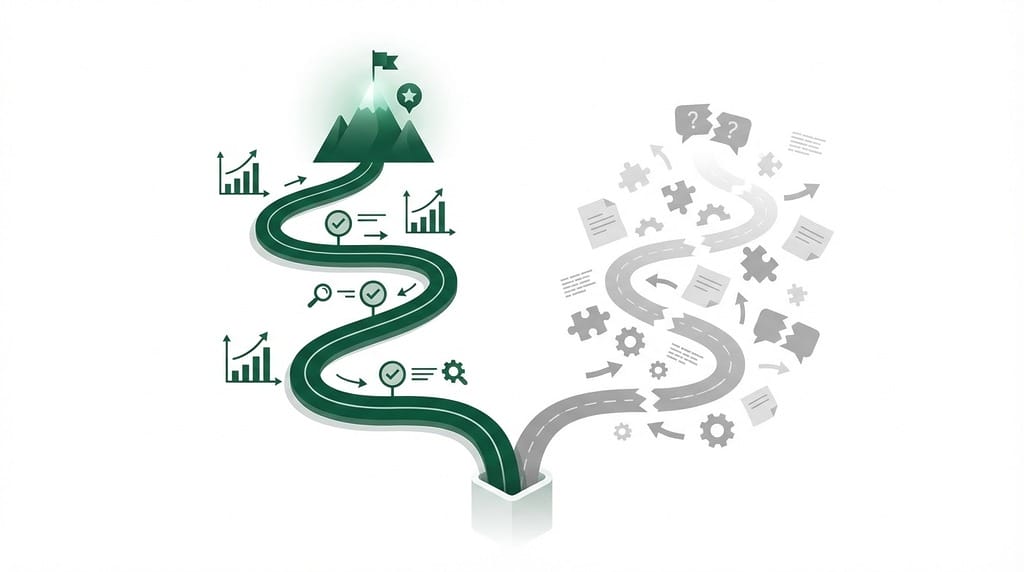
Start with diagnosis, not development. Pull your 360 feedback and find where self-ratings and stakeholder ratings diverge. That divergence pattern identifies your gap: expression, authority, or context. Each requires a different intervention. Prescribing gravitas training for an expression gap wastes months. Assessment-driven coaching that matches intervention to diagnosed gap produces measurable results.
Behavioral change in presence coaching happens faster than most leaders expect—especially when it begins with data from executive coaching tools like Genos EQ and 360-degree feedback that identify whether the gap is expression, authority, or organizational context. A senior leader adjusts how they communicate decisions, and the shift is visible within weeks. Perception change, though, operates on a different clock. The organization’s narrative about that leader, built over years of observation, does not update at the same speed. Three months of consistent new behavior meets an audience still running last year’s mental model. This pattern is one reason the executive coaching guide emphasizes structured measurement at the midpoint of every engagement, not just at completion. That gap between what the leader is now doing and what the audience still sees is where most executive presence development stalls. Not because the work failed, but because the leader measured the wrong variable and concluded the effort had no impact.
Three months of consistent new behavior meets an audience still running last year’s mental model.
The leaders we assess for presence gaps are rarely under-confident. They score high on emotional awareness. They process deeply. What the data surfaces, consistently, is that they are under-expressed. The audience experiences distance where the leader experiences engagement. Development that targets confidence when the actual gap is expression wastes months of effort and erodes trust in the process itself.
Key Takeaways
- Executive presence development fails when it skips diagnosis. The same feedback, “you need more presence,” can point to three different gaps—authority, context, or expression—each requiring a different intervention.
- Expression gaps are the most common finding: leaders who process deeply but display little. The work is visibility practice, not confidence building.
- Authority gaps require a shift in operating register, not more preparation. The skill that earned the promotion often produces the gap at the next level.
- Context gaps live in the organizational system, not in the leader. When 360 ratings split along cultural lines, individual development is not the primary lever.
- Behavioral change happens in weeks. Perception change happens in quarters. Measuring only perception early in the process produces false negatives.
Why Most Presence Development Fails
Development fails when it treats executive presence as one thing. Assessment data breaks it into distinct gaps, each requiring a different intervention, different timeline, and different definition of success.
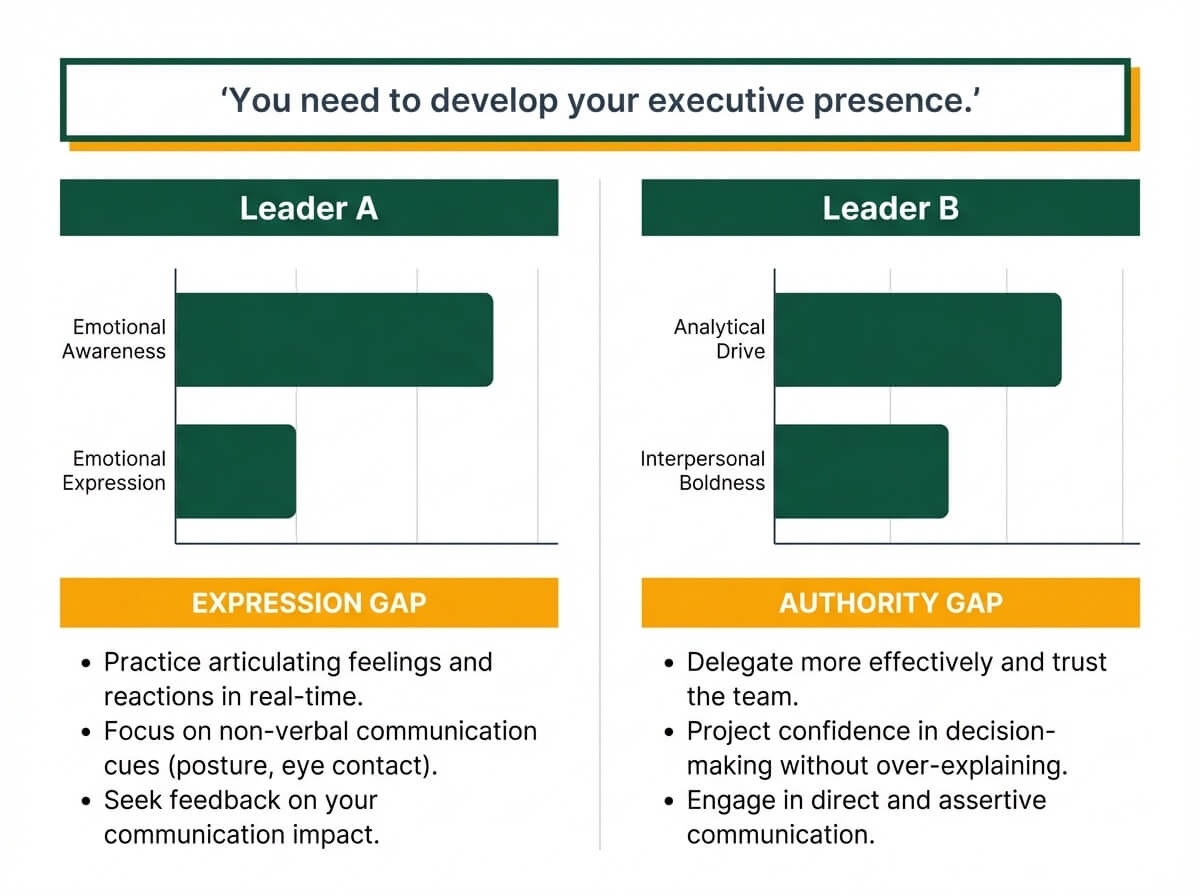
Consider two leaders who receive identical 360-degree feedback: “Needs to develop executive presence.” The standard response is a generic development plan. Read a book. Practice body language. Work on your confidence. Most advice, including Hewlett’s three-pillar model, prescribes the same remedies regardless of the underlying cause.
Assessment data tells a different story. Leader A, a VP of Engineering, completes the Genos EQ assessment. The scores reveal 90th-percentile emotional awareness paired with 40th-percentile emotional expression. She processes everything; her team sees almost none of it. This is an expression gap. Leader B, a CFO, takes the ProfileXT behavioral assessment. High analytical drive, moderate interpersonal boldness. He communicates through data where the board expects conviction. This is an authority gap.
Same feedback. Different assessment data. Different gaps. Different development plans. A presence gap assessment that identifies which of the three gaps is primary is the step most development programs skip entirely. What most career advice calls “gravitas” fractures, under assessment instruments, into three measurable components—what we call the ACE Framework: authority (what register the leader operates in), context (what the organizational culture defines as “executive”), and expression (what is visible). Treating all three as one problem is why most career development efforts around presence produce frustration rather than results. These are among the most common leadership development challenges we encounter in our practice.
There is a second failure sitting underneath the first, and it is about where the money goes. Sylvia Ann Hewlett’s research, summarised in Forbes in 2026, puts the weights at gravitas 67 per cent, communication 28 per cent, and appearance just five per cent. Most presence training inverts that. It works on the visible five per cent because the visible five per cent is what a workshop can plausibly change in a day — posture, slide design, vocal warm-ups, what to wear. Hewlett’s own conclusion is that the majority of development investment goes to the least decisive components while gravitas is left almost entirely unaddressed.
The consequence shows up in the aggregate numbers. Gartner’s research finds three in four HR leaders report their managers are overwhelmed by their responsibilities, and that organisations updating their leadership programs and increasing development spend are largely not seeing results. Spending more on the wrong 33 per cent does not produce presence; it produces better-presented leaders who still cannot hold a room when the room turns.
The mechanism is worth naming plainly, because it is the part most programs get wrong. Presence training usually transfers knowledge — a model, a vocabulary, a checklist — and then stops. Knowledge is not the binding constraint. Under pressure, in the meeting where the number is bad and the question is hostile, nobody retrieves a framework. They fall back on whatever they have actually practised. Gravitas is a set of behaviours rather than a personality trait, which is precisely what makes it learnable, and also what makes a one-off workshop structurally incapable of building it. Behaviour changes through repetition under something approximating real stakes, which is why the development plans that work look less like a seminar and more like a rehearsal schedule with a witness.
Closing the Expression Gap
Expression gaps are the most common assessment finding. The leader is not under-confident. They are under-expressed. The development work is making internal processing visible.
Say you are coaching a CTO who scores in the 90th percentile for emotional awareness on the Genos EQ but in the 40th percentile for emotional expression. Her direct reports describe her as “hard to read” and “detached.” She describes herself as deeply engaged. Both are telling the truth. The gap is not in how much she cares or how well she understands the business dynamics around her. The gap is in how much of that internal processing ever becomes visible to the people who need to see it.
This is the most common pattern in presence coaching, and it is the most misdiagnosed. The standard prescription, build your confidence, misses the mark entirely. Confidence is not the deficit. Expression is.
Confidence is not the deficit. Expression is.
Three executive presence exercises target expression gaps directly:
- Decision narration. Instead of announcing conclusions, the leader narrates the reasoning in real time: “I’m weighing two factors here” or “My concern is the timeline risk on the second option.” This makes the thinking process visible to stakeholders who previously experienced only silence followed by a decision.
- Expression calibration. The leader practices communicating reactions as they happen rather than after processing. In meetings, this means voicing initial responses: “That surprises me” or “I need to think about that, but my first reaction is positive.” Small signals that the audience can read.
- The checking-in protocol. At structured intervals, the leader asks direct reports a specific question: “What are you reading from me right now?” The gap between what they report and what the leader intends becomes concrete, measurable learning data.
The timeline for expression gap work: behavioral change in 8 to 12 weeks. The leader will communicate differently within two months. Perception change, where stakeholders update their mental model, takes 3 to 6 months. That lag is normal. It does not mean the work is failing. It means the audience needs repeated exposure to the new pattern before their narrative shifts. For leaders pursuing assessment-driven presence coaching, this timeline sets realistic expectations from the start.
Closing the Authority Gap
Authority gaps appear when a leader operates in the register that earned the promotion rather than the one the role requires. The work is restraint and recalibration, not skill acquisition.
The expression gap is about visibility. The authority gap is about register. Consider a newly promoted SVP who still brings 40-slide decks to board meetings. At the director level, those decks demonstrated mastery. At the senior vice president level, they signal the opposite: a leader still proving competence rather than projecting it. The same behavior that accelerated the career is now producing the presence gap — the credibility shift that compounds over time. ProfileXT data typically shows the pattern: high analytical drive paired with moderate boldness. The leader defaults to building the case when the room expects them to state the position.
The same behavior that accelerated the career is now producing the presence gap.
Authority gaps are harder to close than expression gaps because they are tied to role identity, not communication mechanics. The development strategies require the leader to renegotiate their internal definition of what their job actually requires.
- Restraint practice. In meetings where the leader would normally contribute first and most, they practice speaking last. This is counterintuitive and uncomfortable. It works because senior management influence operates differently than individual-contributor influence. When a senior leader speaks less frequently, each statement carries more weight. The room pays closer attention.
- Position-first communication. The leader practices stating their position before presenting supporting data, reversing the analyst-to-executive communication pattern. “I recommend we delay the launch by two weeks” before “here are the twelve reasons why.” Decisions get communicated before justifications.
- Meeting contribution audit. For two weeks, the leader tracks three data points from every meeting: how many times they spoke, how many times they were asked for their view versus volunteering it, and whether the meeting outcome changed based on their input. The data reveals the pattern faster than any coaching conversation.
The honest timeline for authority gaps: quarters, not weeks. Behavioral adjustments appear within a month, but the deeper shift, where the leader stops experiencing restraint as withholding and starts experiencing it as leadership, takes longer. This is not a communication technique to learn. It is a professional identity to renegotiate. Trust in the process builds slowly as the leader observes that less talking and less proving produces more influence in the room.
When the Gap Is Not Yours to Close
When 360 ratings split along organizational lines rather than behavioral patterns, the gap is contextual. The conversation shifts from coaching the leader to advising the organization.
Which Gap Are You Working On?
Authority, context, and expression gaps each require different development strategies and different timelines. Assessment data identifies which one applies to you.
A leader who was effective at a previous company receives “lacks executive presence” feedback at the new one. The leader did not change. The audience changed. When we look at the 360-degree feedback in detail, the ratings split: high from one business unit, low from another; strong from peers, weak from senior leadership. The split maps to organizational subcultural boundaries, not to behavioral inconsistency. This is a context gap, and it raises a different question than the first two. For real-world executive presence examples of how context shapes perception, the pattern is consistent: the same behavior reads as “confident” in one culture and “aggressive” in another.
Before coaching a leader with a context gap, we run an organizational audit. What does this culture actually reward? What does senior management in this business define as “executive”? Is the definition consistent across functions, or does it shift between the engineering floor and the C-suite? The audit determines whether the development target is the leader’s style-switching ability or the organization’s definition itself.
For leaders developing executive presence inside a misaligned culture, the work becomes coachable once the audit confirms the leader can adapt to what the context rewards. Generic executive presence training skips the audit and applies identical tactics to every gap. Building executive presence in a context gap looks different from the expression and authority work above:
- Audience decoding. Before changing any behavior, the leader maps what each subculture actually rewards. The engineering floor may prize precision and understatement; the C-suite may read that same restraint as a lack of conviction. Cataloging these differences first makes style-switching deliberate rather than reactive.
- Register switching, not impersonation. The leader practices adjusting delivery (pace, directness, how much reasoning they show) for each audience without abandoning their actual position. The skill is reading a room’s working definition of “executive” and meeting it on substance, not performing as someone else.
- Sponsor calibration. The leader recruits one senior insider who already reads as “executive” in the target culture and uses them as a calibration partner: rehearse the message, get a read on how it will land, adjust before the room rather than after. This converts cultural guesswork into specific, testable feedback.
The honest limitation: coaching can sharpen a leader’s ability to read and adapt to different cultural expectations. It can build the skill of style-switching across audiences. But coaching does not make organizational culture more inclusive.
Coaching does not make organizational culture more inclusive.
When the context is the primary barrier, when the organization’s implicit definition of “executive” systematically excludes certain leadership styles, we name that in the discovery conversation. Sometimes the right recommendation is not coaching the leader but advising the CHRO. Sometimes it is helping the leader evaluate whether this is the right organizational fit. Executive presence is influence without positional authority, and some organizational contexts constrain that influence regardless of the individual’s skill.
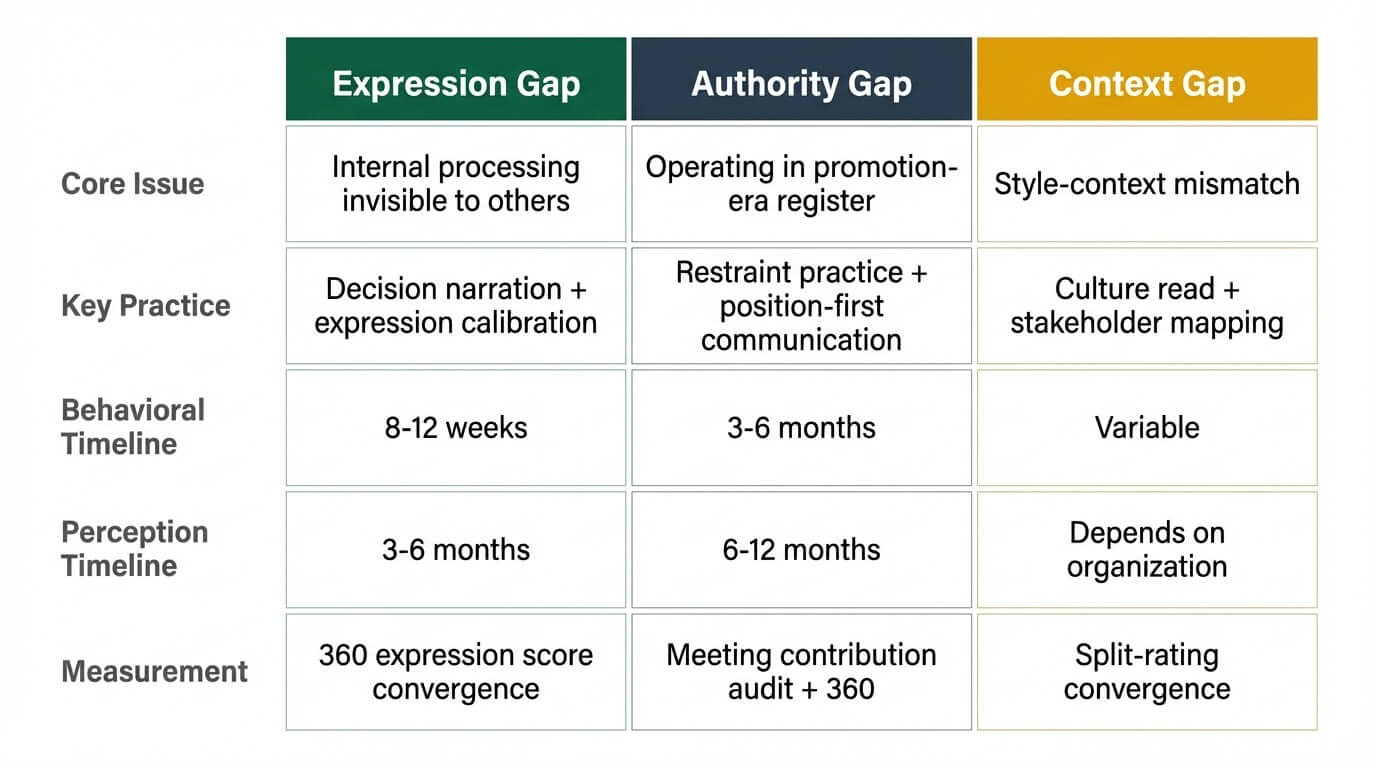
How to Measure Progress
The right measurement depends on which gap the development targets. Behavioral change and perception change operate on different timelines, and tracking only one produces misleading results.
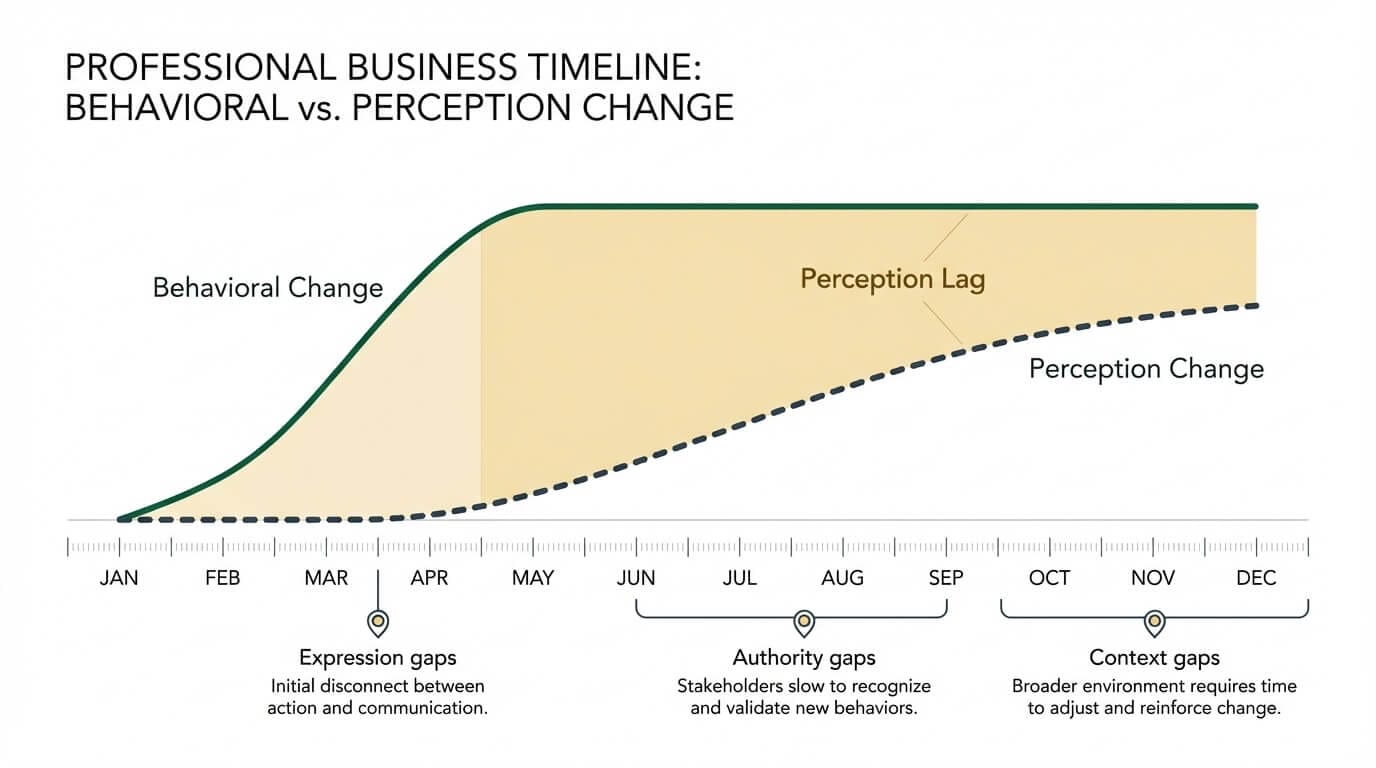
Each gap type has its own measurement approach. Aligning measurement to gap type is as important as aligning the development strategy. Vague leadership development goals like “improve executive presence” make progress unmeasurable. Gap-specific goals make it concrete.
| Gap Type | Behavioral Timeline | Perception Timeline | Measurement Instrument |
|---|---|---|---|
| Authority | 4–8 weeks | 6–9 months | Meeting contribution audit data + 6-month 360 |
| Context | Varies | 9+ months | Stakeholder mapping; split-rating convergence monitoring |
| Expression | 8–12 weeks | 3–6 months | Repeated 360 at 3 and 6 months; Genos EQ expression re-score |
For authority gaps, behavioral tracking data (the meeting contribution audit) provides the leading indicator, and the 6-month 360 provides the lagging confirmation. For context gaps, the metric is whether split ratings converge over time, which depends partly on the leader’s learning and partly on the organizational environment. For expression gaps, the key metric is 360 convergence: the distance between self-ratings and stakeholder ratings on specific dimensions should narrow over two measurement cycles.
The critical insight across all three: behavioral change precedes perception change. A leader who measures only perception in the first quarter will see minimal movement, even when the behavioral data shows significant shifts. Measuring both, and understanding the lag between them, prevents premature abandonment of development work that is, in fact, producing results.
Frequently Asked Questions
Is executive presence innate, or can it be developed?
Some components of presence are more natural for some leaders than others. But the framing of “innate versus learned” misses the point. Executive presence is a perception gap, not a personality trait. Development does not install a new personality. It targets the specific gap between what the leader does and what the audience experiences. Authority gaps take longer because they involve role identity. Context gaps require organizational change alongside individual adjustment. Expression gaps respond to behavioral practice within weeks. The question is not “can I develop presence?” but “which gap do I have, and what does closing it actually require?”
How long does it take to develop executive presence?
The timeline depends on the gap type. Expression gap development produces visible behavioral change in 8 to 12 weeks and stakeholder perception shifts in 3 to 6 months. Authority gap work takes longer: behavioral adjustments in 4 to 8 weeks, but perception shifts in 6 to 9 months because they require the audience to update a deeply held narrative about the leader. Context gaps have the longest horizon, often 9 months or more, because they involve both individual adaptation and organizational variables beyond the leader’s direct control.
Is executive presence coaching worth the investment?
When coaching is preceded by accurate diagnosis, yes. The ICF Global Coaching Study documents strong ROI for executive development engagements. The key variable is whether the coaching targets the right gap. Generic presence coaching that prescribes gravitas training for a leader with an expression gap, or communication workshops for a leader with a context gap, wastes the investment. Assessment-driven coaching that matches the intervention to the diagnosed gap produces measurable business results: better decisions in senior leadership meetings, stronger trust from direct reports, and career advancement tied to demonstrated influence rather than visibility tactics.
Executive presence development that works starts with one diagnostic step. Pull your most recent 360-degree feedback results. Look at where your self-ratings and stakeholder ratings diverge by more than a point. If the divergence is consistent across all audiences, the gap is authority or expression, and the strategies in this article apply directly. If the ratings split by audience, where one group rates you high and another rates you low along organizational lines, the gap is contextual, and the development conversation is different. That divergence pattern is the first data point. From there, targeted development replaces generic advice, and measurable impact replaces hope. If you are ready to identify your specific gap and build a development plan around it, executive coaching grounded in assessment data is the most direct path to closing it.
Stop Practicing the Wrong Thing
Generic presence advice wastes months. A diagnostic conversation identifies your specific gap—authority, context, or expression—and builds a plan around it.
Book a Free Consultation →