
The Authority Nobody Gave You Permanently
Key Takeaways
- Interim executives and fractional CxOs oscillate between full directive authority and zero positional authority - a pattern no permanent corporate role produces
- The oscillation builds comfort with power extremes but never installs the muscles for shared, negotiated, ongoing authority
- Going permanent destroys the competitive advantage that made the interim professional valuable - their externality
- The coaching question isn't "how do I influence better" but "who are you when your authority is neither total nor zero?"
The board meeting where everyone defers. Fourteen months into the restructuring mandate, and the room knows who decides. The interim CRO walks in with full authority - not inherited, not negotiated, but granted by a PE sponsor who needed someone to make the calls the permanent team wouldn't make. Every question routes through her. Every decision sticks.
Six months later. A coffee shop in Midtown. Same person, laptop open, writing another proposal. No title. No team. No room where anyone defers to anything. The authority that defined every day for over a year doesn't taper off or transition - it simply ends. And the next mandate, if it comes, will hand her a different company, a different board, a different version of total authority. Until that one ends too.
The Authority Spectrum
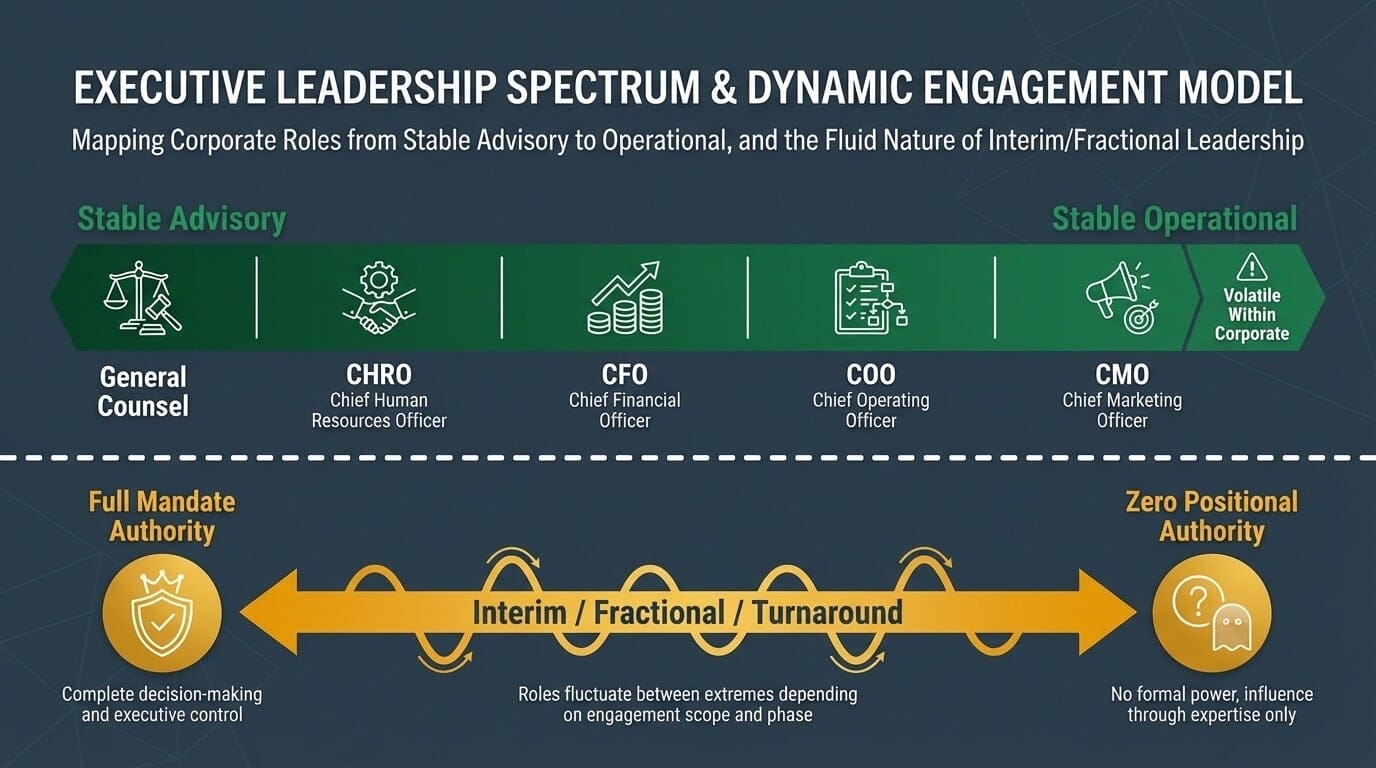
Where a leader sits in the decision architecture shapes the specific anxiety that position creates. For most leaders, that position is structurally stable. A General Counsel operates in the advisory-track power dynamics that come with the role - high influence, low direct authority, and the particular tension of seeing risks nobody else wants to hear about. That position doesn't change from quarter to quarter.
A COO holds operational authority that goes unseen until something breaks. Continuous, quiet, load-bearing. A CMO navigates accountability without control - owning outcomes produced by teams and channels that don't report to them. Each of these positions creates its own formation, its own strengths, its own blind spots. But the position itself is stable. You know where you stand in the decision architecture, even when standing there is uncomfortable.
Outside the corporate spectrum entirely: interim executives, fractional CxOs, turnaround consultants. Their authority doesn't sit within a range. It toggles between extremes - full directive authority during an active mandate, zero positional authority between engagements. No permanent corporate role oscillates like this. And that oscillation creates patterns the career installed that are as distinct and predictable as anything a functional role produces.
What the Oscillation Installs
During an active mandate, the authority often exceeds what a permanent C-suite holds. Boards and PE sponsors explicitly authorize interim leaders for the decisions the existing team couldn't or wouldn't make. The authority comes through expertise and mandate, not organizational tenure or accumulated political capital. It's time-bounded by design - six to eighteen months, exit date known to both parties. And within that window, the interim CRO or CFO has more unilateral decision rights than most permanent executives will ever hold.
Between mandates, the authority drops to zero. Not reduced - eliminated. The identity that was "the person running this company" becomes "the person writing proposals to run the next one." The financial anxiety of eat-what-you-kill compensation compounds the identity shift. There is no maintenance mode, no steady-state version of this career where the authority stays at a moderate, continuous level.
The gap isn't between having authority and wanting more of it. The gap is between the extremes the career practiced and the middle it never crossed.
The formation this creates is specific. Comfort with power - many people fear authority, but the oscillation-formed leader has wielded enormous decision rights and survived the consequences. Comfort with powerlessness - many people need status, but this leader has learned to function with no organizational standing at all, operating on expertise and reputation alone. What the oscillation never installs: medium-mode authority. Shared decision-making. Ongoing negotiation with peers who have their own mandates and their own timelines. Influence through long-term relationship rather than mandate-backed expertise. These require muscles the career never built, because the leader went from total authority to none and back again - skipping the entire middle ground that the full formation profile describes.
The anxiety this produces is categorically different from what corporate leaders experience. A General Counsel worries about being heard. An operations leader worries about being recognized. The oscillation-formed leader worries about something more existential: will there be a next mandate? That question sits underneath every engagement, even the successful ones. It isn't positional anxiety - it's survival anxiety. And it operates even during the periods of peak authority, creating a specific tension that the inverse problem - having the title but not the room - never quite captures, because the interim leader's problem is the room itself appearing and disappearing.
The Outsider Paradox
The interim professional's competitive advantage is externality. Fresh eyes that see what insiders have normalized. No political debts accumulated over years of organizational life. The ability to make hard calls - restructuring a division, exiting a market, replacing a leadership team - without worrying about the long-term relationship consequences, because there is no long term. This externality is not a side benefit. It is the differential value that boards and sponsors are paying for.
When that professional goes permanent, the advantage evaporates instantly. They are the insider now. Their perspective is no longer fresh - it's invested. Their political neutrality is gone - they have a permanent stake in every decision. The very thing that made them exceptional at the mandate role has been destroyed by the act of accepting the permanent one.
Clients rarely articulate this as a paradox. What they say is closer to "I'm not effective anymore" or "something changed and I can't figure out what." The self-diagnosis is competence doubt. What actually happened is structural: the act of joining destroyed the competitive advantage that made joining attractive to both parties. The board that wanted someone who would make the hard calls without political constraint now has a permanent executive who can no longer be politically neutral. Both sides made the decision in good faith. Neither anticipated that the value proposition would self-destruct on contact with permanence.
What Medium-Mode Actually Requires
The leader who leaves the oscillation for a permanent seat enters a genuinely foreign authority context. Shared authority means negotiated decision rights with peers - not mandate-backed unilateral decisions. The interim model worked because the engagement letter effectively granted permission to decide. In a permanent role, that permission must be built through sustained investment in peer relationships, organizational understanding, and political capital that accumulates over quarters, not weeks.
Not Sure Where to Start?
Book a free consultation to discuss your goals and find the right path forward.
No exit date changes the calculus fundamentally. In the mandate model, you can make unpopular decisions knowing you'll be gone before the political consequences compound. You deliver results and leave. In a permanent role, every unpopular decision lives with you. The people you overruled are in the next meeting, and the one after that. The formation never installed the muscle for living with consequences rather than delivering results and departing.
Influence through long-term relationship is qualitatively different from influence through expertise and mandate. It accumulates differently, decays differently, and requires different maintenance. The leader who could walk into a crisis and command a room through sheer competence now needs to build authority through consistency, trust, and the slow work of demonstrating that their judgment accounts for the organization's long-term interests - not just the immediate operational fix.
It feels like a demotion even when it's a promotion. The authority is continuous but constrained - and the formation reads "constrained" as "diminished."
This is why generic advice falls short. "Build relationships" is not wrong - it's structurally insufficient. The oscillation-formed leader knows how to build client relationships, stakeholder relationships, sponsor relationships. What they've never built is peer relationships where the authority is permanently shared and the negotiation never ends. That is what the permanent seat demands, and it operates on top of the currency shift that compounds the authority shift - the entire vocabulary of how value is demonstrated changes simultaneously with how authority is held.
What Formation-Aware Coaching Sees
The standard coaching prescription for this profile: build your influence skills, slow down, invest in relationships. Not wrong. But it treats behaviors without reaching the formation that generates them. The oscillation-formed leader can learn a stakeholder mapping framework in an afternoon. What they can't do is answer the question underneath it: who am I when my authority is neither total nor zero?
Formation-aware coaching recognizes the oscillation pattern. It sees the comfort with extremes and the atrophied middle. It understands that the existential anxiety - will there be a next mandate? - is categorically different from the positional anxiety that most executive coaching is designed to address. And it works at the identity level rather than the skill level, because the gap isn't in what this leader knows how to do. It's in who they've become through years of authority that arrives and disappears on someone else's timeline.
The outcome isn't abandoning the temporary authority formation. The mandate skills are genuinely valuable - the ability to walk into chaos, assess rapidly, decide under uncertainty, and execute under time pressure. Those capacities don't need to be unlearned. They need to be expanded. The leader who can build authority through expertise can learn to sustain authority through relationship. The person who thrives in crisis can discover what they're capable of when nothing needs fixing. The pattern-recognition that finds what's broken can also find what's nascent.
If the oscillation pattern describes something you recognize - not from a textbook but from the inside - formation-aware executive coaching is built for exactly this conversation.
Not Sure Where to Start?
Book a free consultation to discuss your goals and find the right path forward.
Book a Free Consultation →