
Coaching Skills That Separate Good Leaders from Great Ones
How do I develop an executive coaching mindset?
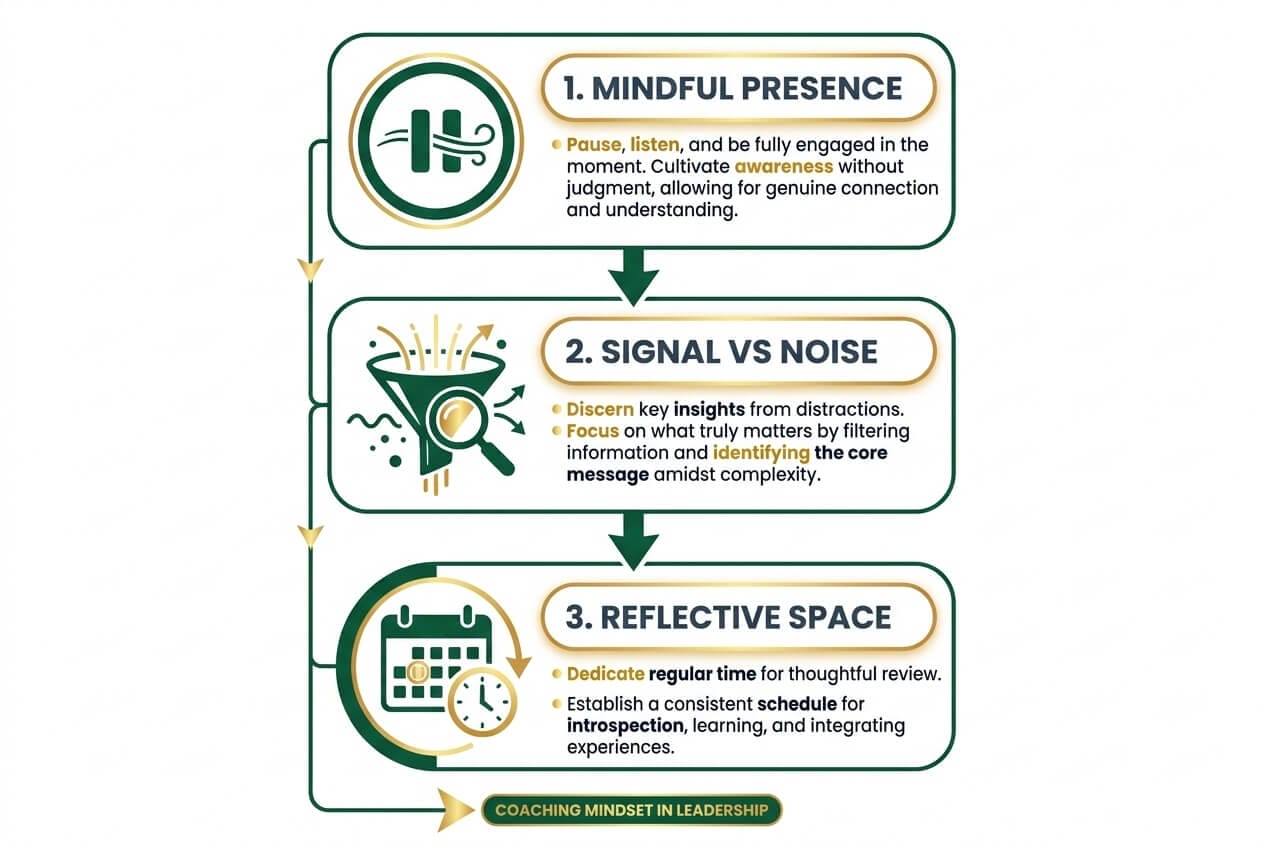
Three practices do the work. Take 90 seconds of stillness before high-stakes conversations to reset your nervous system from threat response to curiosity. Identify which two uncertainties actually change your trajectory and ignore the rest. Block 30 protected minutes weekly to ask one question: What am I not seeing? Repeat until it becomes instinct.
The executive sits across from me, arms crossed, jaw tight. She already knows what she wants to do about her underperforming VP. Fire him, restructure the team, bring in someone from outside. She came to the session looking for validation, not conversation.
I ask one question: “What would change if you didn’t have to solve this today?”
Her shoulders drop. She’s quiet for a long moment. Then she starts talking about something she hadn’t considered – what the VP’s struggles might be telling her about a problem in the organization that no personnel change would fix.
That moment – the shift from solving to seeing – is the coaching mindset at work. And it’s not a skill reserved for professional coaches. Three recent pieces from experienced coaching practitioners point to the same conclusion: the capabilities that separate competent leaders from truly effective ones aren’t technical skills or strategic frameworks. They’re shifts in how you relate to uncertainty, expertise, and the people around you.
Key Takeaways
- Your brain treats uncertainty as a physical threat, shutting down the strategic thinking you need most in high-stakes moments
- The shift from expert to facilitator is one of the most difficult – and most rewarding – transitions in executive leadership
- Coaching mindset skills like holding ambiguity, asking over telling, and creating reflective space are learnable and practical, not abstract
- Three specific practices can help executives build these capabilities without formal coaching training
Why Your Brain Fights the Coaching Mindset
The biggest obstacle to developing a coaching mindset isn’t skepticism or time constraints. It’s neurobiology.
Dr. Sarah Evans, an MCC-level coach and researcher, recently described the neurological mechanics behind this challenge. Our brains are wired to seek predictability, control, and clarity. When uncertainty shows up – a market shift, a difficult board conversation, a team conflict with no obvious resolution – the amygdala interprets it as a threat. The limbic system fires. Fight, flight, freeze, or appease.
The problem for executives is specific and costly. The amygdala’s threat response suppresses the prefrontal cortex, the part of the brain responsible for planning, strategic thinking, and emotional regulation. The moment you need your best judgment is exactly the moment your biology makes it unavailable.
Evans points to research from affective neuroscientist Jaak Panksepp showing this response can be rewired. When we meet uncertainty with curiosity instead of control, we activate what Panksepp called the SEEKING system – a neural pathway that drives exploration, learning, and the pursuit of meaning. The shift isn’t willpower. It’s a different kind of attention.
The poet John Keats named this capacity in 1817: negative capability – the ability to sit with uncertainty, mysteries, and doubts without reaching for premature resolution. Michael Hudson, writing on the concept’s application to leadership, describes it as the ability to hold multiple contradictory perspectives at once, resist premature closure on complex problems, and use ambiguity as fuel for deeper understanding rather than as a problem to eliminate.
For executives, this isn’t a philosophical idea. It’s a practical capability with direct business implications.
What Not Knowing Looks Like in Executive Leadership
Consider a VP who’s just been told her division is being restructured. Every instinct says: get ahead of this, control the narrative, protect your team. The default executive response is to move fast, decide fast, communicate certainty.
The coaching mindset suggests something different. Before acting, pause. What do you actually know? What don’t you know? What assumptions are you making because the uncertainty feels intolerable?
This isn’t passivity. It’s a different kind of leadership intelligence. The VP who can hold the ambiguity long enough to have real conversations with her team, her peers, and her leadership often discovers options that the “move fast” approach would have missed entirely. A restructure that looked like a threat becomes an opportunity to redesign a system that wasn’t working in the first place.
The executives who learn to sit with uncertainty don’t become less decisive. They make fewer decisions – and better ones.
Or take the CEO navigating a market disruption who gathers his executive team and asks, “What if our current strategy is exactly right and also completely wrong?” That question, which refuses to collapse complexity into a single answer, invites the kind of thinking that produces genuine strategic insight rather than reactive pivots.
The executives who develop this capacity share some common behaviors. They ask more questions than they answer in meetings. They get comfortable saying “I don’t know yet” to their boards. They create space between stimulus and response – not because they’re indecisive, but because they’ve learned that the quality of a decision often depends on how long you can resist the pressure to make it.
This runs counter to the dominant culture in most organizations, where speed and certainty are rewarded and ambiguity is treated as a failure of leadership. Developing a coaching mindset means questioning that assumption.
From Expert to Facilitator: The Hardest Leadership Shift
Fran Fisher, an MCC who has mentored coaches for three decades and served as a founding board member of the International Coaching Federation, recently described her own version of this shift. Early in her career, she was the person with answers. People came to her for advice, and she gave it generously. She was good at it. It felt rewarding.
Stop Being the Bottleneck
If letting go of “I have the answers” feels risky, a coach can help you shift from expert to facilitator without losing authority.
The turning point came when she recognized that the satisfaction she got from being helpful was actually getting in the way. The more she provided answers, the less her clients developed their own capacity to find them. This is the core of coaching the person, not just the problem. The real shift was moving from expert to facilitator – from someone who solves to someone who creates the conditions for others to solve.
This pattern plays out in executive leadership every day. The technical leader who got promoted because she was the smartest person in the room now needs to build a team that’s smarter than she is. The founder who built the company on instinct and personal drive needs to distribute decision-making across an organization that’s outgrown his ability to touch everything.
The shift from “I have the answers” to “my team has the answers” isn’t a loss of control. It’s an expansion of capacity. When a leader stops being the bottleneck for every decision, the organization develops its own intelligence. Teams start solving problems the leader didn’t even know existed. People take ownership because they’re trusted to think, not just execute.
The difficulty is real, though. Letting go of expertise as your primary value requires a different source of professional identity. It means measuring your impact by what your team produces, not by what you personally contribute. For many executives, that feels like giving something up. What it actually creates is something larger than any individual contribution.
The Opportunity Mindset in Practice
A recent ICF Global article explored what they call “the opportunity mindset” – the idea that some of the most important professional insights don’t come from formal analysis or strategic planning. They come from conversations.
For executives, this translates directly. The leaders who approach conversations with curiosity rather than an agenda tend to discover things their more structured colleagues miss. A casual check-in with a frontline manager reveals a customer pattern that hasn’t shown up in the data yet. A question asked out of genuine interest at a board dinner opens a partnership opportunity that no RFP process would have surfaced.
This isn’t about being unfocused or undisciplined. It’s about expanding your aperture. The coaching mindset treats every interaction as a potential source of insight, not just the ones scheduled on the strategic calendar.
Executives who build this habit tend to do a few things consistently. They pay attention to trends at the edges of their industry, not just the center. They ask questions they don’t already know the answer to – a harder habit to develop than it sounds. They treat disagreement as data rather than as a problem to manage.
The opportunity mindset also changes how leaders think about their own development. Rather than waiting for a formal coaching engagement or leadership program, they start treating their daily work as a practice ground. Every meeting is a chance to listen differently. Every conflict is a chance to hold complexity instead of collapsing it. Every conversation is a chance to be curious instead of certain.
Three Practices for Building a Coaching Mindset
These aren’t abstract concepts. They’re specific behaviors you can start practicing in the work you’re already doing.
Practice 1: Mindful presence before high-stakes conversations.
Before your next difficult meeting, take 90 seconds. Stop moving. Notice the impulse to plan your opening statement or rehearse your argument. Name what you’re feeling – anxiety, frustration, pressure to perform. Stay with it for a few breaths without trying to fix it.
This isn’t meditation. It’s a reset. Evans draws on neuroscience research by Nan Wise showing that these micro-moments of awareness literally rewire the brain’s response to uncertainty. You’re training your nervous system to stay in SEEKING mode – curious and open – rather than defaulting to threat response. Over time, you build what Evans calls an internal emotional flexibility that lets you stay grounded when the situation around you isn’t.
Practice 2: Distinguish signals from noise.
Not every uncertainty deserves your attention. The skill is learning to separate the substantive unknowns – the questions that are strategically important and too consequential to ignore – from the trivial ambiguities that create anxiety but don’t actually matter.
Before your next leadership team meeting, ask yourself: of the five things keeping me up at night, which two would actually change our trajectory? Focus your energy there. Let the rest exist without resolution. This kind of purposeful selectivity is what Evans calls “listening for signals” – directing your uncertainty tolerance toward the questions that deserve it.
Practice 3: Create structured reflective space.
Block 30 minutes on your calendar each week that’s protected from meetings, email, and operational demands. Use it to think about one question: What am I not seeing?
This isn’t journaling or planning. It’s creating the conditions for the kind of insight that doesn’t happen when you’re moving at operational speed. Executives who maintain this practice consistently report that their best strategic thinking happens in these protected spaces, not in the strategy meetings designed for that purpose.
The coaching mindset isn’t a certification or a training program. It’s a way of being with complexity that develops through practice – and often through the discomfort of doing things differently than your instincts suggest.
The executives I work with who develop these capabilities don’t become less decisive. They become more deliberately decisive. They make better choices because they’ve given themselves permission to sit with a question before answering it, to listen before advising, to be curious before being certain. That’s what executive coaching builds.
What would change in your leadership if you treated not knowing as a skill rather than a weakness? If you gave yourself 90 seconds of stillness before your next high-stakes conversation? If you spent less time being the expert and more time creating the conditions for your team’s expertise to surface?
Those questions don’t need an answer right now. Sit with them.
Turn Uncertainty Into Better Decisions
If you’re stuck between “solve it now” and “see what’s really happening,” book a free consult to map next steps for your leadership.
Book a Free Consultation →