Executive Coaching for Women: Systems, Not Just Confidence
What is executive coaching for women?
Executive coaching for women is one-on-one leadership coaching that helps senior women navigate the systemic patterns—compensation gaps, perception double standards, and visibility traps—that general coaching misses. The strongest engagements anchor salary negotiations on what a male peer would ask for, map an organization’s unwritten rules, and are led by MCC-credentialed coaches, including a female Master Certified Coach.
Key Takeaways
- The three patterns that show up most in coaching women leaders (compensation, perception, visibility) are systemic, not personal. They cross industries and seniority levels.
- Women do not lack negotiation skill. The gap is in anchoring: asking “What would a man at my level ask for?” instead of “What is the minimum I would accept?”
- Executive presence for women is not about performing confidence. It is about observing what success looks like in your specific organization and adapting strategically.
- When you hire, screen for a systemic lens, not just individual skill-building. Ask how a coach handles organizational dynamics, not only personal development.
- The return often shows up first in compensation. A single well-anchored negotiation can return several times the cost of the engagement.
Who Executive Coaching for Women Is For—and Who Delivers It
Executive coaching for women is built for senior leaders operating in systems that were not designed around them: directors and VPs targeting the C-suite, newly promoted executives inheriting teams that underestimate them, and founders or partners who carry P&L responsibility but not yet the perceived authority that should come with it. If you are highly capable and still watching less-qualified peers get sponsored past you, that gap is what this coaching is for.
It is not remedial. Most women who seek it are already effective leaders. What they want is a coach who can name the organizational dynamics working against them and build strategy around those dynamics, rather than a generic development plan that treats the friction as a personal shortcoming.
Who delivers it matters as much as the method. At Tandem’s executive coaching practice, engagements are led by two Master Certified Coaches (MCC, the highest credential the International Coaching Federation issues, held by fewer than 4% of coaches worldwide): Cherie Silas, MCC, a woman executive who has navigated these systemic patterns firsthand, and a male MCC who brings an insider read on how male-dominated leadership cultures actually operate. You can request the coach whose perspective fits your situation—many clients specifically want a female executive coach who has lived the double bind, and some want both lenses across the engagement.
The clearest way to see what you are buying is to compare how two coaches respond to the same problem. A coach working symptom by symptom hands you a technique. A coach working the system asks what in the organization is producing the symptom in the first place.
| What you bring to coaching | Symptom-focused coaching (typical) | System-focused coaching (Tandem) |
|---|---|---|
| “I’m not being heard in meetings” | Teaches assertive-communication techniques | Maps who sets the agenda, how decisions actually get made, and where to intervene structurally |
| “I was passed over for promotion” | Builds a personal development plan | Examines promotion criteria, sponsorship gaps, and how visibility is assigned in your org |
| “I undersold myself in the offer” | Practices negotiation scripts | Resets the anchor to market value and rebuilds the internal script behind the number |
| “The invisible office work lands on me” | Suggests learning to say no | Resets team norms so logistical labor stops defaulting to the women in the room |
What Makes Coaching Different for Women
Three patterns show up in nearly every executive coaching engagement with women leaders. They cross industries, seniority levels, and company size. And they are rarely about missing skills.
The first is compensation. Women consistently accept less than men at the same skill level in the same role. Not because they cannot negotiate, but because they have been conditioned to anchor on "What is the lowest I would accept?" instead of "What would my male counterpart ask for?"
The second is perception. The same behavior that reads as assertive from a male executive reads as emotional from a woman. A man raises his voice in a strategy meeting and the room hears conviction. A woman does the same and the room hears instability. The behavior is identical. The interpretation is not.
The third is visibility. Women are more likely to handle the logistical work that keeps meetings running: organizing materials, following up on action items, making sure the room is set up. That work is necessary and unrecognized. Worse, it actively lowers perceived status in the leadership group.
These are not individual failings. They are systemic patterns that coaching addresses at both the personal and organizational level.
The Double Standard in the Boardroom
The perception gap between men and women in executive roles is well-documented. Research on unseen barriers to women's advancement shows that women face a "prove it again" pattern: they must demonstrate competence repeatedly in situations where men are given the benefit of the doubt after a single success.
In coaching, this pattern surfaces in specific, observable ways. A woman VP describes presenting the same strategic recommendation her male peer presented two weeks earlier. His version was approved. Hers was tabled for further analysis. The content was identical. The credibility assigned to the speaker was not.
Or consider the meeting cleanup problem. After a working session, a senior woman notices the empty coffee cups and scattered papers. She stacks them on her way out. The men walk past. The next day, the team unconsciously files her as "the one who handles the details" rather than "the one who drove the strategy discussion." One small action, repeated over months, reshapes how the group perceives her leadership capacity.
These dynamics compound over time. A woman who is seen as “detail-oriented” rather than “strategic” gets assigned to operational roles instead of growth roles. She delivers results there, which reinforces the perception. Within three years, her male peers have moved into P&L ownership while she runs increasingly complex operations with no line-of-sight to the C-suite. The original cause was not skill or ambition. It was one unconscious pattern left unchecked.
Coaching does not pretend these dynamics are fair. It does not tell women to ignore them or to simply “be more confident.” It names the patterns, makes them visible, and builds specific strategies for operating within a system that was not designed for them, while also equipping women to change that system from the inside.
Naming the pattern is only the first move. The next is deciding what to do about it, and that is where the two-level distinction between symptom and system starts to change outcomes rather than just describe them.
Building Presence Without Performing
Executive presence is the most frequently cited goal when women leaders seek executive presence coaching. But presence for women is complicated by the double bind: too assertive and you are labeled aggressive, too collaborative and you are labeled soft.
Close the Gap Between How You Lead and How You’re Read
If you’re stuck in the double bind, a coach can help you identify the unwritten rules and adjust your framing without losing authenticity.
One technique that works: behavioral observation of leaders one and two levels above you. Not to imitate them, but to map what success looks like in your specific organization. How do the most effective leaders in your company communicate in high-stakes meetings? How do they handle disagreement? How do they signal authority without relying on volume or position?
This is not about performing a version of leadership that does not belong to you. It is about understanding the unwritten rules of your organization well enough to use them strategically. Women who develop this observational skill report that the gap between how they lead and how they are perceived begins to close. Not because they changed who they are, but because they learned where the system needs to be met on its own terms.
A common example: a woman director notices that the two most respected VPs in her division never apologize for taking up time in meetings. They state their point and stop talking. She realizes she opens every contribution with “Sorry, just a quick thought”, a verbal habit that signals lower status twelve times a day. Within two weeks of dropping that phrase, colleagues begin responding to her input differently. Not because the ideas changed. Because the framing did.
The distinction matters. Developing executive presence as a woman leader is not about becoming someone else. It is about becoming more visible as the leader you already are, in a system that was not built to see you clearly. Research from the Center for Creative Leadership confirms that women and men are evaluated on different criteria for the same leadership behaviors, a gap that targeted coaching directly addresses.
Salary, Negotiation, and Knowing Your Number
Salary negotiation is one of the fastest-moving coaching topics for women executives. Not because women lack negotiation skill. Most are highly effective negotiators in every other context. The gap is in how they negotiate for themselves.
The reframing technique: Instead of asking yourself “What is the lowest salary I would accept?” ask “What would a man at my skill level, in this role, ask for?” Then ask for more than that. The negotiation is expected. The system is built for it. Women who anchor on the minimum leave money on the table that their male counterparts collect without hesitation.
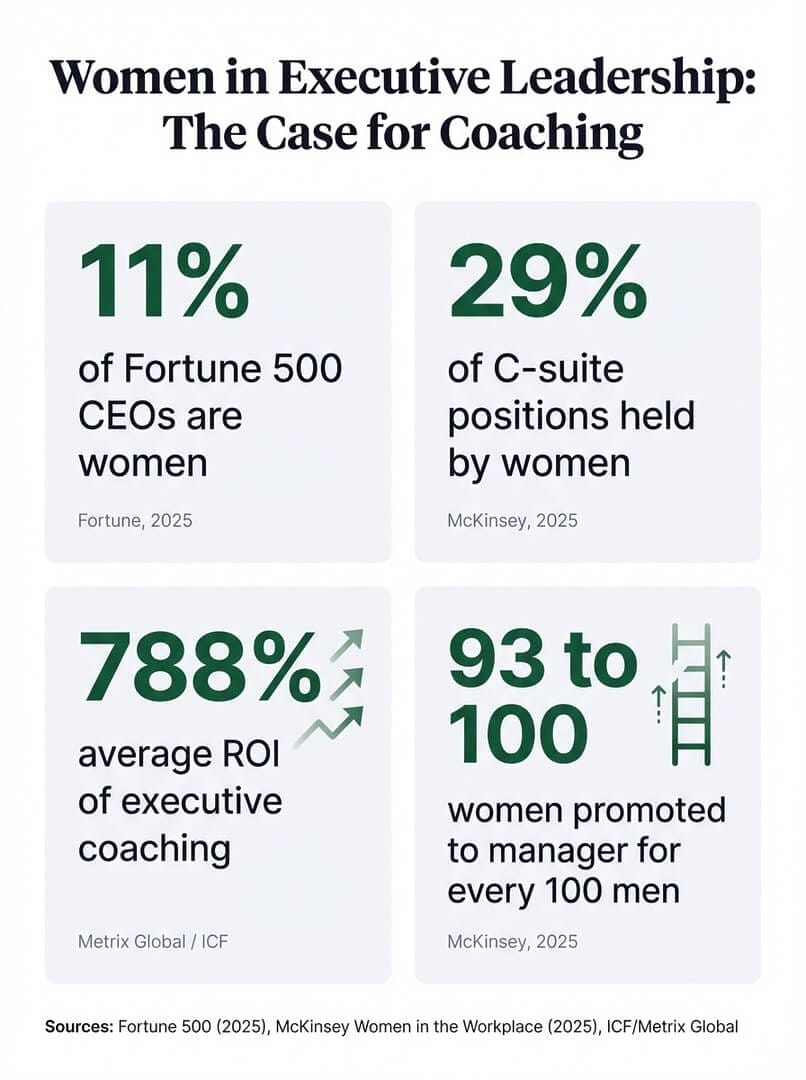
Women in the Workplace research consistently shows that women are promoted at lower rates than men and compensated less for equivalent work. Coaching addresses this at the behavioral level: retraining the internal script from "What can I get?" to "What do I deserve based on the value I deliver?"
Women who go through this process often describe a shift that extends beyond salary. Once you learn to negotiate compensation from a position of earned value rather than gratitude for the opportunity, the same mindset applies to project assignments, visibility opportunities, and board-level conversations. The skill is transferable because the underlying pattern (undervaluing your own contribution) shows up everywhere. A woman who learns to ask for appropriate compensation also learns to claim credit for results, request high-visibility projects, and push back on assignments that are below her capability level. The negotiation skill becomes a leadership posture.
How Coaching Works in Practice
Executive coaching for women typically begins with an assessment that identifies the specific patterns affecting your leadership effectiveness. One resource that accelerates this is Marshall Goldsmith’s How Women Rise, which catalogs seven behavioral habits that hold women back in executive roles. The book is not exclusively about women. Roughly 30% of male executives exhibit the same patterns, but the frequency and organizational consequences are disproportionately felt by women.
From there, coaching builds on three tracks simultaneously.
Track 1: Pattern recognition. You learn to see the systemic dynamics operating in your organization. Not as abstract theory, but as specific interactions you can observe and respond to. Who gets interrupted in meetings? Whose ideas are attributed to someone else? Where does logistical work land disproportionately? Most women executives can answer these questions within minutes once someone asks. The problem is that no one in a position of authority asks. Coaching makes the invisible architecture of your workplace visible so you can work within it deliberately rather than react to it unconsciously.
Track 2: Strategic adaptation. Coaching develops the skills to operate within the system you are in while maintaining your authentic leadership identity. This includes the behavioral observation technique described above, communication adjustments for specific high-stakes contexts, and a mental model we call the reframing question: "How would a man in this same position handle this scenario?" Not to imitate male leadership, but to identify where gendered expectations are constraining your options.
Track 3: Organizational influence. For women targeting coaching for women in the C-suite or senior leadership positions, coaching extends beyond personal development into organizational change. How do you influence hiring practices, meeting norms, and promotion criteria from within? How do you build coalitions with other leaders who see the same systemic issues? Setting leadership development goals for women leaders at this level means defining success in terms of both personal advancement and the organizational conditions you leave behind.
A woman who learns to negotiate compensation from earned value rather than gratitude for the opportunity does not just earn more money. She changes how she shows up in every room she enters.
What It Costs—and Whether It Is Worth It
Executive coaching is priced by the depth of the coach and the shape of the engagement, not by a flat rate. The variables that move the number are the coach’s credential level (an MCC with 2,500+ logged hours commands more than a newly certified coach), the length of the engagement (a focused three-month sprint versus a year of C-suite partnership), and the format (one-on-one versus a blended program with assessments and stakeholder interviews). Rather than publish a list price, Tandem scopes the engagement to the situation in a first conversation, so you are pricing the actual work, not a package.
On whether it is worth it, the honest answer is that the return usually appears first in compensation. If coaching helps you anchor a single offer or promotion negotiation at market value instead of your minimum, that one conversation frequently returns several times the cost of the engagement—and unlike a one-time bonus, the corrected salary compounds across every future raise calculated as a percentage of it. The broader case for hiring an executive coach is well-established: the ICF and Metrix Global studies put the median ROI of executive coaching in the high multiples, and the effect is larger for leaders correcting a systemic undervaluation rather than a skill gap.
The non-financial return is harder to price but often matters more over a career: the shift from doing the invisible work to assigning it, from asking permission to setting the agenda, from being read as operational to being read as strategic. Those changes decide who gets the P&L role and who gets the complex-but-capped operations role, and that fork is worth far more than any coaching fee.
Choosing the Right Coach
Three factors matter more than any marketing claim when selecting an executive coach as a woman leader.
Interview Your Coach Like a Board Decision
Want an MCC coach who can spot systemic dynamics (not just “communication tips”)? See how Tandem approaches women’s leadership coaching.
Credential depth. ICF credentials come in three levels: ACC (Associate, 100+ coaching hours), PCC (Professional, 500+ hours), and MCC (Master, 2,500+ hours). The hours are not just practice. They represent the breadth of client situations a coach has navigated. For women-specific coaching, the lived hours matter because systemic patterns are subtle and easily missed by coaches with limited experience.
Experience with your context. Has the coach worked with women at your level, in your type of organization? A coach who primarily works with mid-career managers will not have the same pattern recognition for C-suite dynamics. Ask for specifics: how many women executives they have coached, what industries, and what organizational challenges came up most frequently.
Systemic lens. Does the coach frame challenges as individual skill gaps to fix, or does she recognize the organizational conditions creating those challenges? A coach who only works at the individual level will help you adapt. A coach with a systemic perspective will help you adapt AND influence the system. Both matter. The combination is what produces lasting career impact.
One useful screening question: “When a woman client tells you she is not being heard in meetings, what is your first move?” A coach focused on individual skills will talk about communication techniques. A coach with a systemic lens will ask about the meeting structure, who sets the agenda, how decisions get made, and whether other women in the organization report the same experience. The first approach treats the symptom. The second treats the system.
If you are ready to explore what executive coaching for women leaders at Tandem looks like in practice, start with a conversation. The first step is understanding your specific situation, not a sales pitch—and you can ask to work with a female MCC coach who has navigated the same dynamics.
Frequently Asked Questions
Can I work with a female executive coach at Tandem?
Yes. Tandem’s team includes Cherie Silas, an ICF Master Certified Coach (MCC) who has navigated these systemic dynamics as a woman executive, alongside a male MCC who brings an insider read on male-dominated leadership cultures. Many women specifically want a female executive coach who has lived the double bind; you can request that coach, or work with both perspectives across the engagement. What matters most is that whoever you choose holds the deep credential and the systemic lens.
Is executive coaching for women worth the investment?
For most senior women the return shows up first in compensation: a single offer or promotion negotiation anchored at market value instead of your minimum frequently returns several times the engagement cost, and that corrected salary compounds across every future raise. The ICF and Metrix Global studies put the median ROI of executive coaching in the high multiples, and the effect is larger for leaders correcting a systemic undervaluation rather than a skill gap. Beyond salary, the shift in how you claim credit, request visibility, and set team norms compounds over a whole career.
Why is executive coaching for women structured differently than general executive coaching?
Three patterns show up in nearly every engagement with women leaders: compensation gaps, perception double standards, and disproportionate logistical work. These are systemic, not personal, so coaching addresses both the individual skill level and the organizational system the leader is operating inside. Coaches who only work at the individual level treat the symptom; coaches with a systemic lens treat the source.
What is the reframing technique for salary negotiation?
Instead of asking 'What is the lowest salary I would accept?' ask 'What would a man at my skill level in this role ask for?' Then anchor higher than that number. Most women executives are highly effective negotiators in every other context; the gap is in how they negotiate for themselves. The reframe rebuilds the internal script from 'What can I get?' to 'What do I deserve based on the value I deliver?'
How do I evaluate whether an executive coach understands women's leadership dynamics?
Ask the screening question: 'When a woman client tells you she is not being heard in meetings, what is your first move?' A coach focused on individual skills will talk about communication techniques. A coach with a systemic lens will ask about meeting structure, who sets the agenda, how decisions get made, and whether other women in the organization report the same experience. The second approach is the one that produces lasting impact.
Talk Through Your Situation—Not a Generic Plan
Bring the meeting dynamics, “prove it again” moments, or comp numbers you’re weighing. We’ll map next steps in a free consult.
Book a Free Consultation →Plan the engagement first →