
Executive Presence Training: A Buyer’s Guide for HR Leaders
How do I choose executive presence training?
Diagnose the gap type first. Expression gaps respond to training programs. Authority and Context gaps require coaching or coaching-embedded programs. Match format to gap, not budget to brand. Then apply the eight evaluation questions on diagnostic rigor, measurement, customization, and follow-through before signing any contract.
A senior leader in your organization has received feedback about executive presence. The CHRO wants a development plan. Your job is to find the right program, and the search returns a wall of landing pages, each claiming the same outcome in different packaging. Executive presence is a perception gap, not a personality trait, and matching the right intervention to the right gap type is the decision that determines whether the investment produces behavioral change or just a certificate.
This is the buyer’s guide that training providers cannot write. It names real programs with real prices, maps the four major program formats, and gives you the evaluation framework to match the investment to the gap.
Key Takeaways
- Executive presence training programs fall into four categories: university certificates, corporate workshops, coaching-embedded programs, and online self-paced courses, each suited to different development needs and budgets.
- The gap type matters more than the program format. Expression gaps respond well to training. Authority and Context gaps require coaching or a coaching-embedded approach.
- Most training failures trace to three patterns: no follow-through after the workshop, satisfaction surveys instead of behavioral measurement, and generic content applied to diverse gap types.
- Eight evaluation questions, grouped by diagnostic rigor, measurement, customization, and follow-through, separate programs that produce behavioral change from programs that produce good reviews.
Types of Executive Presence Training Programs
Executive presence training programs range from $49 online courses to $5,900 in-person intensives. The format determines what kind of development the program can deliver, and no single format fits every situation. Four categories account for nearly all options on the market.
University Certificate Programs
University certificates carry institutional credibility and structured curricula. Wharton’s Executive Presence and Influence program runs six weeks online for approximately $2,600, covering communication frameworks and influence techniques. Berkeley’s Advanced Executive Presence Program is a three-day in-person intensive at $5,900 with a performance-based methodology. INSEAD offers a five-week online program at roughly $2,300 focused on leadership communication.
These programs excel at building foundational awareness. They do not typically include individual assessment, 1:1 coaching, or behavioral measurement at three or six months. For a leader who has never examined their communication patterns or received structured presence feedback, a university certificate provides a strong starting point.
Corporate Workshops
Corporate workshops (Dale Carnegie, Franklin Covey, and similar providers) run one to three days, on-site or virtual, with content customized to the organization. Pricing varies by group size, typically $1,500 to $4,000 per participant. The strength is efficiency: a team of ten leaders gets shared vocabulary and practice time in a compressed format. Many organizations use workshops as a leadership bench development tool, exposing emerging leaders to presence concepts before individual gaps become visible in stakeholder feedback.
The limitation is depth. Two days cannot address the individual perception gaps that drive most presence feedback. A workshop can teach a room of leaders how executive presence functions as a concept. It cannot tell each leader which specific gap their stakeholders are seeing.
Coaching-Embedded Programs
Coaching-embedded programs combine group training with individual coaching sessions before, during, and after the cohort experience. Pre-program assessment (360-degree feedback, behavioral instruments, or emotional intelligence measures) identifies each participant’s specific gap type. The group sessions build shared frameworks. The individual coaching closes the gap that group learning cannot reach.
In practice, a coaching-embedded program might include pre-program assessment to identify each participant’s gap type, a two-to-three-day training program where content is informed by aggregate assessment themes, and then three to six individual coaching sessions spaced over three months to address the specific gap the assessment revealed. Investment runs $5,000 to $15,000+ per participant depending on the coaching duration and assessment depth.
Online Self-Paced Courses
Online self-paced courses on platforms like Coursera, LinkedIn Learning, and Udemy cost $49 to $99 per person. They provide conceptual exposure at scale. No individual feedback, no accountability structure, no behavioral measurement. Useful for awareness-level development across a broad population, not for closing a specific leader’s presence gap.
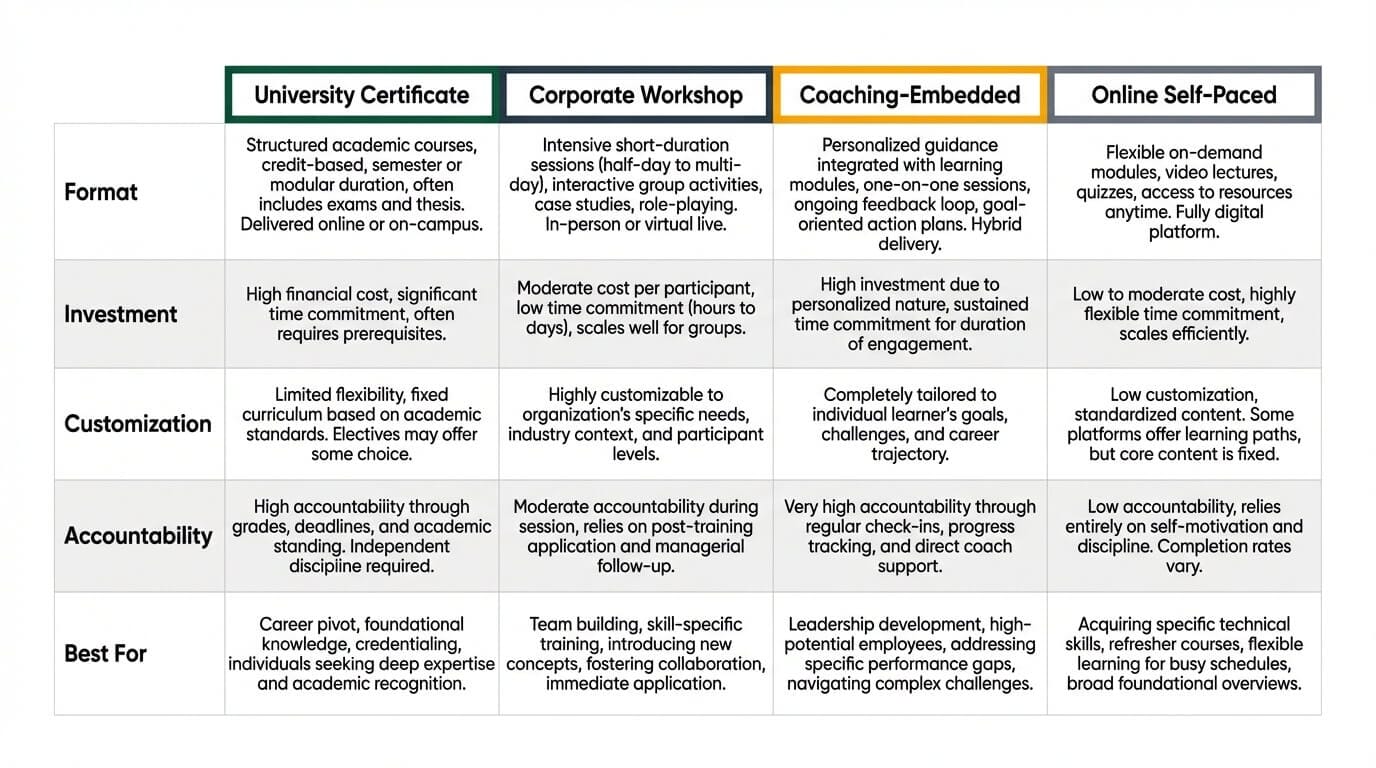
| Program Type | Format | Investment | Customization | Accountability | Best For |
|---|---|---|---|---|---|
| University Certificate | 3-6 weeks online or 2-3 day in-person | $2,300–$5,900 | Low (standard curriculum) | Moderate (cohort deadlines) | Individual leaders building foundational awareness |
| Corporate Workshop | 1-3 days, on-site or virtual | $1,500–$4,000/person | Moderate (org-customized) | Low (event-based) | Leadership teams needing shared vocabulary |
| Coaching-Embedded | 3-6 months, group + individual | $5,000–$15,000+/person | High (assessment-informed) | High (coaching + measurement) | Leaders with specific, diagnosed presence gaps |
| Online Self-Paced | Self-directed, 4-8 hours | $49–$99 | None | None | Broad awareness at scale |
The table makes the trade-offs visible, but format alone does not determine outcomes. The types of coaching for leaders available within a program matter as much as the program structure itself. A well-facilitated workshop can outperform a poorly designed coaching-embedded program if the facilitator brings genuine diagnostic skill.
The format of a training program tells you what the schedule looks like. The diagnostic rigor of the facilitator tells you what the outcome will be.
How to Evaluate a Training Program
Program brochures emphasize what participants will learn. They rarely describe how behavioral change will be measured or whether the content adapts to individual needs. Five evaluation dimensions separate programs that produce lasting development from programs that produce temporary enthusiasm.
Want a Second Set of Eyes on Vendor Claims?
Bring a brochure or proposal. We’ll pressure-test diagnostic rigor, measurement (Level 3), customization, and follow-through before you invest.
Facilitator Credentials
The person leading the program matters more than the institution hosting it. Look for facilitators with coaching credentials (ICF PCC or MCC), experience with executive populations, and familiarity with behavioral assessment instruments. A communication professor and an executive coach bring fundamentally different skill sets. Both are valid. The question is which skill set matches what your leader actually needs.
Measurement Methodology
Ask how the program measures outcomes. Most programs measure at Kirkpatrick Level 1 (participant satisfaction) or Level 2 (knowledge acquisition). Those are smile sheets. The question that matters is Level 3: did observable behavior change? And the question after that is whether stakeholder perception shifted at 90 days, at 180 days. Programs that cannot answer those questions are selling an experience, not a development outcome. Hewlett’s framework provides one lens for defining what “presence” means. But without measurement methodology tied to behavioral observation, any framework stays theoretical.
Customization
Does the program deliver one curriculum to all participants, or does it differentiate based on individual assessment data? A leader whose 360 feedback reveals that direct reports experience detachment where the leader experiences deep engagement has a different development need than a leader whose feedback reveals over-preparation compensating for authority uncertainty. Cookie-cutter content addresses neither well. Assessment-based executive presence development starts with diagnosis, not curriculum.
Follow-Through
A two-day workshop creates awareness and initial motivation. Behavioral change requires sustained practice with feedback. Without post-program reinforcement, participants revert to baseline within four to six weeks. The evaluation question: what happens after the last session? If the answer is “nothing,” the program is an event, not a development intervention.
Awareness without follow-through is the most expensive way to change nothing.
Group Size and Participant Profile
A program with 50 participants and one facilitator cannot provide individual feedback. A program with 8 participants and two facilitators can. The participant profile also matters: are you placing a VP among directors, or among peers? The cohort dynamics affect psychological safety, which affects willingness to practice new behaviors in real time. Senior leaders will not experiment with unfamiliar communication patterns in front of people they manage.
The most expensive mistake in executive presence training is applying generic content to a diagnosed gap. A leader flagged for “lacking presence” in stakeholder feedback does not need the same program as a high-potential director building leadership skills for a future role. The feedback language may be identical. The underlying gap type is not.
Training vs. Coaching: When Each Is Right
Training and coaching address different types of executive presence gaps. The investment decision is diagnostic: which gap type is primary determines which intervention is right. If you understand what executive coaching involves, the distinction becomes practical rather than theoretical.
Three gap types clarify the decision.
Expression gaps occur when leaders process deeply but display little. Their teams experience detachment where the leader experiences engagement. These gaps respond well to training because the underlying need is skill acquisition: learning to narrate decision rationale in real time, making internal processing visible, practicing techniques that increase external expression. A structured program with practice opportunities and peer feedback can close an expression gap efficiently.
Authority gaps occur when leaders have not yet shifted from proving value to projecting confidence. They over-prepare, over-explain, and add to every conversation when their role now requires restraint, questions, and selective contribution. Authority gaps do not respond to training because the underlying need is not knowledge. It is behavioral change in context, coached through real leadership situations over months, not taught in a workshop over days. This is where executive presence coaching produces results that training cannot.
Context gaps occur when the organization’s cultural template and the leader’s style do not match. The leader was effective in a previous role or company. The new environment defines “executive” differently. Training cannot close a context gap because the gap is not in the leader. It is in the relationship between the leader’s style and the organization’s expectations. Coaching helps the leader read and adapt to the context. Sometimes the honest recommendation is not coaching at all but a conversation with the CHRO about which leadership styles are being systematically excluded.
The strongest approach for many organizations combines both. Training handles the knowledge layer at scale: shared vocabulary, communication frameworks, awareness of presence patterns. Coaching handles the individual behavioral layer: diagnosing the specific gap, designing a targeted development plan, and working through real situations where the gap appears. The training investment is lower per person. The coaching investment is deeper per person. Combining them gets the economics of group learning with the outcomes of individualized development.
The executive coaching cost for a six-month presence engagement typically runs $15,000 to $30,000 per leader. Training runs $2,000 to $6,000. The question is not which costs less. The question is which one closes the gap that actually showed up in the feedback. A leader with an expression gap who gets coaching instead of training is over-served. A leader with a context gap who gets training instead of coaching is under-served. Both waste the investment.
For leaders interested in developing executive presence independently, self-directed work can supplement either approach but rarely replaces the feedback loop that both training and coaching provide. The distinction between executive coaching vs. life coaching also matters here: life coaching works from the client’s self-defined goals. Executive coaching works from organizational data and stakeholder feedback, which is exactly what presence development requires.
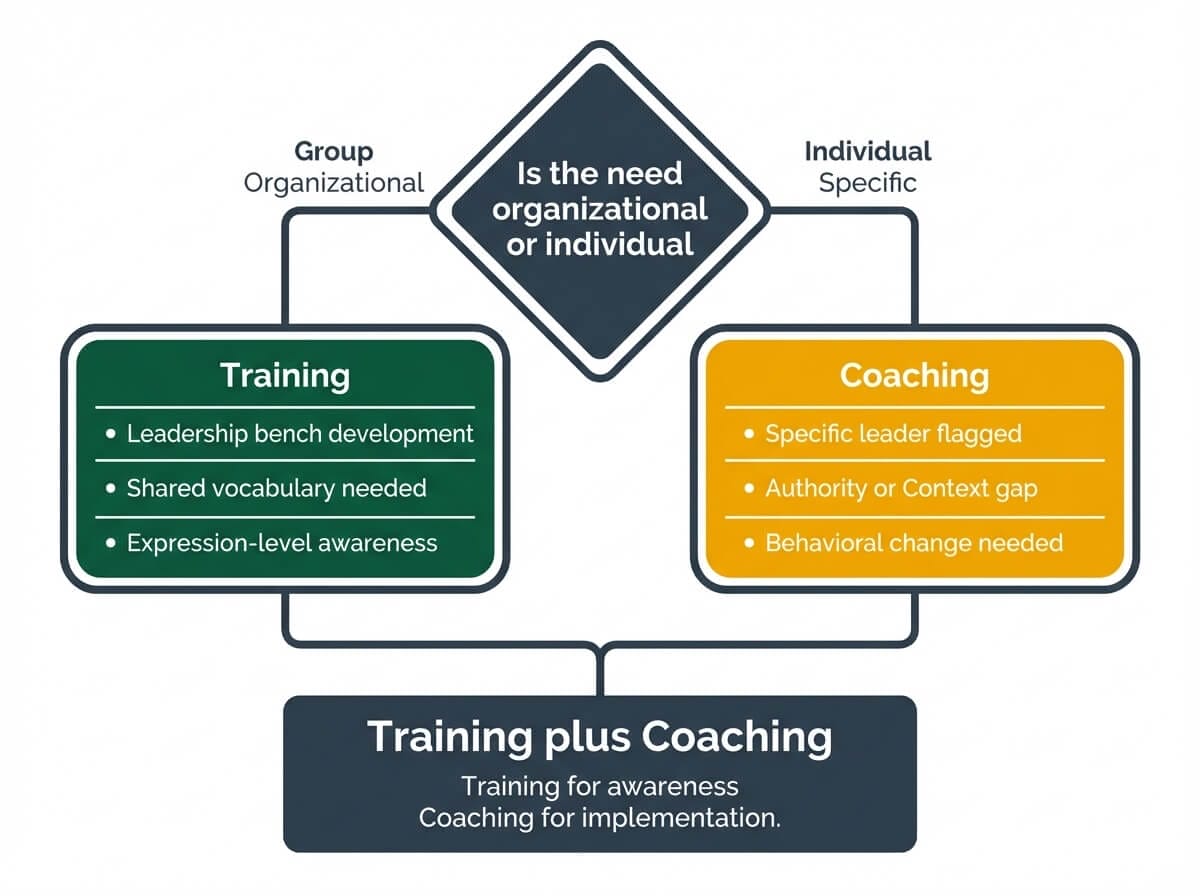
A leader with an expression gap who gets coaching is over-served. A leader with a context gap who gets training is under-served. Both waste the investment.
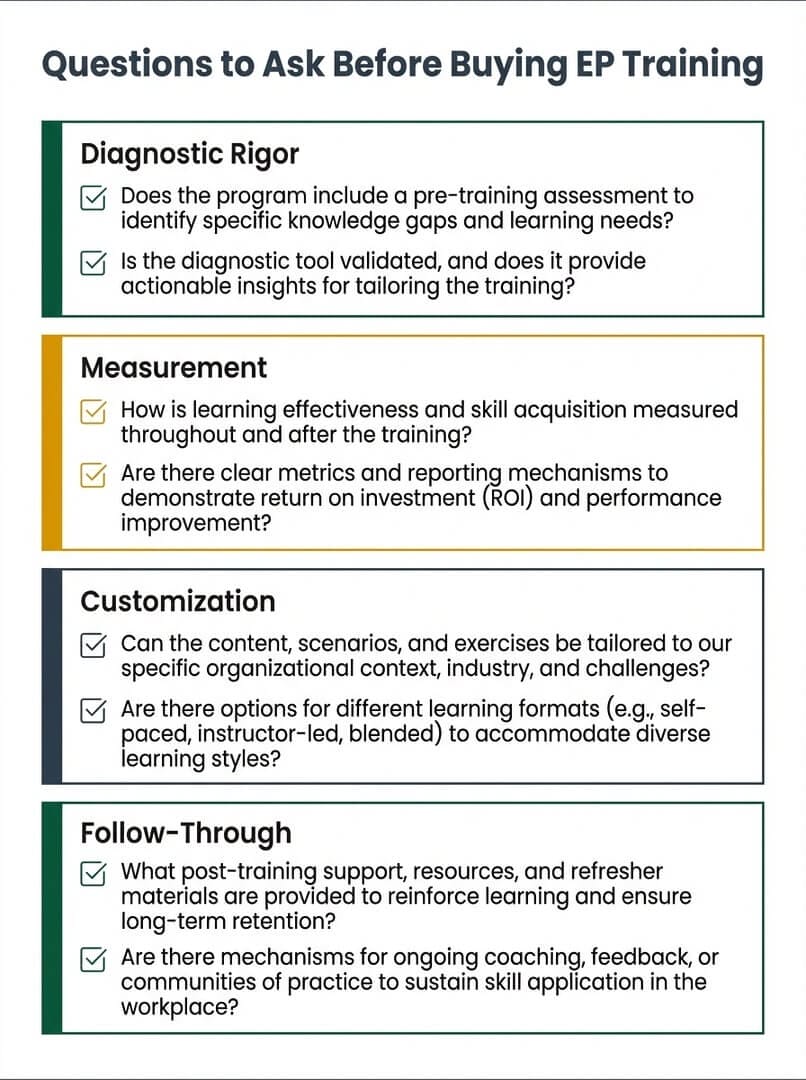
What to Ask Before You Buy
These ten questions separate programs that produce behavioral change from programs that produce good reviews. Group them into four categories when evaluating any executive presence training provider.
Diagnostic Rigor
- How do you diagnose each participant’s specific presence gap before the program begins? Programs that skip individual assessment deliver generic content. The diagnosis determines whether the content will be relevant to the individual leader.
- What instruments inform your program design? 360-degree feedback, emotional intelligence assessments, behavioral tendency profiles, and stakeholder interviews each reveal different dimensions. The combination matters more than any single instrument.
Measurement
- How do you measure behavioral change after the program? Participant satisfaction surveys do not measure development. Ask for 90-day or 180-day behavioral outcome data. If the provider cannot describe their measurement methodology, the program has not been designed to produce measurable results.
- Can you share anonymized outcome data from previous cohorts? Providers confident in their results will have this data. Providers who do not track outcomes will redirect the conversation to testimonials.
Customization
- How is content adapted to participants’ specific gaps? One curriculum for all participants means the program teaches a general model, not the specific behaviors each leader needs to change.
- What is the facilitator-to-participant ratio? A ratio above 1:12 limits the facilitator’s ability to observe, diagnose, and coach in real time.
- What is the experience level of your facilitators with executive populations? Teaching communication skills to mid-level managers and coaching presence with senior executives are different activities. The facilitator’s experience with your population determines whether feedback lands or bounces.
Follow-Through
- What happens after the last session ends? Programs without post-program support assume that awareness produces behavioral change. It does not. Ask about coaching follow-ups, peer practice groups, manager involvement, or structured application assignments.
- How do you ensure behavioral transfer to the actual work environment? Practice in a workshop room is not the same as practice in a leadership team meeting. The gap between training context and work context determines whether learning sticks.
- What is the expected timeline for observable change? Honest providers will say weeks for behavioral adjustments, months for stakeholder perception to catch up. Providers who promise rapid transformation are selling a different product than development.
FAQ: Executive Presence Training
What is the best executive presence training program?
There is no single best program. The right choice depends on the gap type (Expression, Authority, or Context), budget, group size, and whether the need is foundational awareness or targeted behavioral change. University certificates like Wharton ($2,600) and Berkeley ($5,900) are strong for individual awareness. Coaching-embedded programs ($5,000-$15,000+) produce deeper results for leaders with specific diagnosed gaps. The evaluation questions in this article help match the program to the need.
How much does executive presence training cost?
Costs range from $49 for online self-paced courses to $15,000+ for coaching-embedded programs. University certificates typically cost $2,300 to $5,900. Corporate workshops run $1,500 to $4,000 per participant. The investment level should match the development depth required: awareness costs less, behavioral change costs more.
Can executive presence be learned through training alone?
Training alone can close Expression gaps, where the need is building communication skills and making internal processing visible. Authority and Context gaps, which involve individual behavioral patterns and organizational dynamics, typically require coaching with assessment data. Most development plans benefit from combining training (for awareness and shared vocabulary) with coaching (for individualized behavioral change).
What is the difference between executive presence training and coaching?
Training teaches frameworks and techniques to groups, building awareness and shared vocabulary. Coaching diagnoses an individual leader’s specific presence gap using assessment data and works through real situations to produce behavioral change. Training is efficient for skill-level development. Coaching is necessary when the gap is perceptual, contextual, or behavioral rather than knowledge-based.
The question was never which training program is best. The question is which gap type is primary.
An expression gap responds to structured training: frameworks, practice, peer feedback. An authority gap requires coaching that works through real leadership situations over months. A context gap may require organizational intervention alongside individual development. The buyer who cannot name the gap type is not ready to select a program. The buyer who can name it will find that the right investment becomes obvious.
The ten evaluation questions above will surface the difference between providers who diagnose before they prescribe and providers who deliver one curriculum to every participant. That distinction tells you more about likely outcomes than any program brochure, alumni testimonial, or university brand name. Start with the gap. Match the investment to the gap. Measure the result.
Match the Program to the Real Gap Type
Walk through your leader’s feedback, budget, and timeline with an MCC coach and leave with a clear recommendation—training, coaching-embedded, or both.
Book a Free Consultation →